A modern car is reliable, but even a well-maintained vehicle can suddenly get a flat tire, lose its battery, or stall in traffic far from a service center. In such moments, small details matter: whether you have a first aid kit, a fire extinguisher, a tow rope, or even a flashlight.
In this article, we'll look at 10 items you should really always carry with you: which items are required by law, which are helpful in emergency situations, and how each item reduces risks on the road.
The main reasons why these things should be in the car
Requirements of traffic regulations and insurers
Having a first aid kit, fire extinguisher, and emergency stop sign in your car is a mandatory traffic requirement. Failure to carry some of these items carries fines, and in the event of an accident, their absence may be considered a safety violation.
Insurance companies also look for a minimum set of safety features in a car, and its absence can complicate the settlement of an insurance claim.
High risks on the highway and in the city
Even in the city, a driver can encounter a sudden stop, a minor accident, a fire under the hood, or a passenger's health deteriorating. On the highway, the risks are higher: higher speeds, less service availability, and sometimes poor cellular service.
You should have items at hand that allow you to:
Mark the vehicle and prevent a secondary collision (sign, vest).
Localize the fire (fire extinguisher).
Provide first aid before the ambulance arrives (first aid kit).
Minor repairs required on site
Most roadside problems—a flat tire, a dead battery, a broken terminal block, or a blown fuse—can be temporarily resolved right on the side of the road. All you need is a jack, a lug wrench, a cable, a jumper cable, and a basic set of tools.
These steps don't replace a full repair, but they do allow you to safely reach a service center without calling a tow truck in relatively simple situations.
Signs and "symptoms" that lack of necessary things is becoming a problem
There is nothing to indicate a breakdown or accident
If a car suddenly stalls or an accident occurs and the driver does not have an emergency stop sign, other road users will notice the obstacle too late.
Typical signs of an impending problem:
You stopped on the side of the road without an emergency sign.
There is poor visibility on the road and you don't have a reflective vest.
This seriously increases the risk of a repeat strike.
There is no way to quickly extinguish the fire
A burning smell, smoke from under the hood or wheels, and melting plastic in the cabin are all signs of a possible fire. If there's no fire extinguisher, or if it's expired or faulty, the chances of containing the fire before the fire department arrives are greatly reduced.
Even a small smoldering of wiring without a fire extinguisher can result in the complete destruction of the car.
There is nothing to provide first aid with.
In the event of an accident or a sudden deterioration in health (bleeding, fainting, cuts), the lack of a complete first aid kit makes it impossible to stabilize the victim's condition until medical personnel arrive.
A sign of a problem is that the first aid kit does not contain sterile bandages, a tourniquet, or antiseptic, or that there is none at all.
It is impossible to fix even the simplest breakdown
If you don't have a jack, a tire wrench, or at least a spare tire/repair kit when you get a flat tire, your car is effectively immobilized. Similarly, a dead battery without jumper cables will turn any parking lot into a "trap."
The dangers of ignoring the problem
Increased risk of road accidents and injuries
The absence of a sign, fire extinguisher and first aid kit directly impacts the safety of road users.
Possible consequences:
Secondary collisions with a parked, unmarked vehicle.
Severe injuries without timely first aid.
The fire spreads to the entire vehicle or adjacent vehicles.
Financial losses and fines
Traffic regulations and national legislation provide for fines for the absence of mandatory items: a first aid kit, a fire extinguisher, a warning triangle, and a high-visibility vest.
Besides the fines, without a tow rope, jack, and tools, you often have to call a tow truck or emergency services. These calls are significantly more expensive than purchasing a basic set of equipment in advance.
Increased downtime and stress
Every minor breakdown without the necessary things turns into a long and stressful wait for roadside assistance.
This is especially critical:
In frost or heat.
With children in the car.
At night or on a busy road.
A prepared kit allows you to act calmly and get back on the road faster.
10 things you should definitely take with you
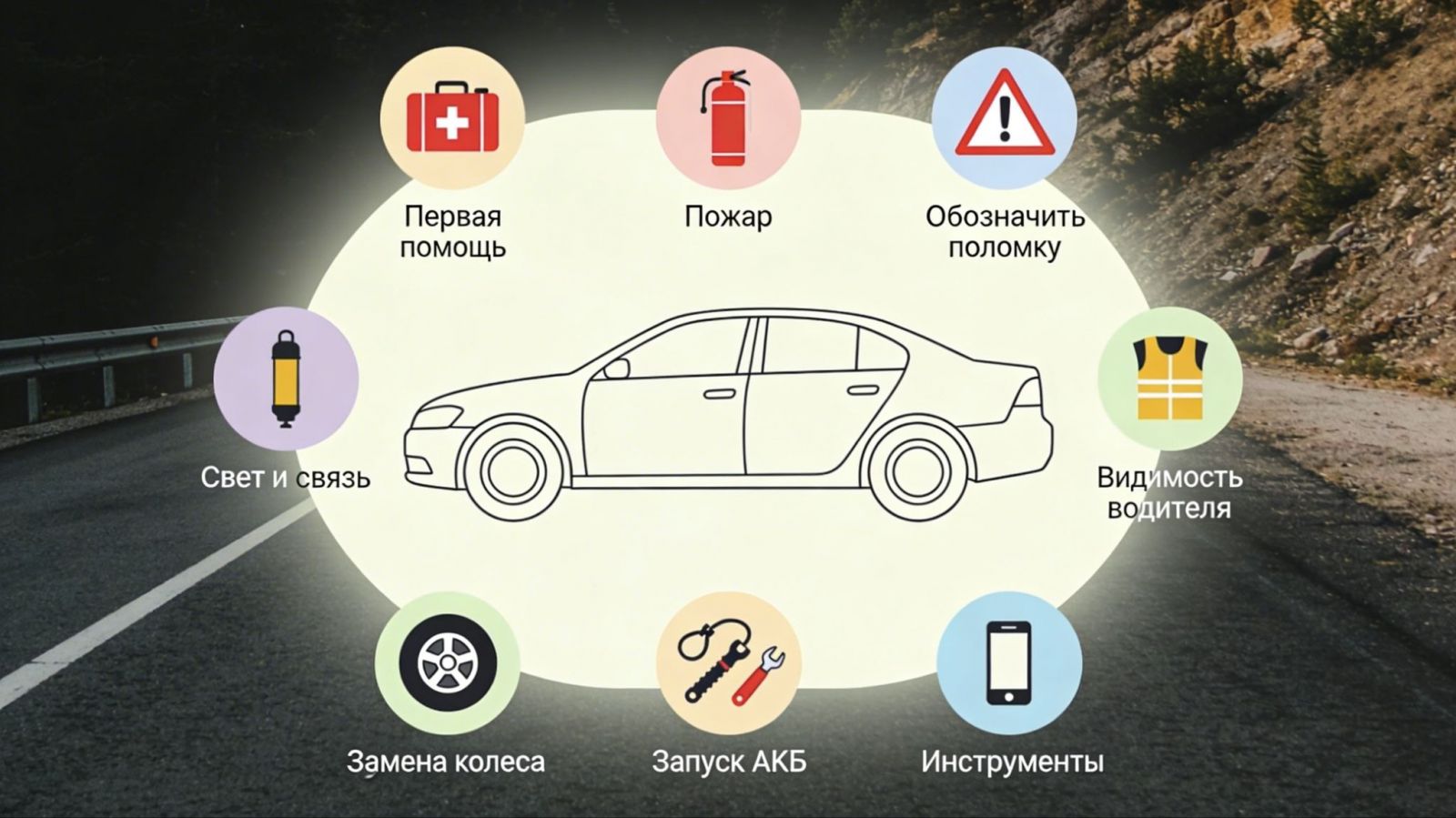
Below is a basic set of 10 key items. Some are required by law, while others are highly recommended for safety and practical purposes.
No. | Thing in the car | Why is it needed (briefly) |
1 | Car first aid kit | First aid for injuries and sudden deterioration of condition. |
2 | Fire extinguisher | Localization of a fire before it spreads. |
3 | Warning triangle | Vehicle designation in case of breakdown/accident. |
4 | Reflective vest | Driver visibility when driving on the road at night. |
5 | Jack | Raise the car to change the wheel. |
6 | Wheel brace + spare tire/repair kit | Replacement or temporary repair of a wheel. |
7 | Tow rope | Vehicle evacuation to the service center. |
8 | Jumper cables | Starting the engine with a dead battery. |
9 | Basic tool set | Minor repairs and tightening of fasteners. |
10 | Flashlight and phone charger | Lighting and communication in emergency situations. |
Next, we will look at each point from the point of view of what you can do yourself and when you need service.
What can you check and do yourself?
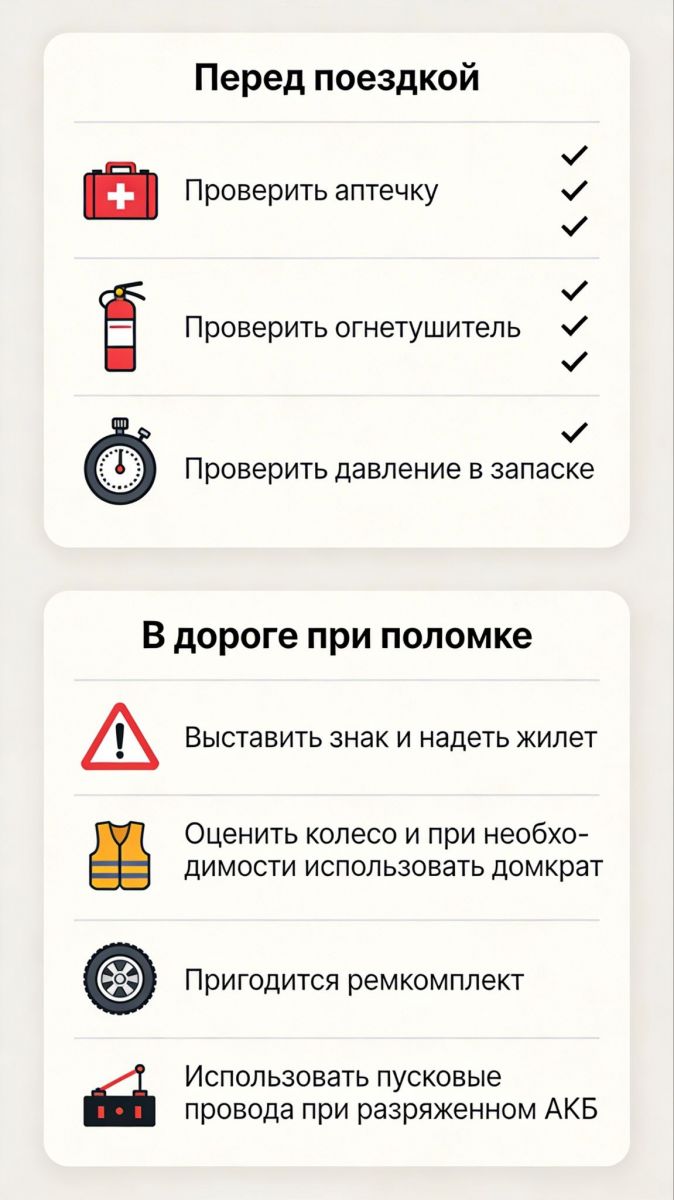
First aid kit
What to check yourself:
Availability of a basic set: sterile bandages, wipes, tourniquet, adhesive plaster, antiseptic, scissors, gloves.
Expiry date of antiseptics and medicines.
What can be done:
Treat minor wounds and cuts.
Apply a bandage or tourniquet if bleeding occurs until the ambulance arrives.
Fire extinguisher
Examination:
Expiry date and recharging marks.
The integrity of the seal and the absence of mechanical damage.
Actions:
At the first signs of fire (smoke, burning smell), stop, turn off the ignition and use a fire extinguisher without opening the hood abruptly.
Warning triangle and vest
Examination:
Integrity of the sign, presence of pillars and reflective elements.
The presence of a vest in the cabin, and not deep in the trunk.
Actions:
Turn on the hazard lights, put on a vest, and place the sign at the recommended distance (in the city – at least 15 m, outside the city – at least 30 m; follow national regulations).
Jack, wheel brace and wheel
Examination:
Where exactly is the jack and wrench located, and does the wrench fit your wheel bolts/nuts?
The condition of the spare tire and its pressure - if it is significantly worn, it makes sense to think about choosing new tires in advance.
Actions:
Replace the wheel on a flat, hard surface, tightening the bolts crosswise.
If there is no spare tire, use a tire repair kit (tow ropes/sealant) as a temporary solution.
Tow rope
Examination:
The integrity of the cable and the serviceability of the carabiners.
The presence of standard towing eyes on the bumper (often covered with plugs).
Actions:
Carefully tow the vehicle to the service center, observing the speed limit and recommendations in the owner's manual.
Jumper cables
Examination:
Integrity of insulation, absence of oxides on the “crocodiles”.
Actions:
Correctly connect the positive to positive and negative to ground terminals of the donor vehicle, observing polarity and starting instructions in the manual.
Basic set of tools
What should be:
A pair of screwdrivers (straight and Phillips), pliers, and several wrenches of the most common sizes.
What can be done:
Tighten loose fasteners, secure sagging elements, replace fuses or light bulbs.
Flashlight and phone charger
Examination:
Charged batteries in the flashlight or the ability to recharge from the cigarette lighter.
Availability of a cable for your phone.
Usage:
Illuminate the wheel, engine compartment, fuse number in the dark.
Ensure contact with a tow truck, service center or emergency services.
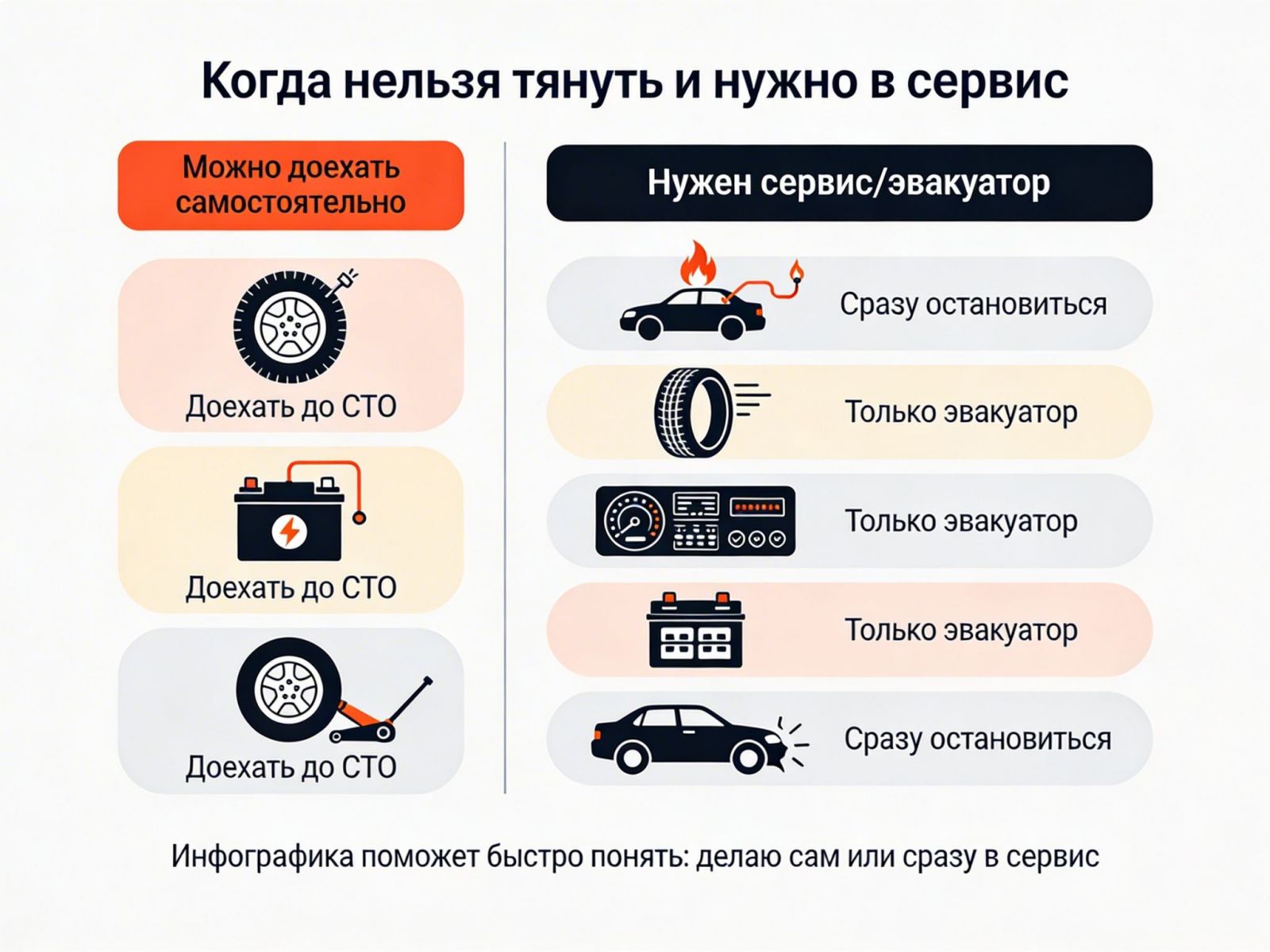
When is it necessary to contact service?
Even if you have all 10 things, many situations require professional help.
It is necessary to contact the service if:
The fire was caused by damage to the fuel system or wiring. Once the fire is contained, the vehicle must be towed and diagnosed.
The wheel is damaged by a side cut, and you are forced to drive on the spare tire or after a temporary repair with tourniquets.
A battery that is systematically discharged is a sign of problems with the generator, electrical system, or even the engine's condition, and not just a reason to jump-start the car and drive on.
Errors related to the braking system, airbags, and engine appear on the dashboard—continuing to drive without diagnostics is dangerous.
If the car has been in an accident, even without any visible major damage, it is necessary to check the geometry, suspension, and hidden damage.
FAQ
Is it possible to drive without a car first aid kit?
No, having a first aid kit in your car is a mandatory traffic requirement; not having one can result in a fine, and in the event of an accident, it increases the health risks.
Is it necessary to carry a fire extinguisher in a passenger car?
Yes, regulations in a number of countries require a working fire extinguisher in a passenger car, usually with a capacity of at least 2 liters, certified to standards.
Is it possible to get by with a repair kit without a spare tire?
A repair kit helps with punctures in the tread, but it won't save you from side cuts or severe damage, so a spare tire or space saver remains preferable.
Is it possible to jump start a car every time the battery runs low?
No, this is only a temporary measure; persistent starting problems indicate a faulty battery, alternator, or current leak and require diagnostics at a service center.
Is hazard warning lights sufficient without a warning triangle?
No, traffic regulations directly require the use of an emergency stop sign in the event of a forced stop or accident, especially outside populated areas.
Conclusion and recommendations
To avoid turning any minor breakdown into a stressful situation on the side of the road, assemble a basic set of 10 key items and check the expiration date of your first aid kit and fire extinguisher, as well as the condition of the tow rope, wires, and spare tire, every few months. Keep the most important items (first aid kit, fire extinguisher, vest, flashlight) in easily accessible places, not under a pile of stuff in the trunk.
Even if you prefer to resolve any issues through the service, these items will help you safely wait for assistance, protect you from fines, and allow you to reach the service station without any problems in most common road situations.