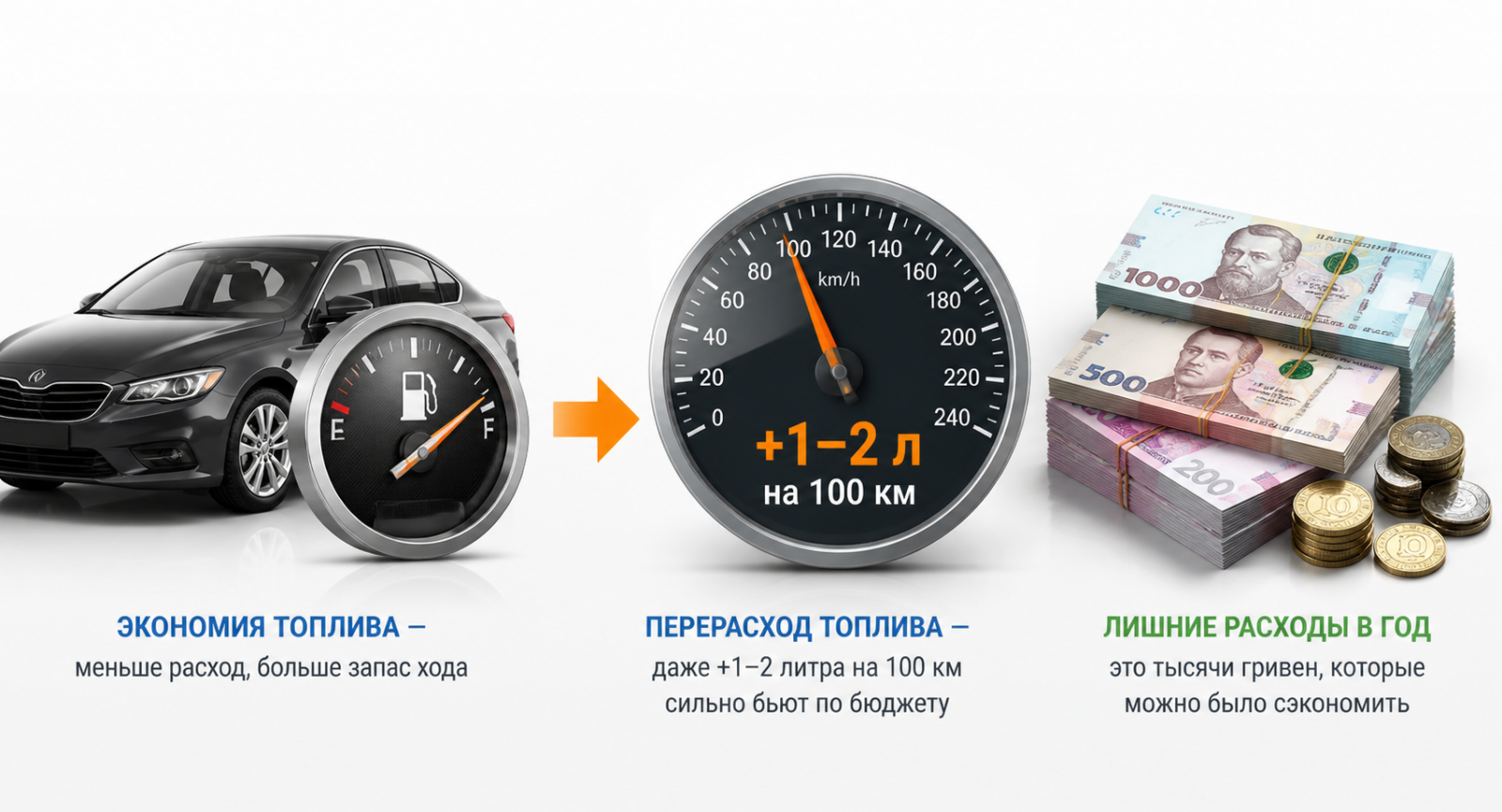
Installing autogas in your car seems like an easy way to save money these days: gasoline prices are rising, trips are becoming more expensive, and autogas remains significantly cheaper per liter than gasoline. But in reality, the question "Autogas or gasoline?" isn't just about the price at the pump.
Installing LPG isn't just a fuel replacement; it's a vehicle conversion, with costs for the kit, installation, setup, and paperwork. In Ukraine, the equipment must be registered after installation, and the solution isn't practical for every engine or mileage.
In this article, we'll explore when converting a car to gas really pays off, what the pitfalls are, what's important to check before installation, and when it's best to stop and stick with gasoline. We'll also show why, in some cases, it's more profitable to invest in genuine used parts from a reputable auto dismantler than in gas.
Why the topic has become relevant
The main reason is simple: the price difference between gasoline and natural gas is once again forcing drivers to count their money. According to price monitoring data in Ukraine, the average price of A-95 gasoline is around 72-75 UAH per liter, while autogas costs approximately 47-49 UAH per liter.
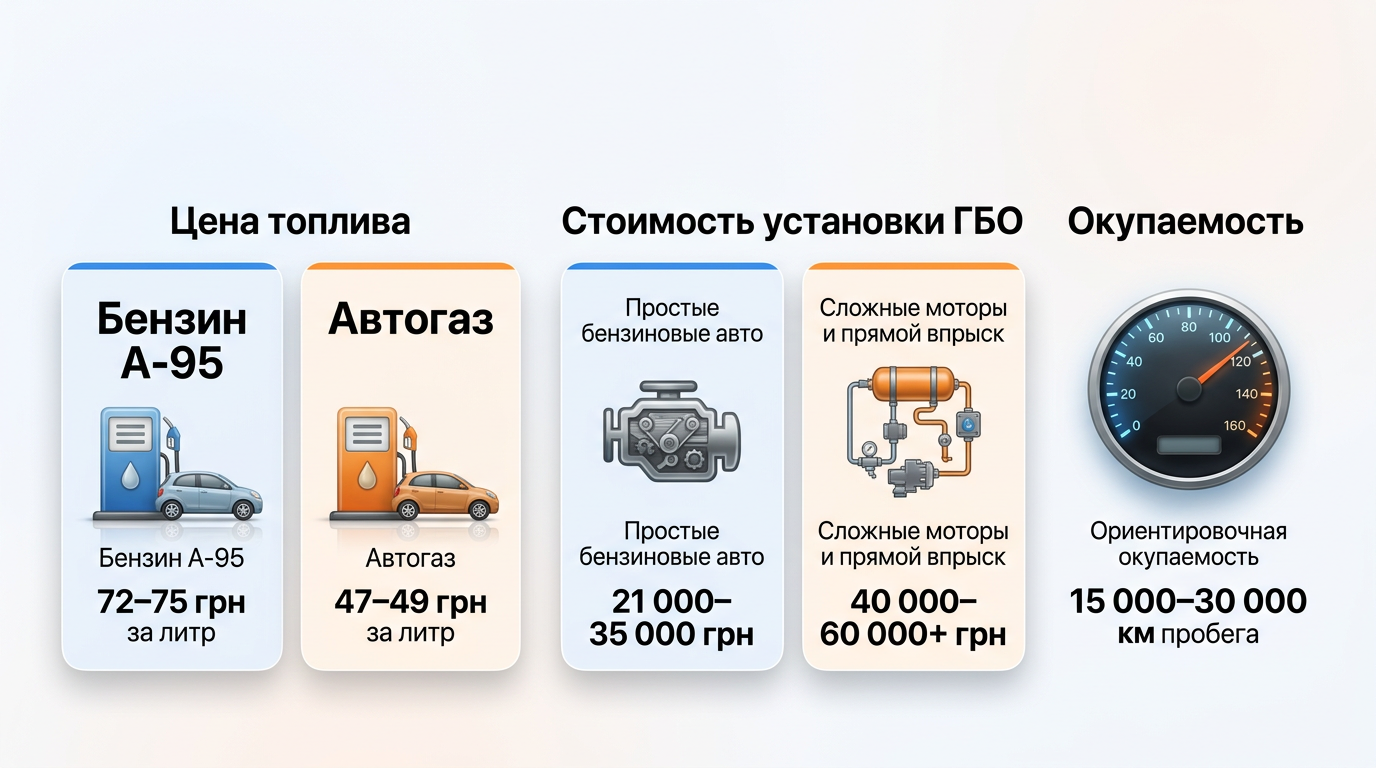
At the same time, LPG installation has become more expensive than it was a few years ago: for popular gasoline cars, the actual starting price often starts at around 21,000–35,000 UAH, and in more complex cases, the cost is significantly higher. For cars with direct injection, the budget can reach tens of thousands of UAH or more.
This means gas is no longer seen as an automatic benefit for everyone. It's now important to consider mileage, engine type, installation costs, and how long the vehicle is expected to be used.
When gas is justified
LPG systems usually make sense if you drive your car a lot and actually spend a significant amount on fuel each month. The higher the annual mileage, the faster the installation pays for itself.
In practice, gas is best suited for:
daily trips around the city and highway;
taxi, delivery, work vehicles;
cars with a simple gasoline engine without a complex injection system;
owners who plan to drive the car for several more years.
If you don't drive much, are buying a car for a short period of time, or the car already requires investments in the engine, transmission, suspension, and body, LPG may not be your first, but your second or third priority.
When gasoline is smarter
Leaving gasoline behind is often wiser if the engine is complex, installation is expensive, or the mileage is low. It's especially worth approaching cars with direct injection, as a gas solution can be significantly more expensive than a standard option.
Gasoline may also be more practical if:
you travel irregularly;
the car is already old and will soon go up for sale;
Maximum ease of maintenance is important;
I don't want to deal with registration and paperwork.
In such cases, fuel savings simply don't offset the initial costs. Sometimes it's more cost-effective to invest in something that actually improves the car's lifespan and marketability rather than refurbishing it.
What to check before installation
Before deciding to install LPG, it's helpful to consider not only the price of the kit but also the condition of the car itself. If the engine is already burning oil, or there are problems with ignition, cooling, or compression, LPG won't solve these issues.
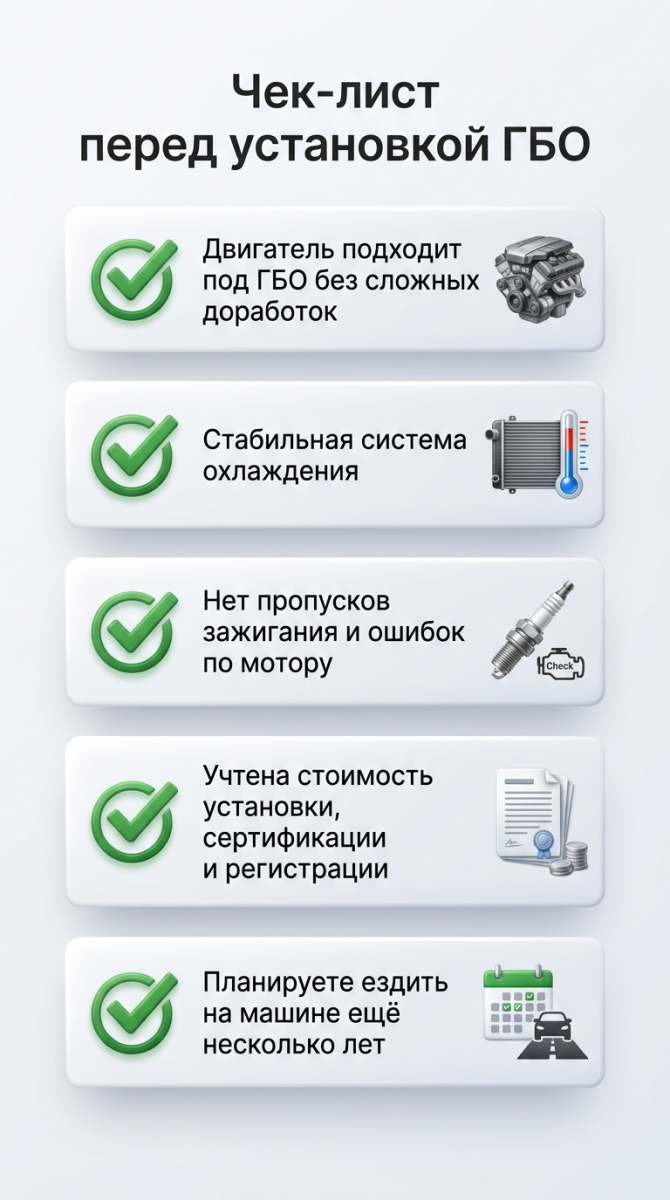
Pre-installation checklist:
Is the engine suitable for LPG without complex modifications?
Does the car have a stable cooling system?
Are there any misfires or engine errors?
How much does it cost not only for installation, but also for registration?
How many years do you realistically plan to drive this car?
It's important to remember that after installing the LPG system, you need to formalize the changes to your documents. In Ukraine, according to industry sources, this is done within 10 days, and the fine for unregistered equipment can be 850 hryvnias, with harsher penalties for repeat violations.
How long does it usually take for LPG equipment to pay for itself?
The payback period for LPG equipment depends on the price difference between petrol and gas, fuel consumption and installation costs, but in real-world conditions it often falls within the range of approximately 15,000–30,000 km.
With active use (city + highway, daily trips), this can mean a period of several months to a couple of years, after which the driver already begins to save on every kilometer.
If installation and registration cost, say, 35,000–45,000 UAH, and the difference in cost per kilometer between gasoline and gas is significant, then even with moderate fuel consumption, mileage becomes the key factor: the more you drive, the faster gas pays back its investment.
How safe is it to drive on gas and what influences the safety of LPG?
Modern LPG systems, when properly installed and maintained, are considered quite safe: they use multi-valves, safety devices, and certified fittings designed to operate under pressure.
The main risks are associated not so much with the gas itself, but with poor installation, worn hoses, leaky connections and lack of regular maintenance.
To reduce risks, it's important to install LPG equipment at a licensed service center, use certified components, have a scheduled inspection at least once a year, and pay close attention to any unusual odors or suspicious sounds, immediately switching to gasoline and contacting a service center.
Comparison of options
Option | Pros | Cons | When it suits |
Gasoline without modifications | No modifications or registration required | Every trip is more expensive | Low mileage, short ownership period |
LPG system on a simple gasoline engine | Real fuel savings | Costs for installation, maintenance and registration | High mileage, long ownership |
In practice, many drivers first calculate the cost of gas, then realize that it's better to spend part of their budget on repairing basic components rather than refurbishing them. For example, genuine used parts often help get a car back on the road faster without overpaying for a new set.
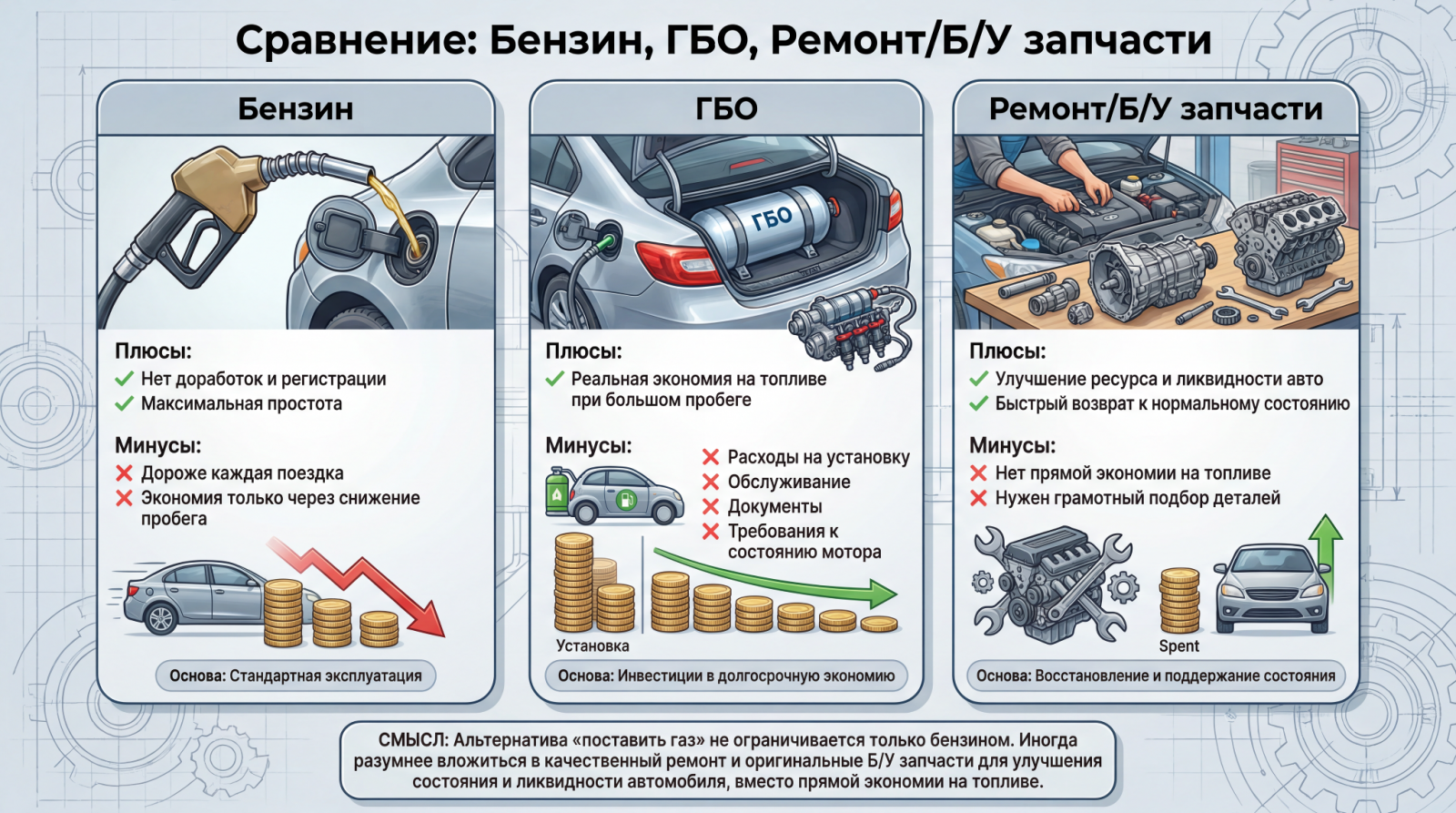
Driver errors
Mistake 1 : installing LPG equipment just because “it’s cheaper at every fill-up.”
Problem: installation may not pay for itself if the mileage is low.
The correct way: first, calculate the annual mileage and the period of ownership of the car.
Mistake 2 : Not taking into account the cost of registration.
Problem: installation is only part of the cost; next comes paperwork and registration.
The right way: include installation, certification and registration in the budget.
Mistake 3 : stepping on the gas on a tired engine.
Problem: LPG does not cure a worn-out engine, and sometimes only accelerates the development of problems.
The right way: first, put the ignition, cooling and compression in order.
Mistake 4 : Not comparing LPG with alternatives.
Problem: Sometimes it is more profitable to invest in repairs than in refurbishment.
The right way: consider not only gas, but also the used auto parts market.
FAQ
Is it possible to install LPG equipment on any car?
No, LPG isn't suitable for every car. The decision depends on the engine type, its technical condition, injection design, mileage, and how much you're willing to invest in installation and subsequent maintenance.
The easiest way to install gas is on cars with a conventional naturally aspirated gasoline engine and distributed injection—the system is usually cheaper and more predictable in operation.
The situation is more complicated and expensive with cars with direct injection: there, equipment and tuning can cost significantly more, and sometimes the final savings are no longer obvious.
How much does LPG installation cost in Ukraine?
For simple gasoline cars in Ukraine, the actual price often starts at around UAH 21,000–35,000 for a basic solution with a 4-cylinder engine.
If the car is more complex, has a more powerful engine, or features direct injection, the price can rise to 40,000–60,000 UAH or more; for certain systems and trim levels, the range can be even higher.
The cost should include not only the kit itself and installation, but also setup, documentation, certification, and registration, as these are also part of the owner's actual expenses.
Do I need to register my LPG system?
Yes, it is necessary: after installing the LPG system, the conversion must be documented in the vehicle documents.
According to industry sources, after installation, the owner must typically contact the Ministry of Internal Affairs service center within 10 days to undergo the re-registration procedure and update the vehicle's registration document.
Driving without registration can result in a fine, and in some cases, additional problems when checking documents and the vehicle's technical condition.
When is LPG unprofitable?
LPG is often unprofitable if you don't drive much and can't recoup the installation costs within a reasonable time frame.
Converting to gas may also be a questionable decision if you plan to sell your car soon, because the installation and registration costs are not always reflected in the selling price.
Another situation is an already tired engine: if the engine requires repair, consumes oil, or has ignition and cooling problems, it is better to first fix the basic components and only then calculate the payback of the LPG system.
Conclusion
LPG can indeed be cost-effective, but only if the car is driven a lot, the engine is suitable for installation, and the owner is willing to pay the registration fees. If the mileage is low or the car is already in need of investment, gasoline and proper repairs may be more cost-effective.
That's why drivers are increasingly considering not just gas but their entire car ownership budget. In some cases, it's more practical to invest in proven, used , genuine parts from auto salvage yards—especially when you need to quickly and affordably restore your car to its original condition.
When choosing a used part, it's important to look not only at the price but also at the part number, components, and condition of the fasteners. This is especially important for auto dismantlers, as an honest inspection saves the owner money and time.