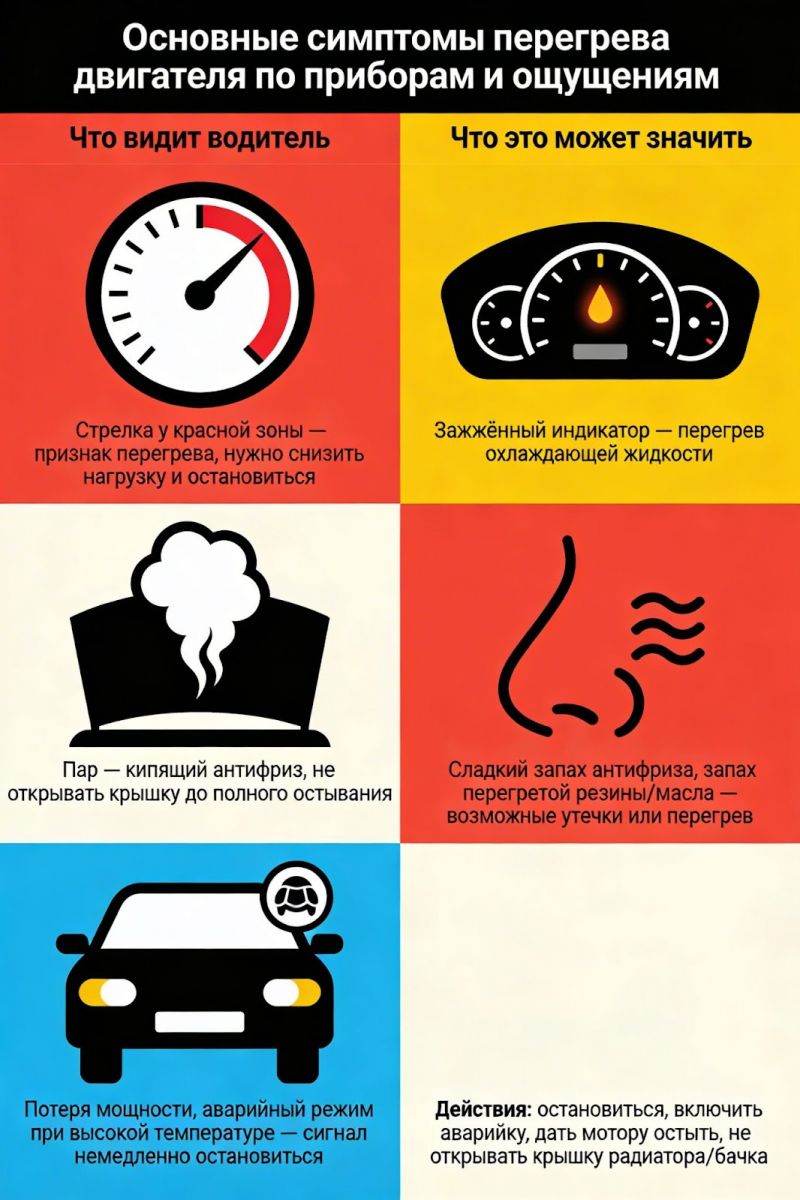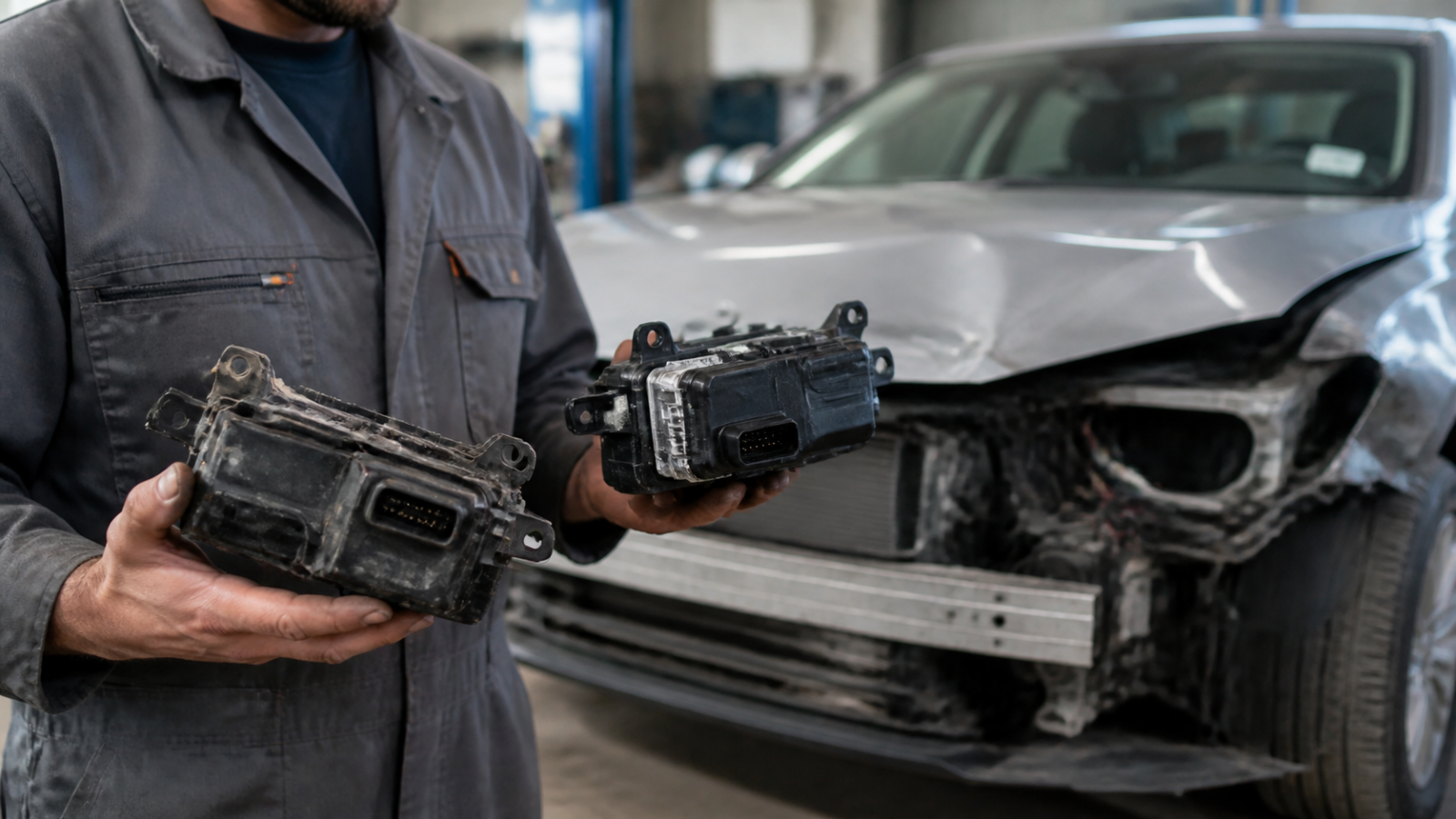
Imagine: after a minor accident, you find a "perfect" part at a car salvage yard—the price is right, the photos are neat, and the seller assures you it "came from a perfectly good car." You buy it, install it... and a week later, the error message lights up on your dashboard, the airbag doesn't deploy, or the engine goes into limp mode.
Modern cars are packed with electronics, safety sensors, and complex control units, so some parts can no longer be purchased based on the "cheap and similar-looking" principle. This is especially true when it comes to airbags, seat belts, ABS/ESP units, ECUs, or turbochargers.
In this article, we'll discuss which parts shouldn't be purchased blindly, how to properly check used originals, and when auto dismantling becomes a smart, rather than risky, decision.
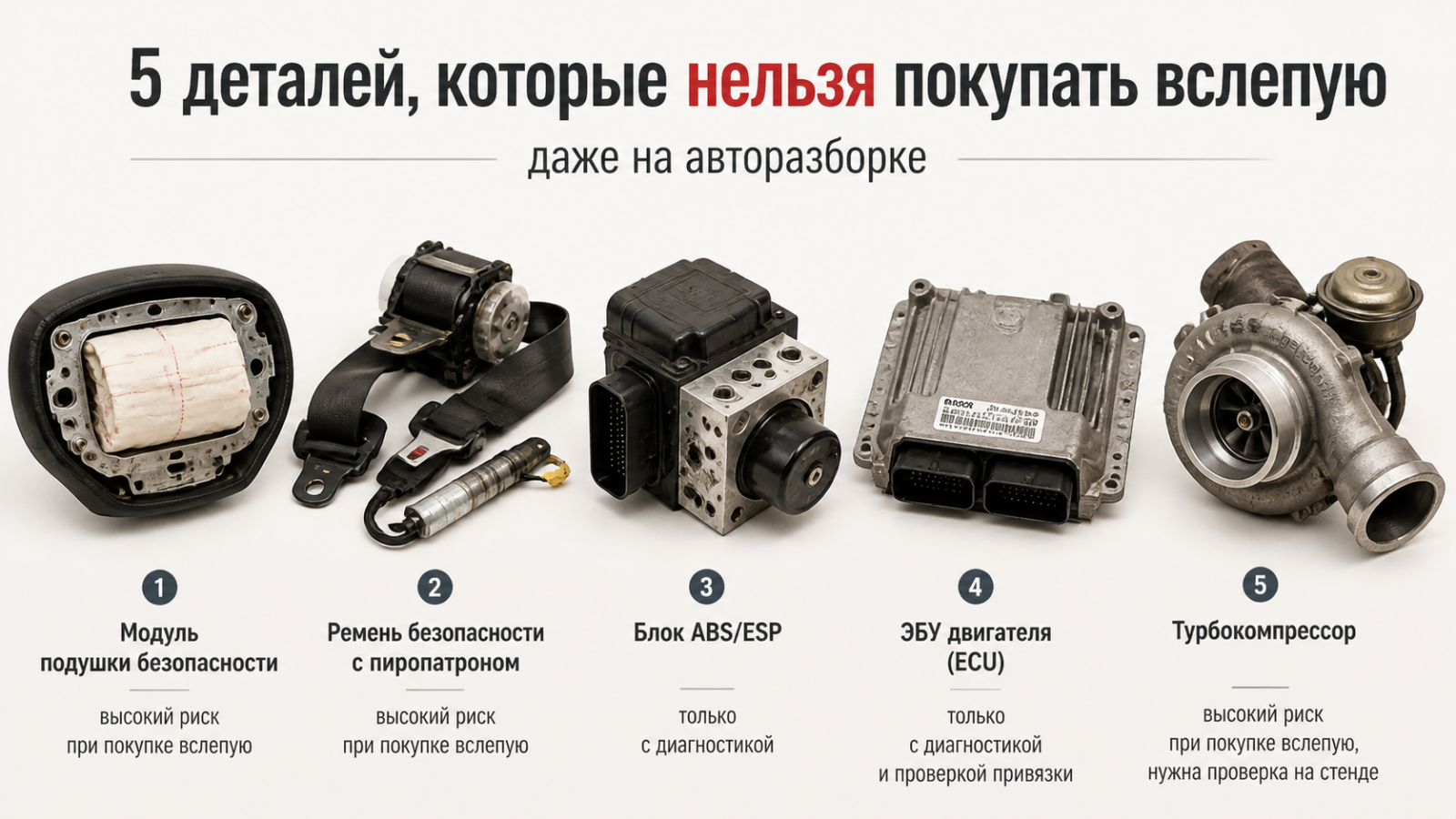
5 Parts That Are Dangerous to Buy Blindly
In this section, we'll focus on parts that directly impact the safety and performance of a vehicle. These can be purchased from a salvage yard, but only after diagnostics, a vehicle history check, and an understanding of the risks.
1. Airbags
Airbags are part of a complex passive safety system that involves impact sensors, the SRS unit, and wiring.
The problem is that some unscrupulous sellers sell airbags that have already deployed (rebuilt or "refurbished") or install blank modules instead of the real ones. Visually, it can be almost impossible to distinguish a quality module from a dangerous substitute just from a photo.
Risks of buying a pillow blindly:
it is unknown whether it has worked before;
Errors in the SRS unit are possible after installation;
discrepancy in configuration (presence/absence of side, knee, curtain);
Incorrect connectors and pyropatrons.
Pillows may be taken from a car dismantling yard only if the following conditions are met:
clear information about the car from which it was removed (VIN, year, configuration);
no traces of alteration or opening;
the possibility of verification or at least a guarantee for installation;
Matching markings and OEM numbers.
2. Seat belts after an accident
The seat belt is another passive safety element, often associated with pretensioners, impact sensors and the SRS unit.
After a serious accident, the belt may look “alive”, but still have:
a spent pyropatron (hidden damage to the mechanism);
stretched or damaged tape;
hidden cracks in the locking mechanism;
damaged fasteners or signs of tampering.
Buying a used seat belt blindly is dangerous because it may not work or hold the passenger in place when needed.
What to look for when choosing a belt from a car dismantler:
are there any traces of the pretensioner being triggered?
condition of the tape (abrasions, tears, creases);
condition of fasteners and bolts;
compliance with OEM number and configuration (presence of sensors, connectors).
For vehicles with a history of accidents, it is worth considering verified original used belts only if there is a clear history of the part and the ability to verify it.
3. ABS/ESP units and other safety units
Modern ABS, ESP and stability control units are complex electronic devices closely linked to sensors, wiring and software.
If you buy such a unit "just from a photo," without checking and understanding compatibility, you can get:
constant errors on the panel (ABS, ESP, indicator tree);
incorrect operation of the braking and stabilization system;
the need for reprogramming or long-term adaptation;
non-functioning assistants (traction control, hill descent control, etc.).
Why you shouldn't blindly pick up an ABS/ESP unit from a salvage yard:
strong dependence on the configuration (drive type, gearbox, options);
different firmware versions;
sensitivity to moisture and overheating;
the risk of receiving a block with a factory problem “fixed” using a makeshift method.
The right approach:
check the OEM number and versions of the units;
specify the donor's configuration (brake system, drive, options);
If possible, test the unit on a bench or provide a warranty for verification;
Buy only from auto dismantlers who record the history of parts and do not hide damage.
4. ECU (engine control units and other systems)
The ECU (engine control unit) and other control units are the "brain" of the car. They are responsible for the engine, transmission, safety, and comfort.
Purchasing an ECU without diagnostics can lead to:
the impossibility of registering or adapting the unit to the vehicle;
conflicts over immobilizer and keys;
"floating" errors and unstable engine operation;
the need for reflashing or even replacing it back.
Features of used ECU:
the same OEM number does not guarantee identical firmware;
blocks can be “re-soldered”, with replaced components;
often have hidden defects (overheating, corrosion, traces of water).
An ECU from a car dismantler should only be considered if:
the OEM code, version and platform match;
there is an understanding of how the block will be registered (there is a master/service);
the seller provides the opportunity to test or a guarantee for verification;
There are photos of the board (if possible) and the case without signs of opening.
5. Turbines without diagnostics
The turbocharger is one of the most expensive and loaded parts of the engine.
The main mistake is buying a turbine "from a photo," relying solely on a clean housing and "a little play." In practice, it's difficult to see without diagnostics:
critical wear of the axle and bearings;
cracks in the body;
scuffs on the shoulder blades;
signs of overheating or oil starvation;
damage to geometry or actuator.
Risks of buying a turbine blindly:
installation of a knowingly “dying” part;
quick failure and repeat repair;
the possibility of engine damage due to turbine failure.
The right approach to a used turbine:
mandatory visual inspection and assessment of axial/radial play;
assessment of the condition of the blades and housing;
understanding the reason for removal (not from an overheated or exhausted engine);
if possible, test on a bench or in a specialized workshop;
Buy only the original, not some obscure refurbished analogue.
What to look for when buying a used part, if you decide to buy it anyway
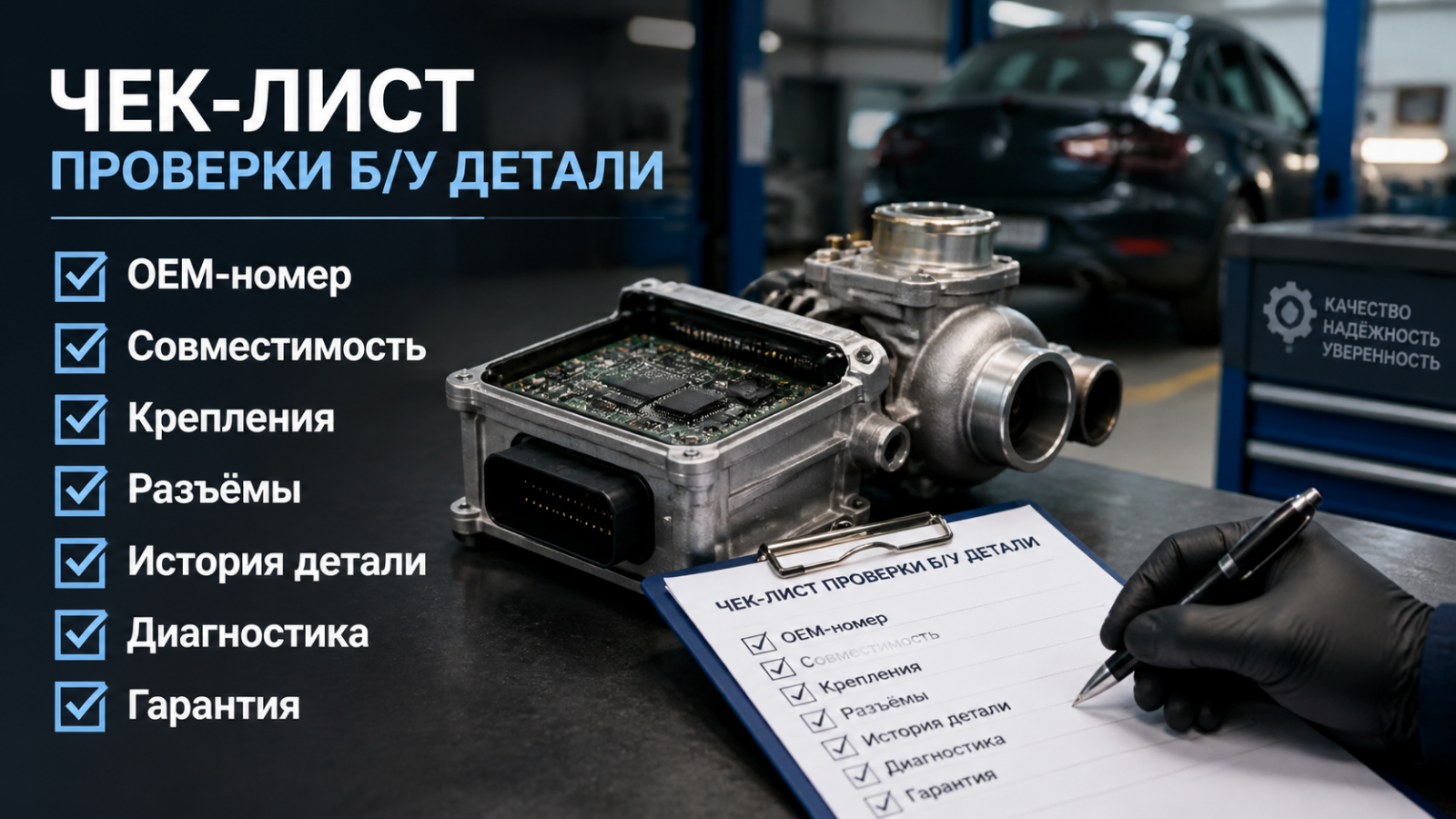
To help avoid mistakes, we use a checklist that can be adapted to different groups of spare parts.
OEM part number. Does the original part number (and revision) match the one on your car?
Compatibility by model and year. Check generation, restyling, engine type, transmission, and drivetrain.
The condition of the fasteners. Are there any cracks, chips, signs of welding, or homemade repairs?
Signs of repair. Soldering, sealant, repainting, sanding—anything that suggests intervention.
The condition of the connectors. Are there any oxidation, broken latches, or wiring issues?
Complete set. Does the part come with modules, sensors, and wiring, or is it sold bare?
Photos from all sides. This is especially important for optics, body parts, and control units.
Part history. Which vehicle was it removed from (country, mileage, type of accident).
Verification options available. On-site testing, installation warranty, or return policy.
A real example of savings if you buy a used original
Example from a car dismantling yard:
Car: Volkswagen Passat B8, 2.0 TDI, automatic transmission after a frontal impact.
Damage: impact to the front right corner
Damaged: bumper, headlight, part of the amplifier, radiators, part of the wiring, some sensors
Remaining usable: hood, left wing, part of the optics, mirrors, interior, control units
What happened during the showdown:
airbags and seat belts were tested and not sold without further diagnostics;
The ABS/ESP unit and engine ECU were tested and then offered as used originals with the possibility of verification;
The turbine was removed and sent for diagnostics, and not sold "as is".
Bottom line for the owner of a similar car:
A used original headlight with intact mounts and control unit could cost 7,000–9,000 UAH instead of 15,000–20,000 UAH for a new one;
An original used bumper that has passed a geometry and mounting check costs 4,000–6,000 UAH instead of 10,000+ UAH for a new one.
This example shows that even after a serious accident, some original parts remain valuable and safe if they are properly checked and selected wisely.
Drivers' Mistakes When Buying Used Parts
Error | What is dangerous? | What is the correct way? |
Buy an airbag "from a photo" | Risk of a non-functioning SRS system in an accident | Check OEM, history, request diagnostics |
Putting on a seat belt after a serious accident | The pretensioner may not work, the belt may not hold | Check the mechanism, belt, history, and, if possible, VIN. |
Buy an ABS/ESP unit without checking the part number and components | Constant errors, incorrect system operation | Check the OEM number, components, and components of the donor |
Take the engine ECU from an "almost similar" version of the car | Conflict with the immobilizer, inability to register | Check the code, firmware, consult with a specialist |
Buying a turbine without diagnostics and understanding the reason for removal | Rapid failure, risk of engine damage | Check the play, condition, history, and run diagnostics. |
The main idea: saving shouldn't be a gamble. Some parts can and should be sourced from auto salvage yards, but when it comes to safety and complex electronics, it's best to double-check everything.
FAQ
Is it possible to buy used airbags?
Only if the part's history is clear, the OEM number matches, and diagnostics are possible; buying a part "by photo" without verification is a life-threatening risk.
How do I know if a used ABS/ESP unit will fit my car?
You need to check the OEM number, vehicle configuration (engine, drivetrain, options), clarify the unit version, and be prepared for adaptation/flashing at a service center.
Is it worth buying an engine ECU from a car dismantler?
Yes, if there is a specialist who can register and check it correctly, and if the unit does not show signs of home-made repairs or water.
Is it possible to return a used part if it doesn’t fit?
This depends on the specific conditions of the auto dismantler, so it is important to clarify the return policy and the availability of a warranty for inspection in advance.
What parts are especially dangerous to buy blind after an accident?
Airbags and seat belts, SRS units, ABS/ESP, ECUs, high-voltage elements of hybrids and electric vehicles, as well as turbines without diagnostics.
Why do seemingly identical parts cost different amounts?
The condition, mileage of the donor, rarity of the component, presence of control units/sensors, and transparency of the part's history all play a role; this is especially noticeable with genuine used parts.
Conclusion and recommendations
A used original part can be a smart choice if it is properly selected, tested, and fits the OEM part number and specifications.
But there are at least five categories of parts—airbags and seat belts, ABS/ESP units, ECUs, and turbochargers—that you shouldn't buy blindly.
They need to be either thoroughly diagnosed or considered for new originals or high-quality replacements, so that savings don't result in safety issues and expensive repairs. For the owner, this is not only a matter of budget in hryvnias but also confidence that the car will provide protection when needed.

.jpg)