You left your car near your house in the summer, during what seemed like a normal downpour, and suddenly it started to hail.
Videos on social media show beautiful white "balls," but in the parking lot the next morning, it's not so pretty: the hood, roof, and trunk lid are densely covered in small dents, as if someone had machine-gunned the car. For many, this is the first serious impact on the car's body, even without an accident.
Then the classic scenario begins: the insurance company offers partial compensation, the official repair shop estimates the repair and paint job will cost tens of thousands of hryvnias, and the driver doesn't understand whether it's really necessary to paint the entire roof and hood if the paintwork appears to be intact.
This is where paintless dent removal (PDR) technology comes into play, and the question of where repairs are more cost-effective and where it's easier to replace the entire part from a salvage yard comes into play.
In this article, we'll explore which hail dents can be removed without painting, when it's best to restore the original metal, and when it's smart to install an original used part from a salvage yard.
We'll discuss pricing, common driver mistakes, show a real-life example, and provide a checklist for choosing used body parts to avoid overpaying and compromising safety.
Real-life example: a hatchback after heavy hail
Let's imagine a typical situation from a car dismantling business: a powerful thunderstorm hits the city, with hail the size of large grapes falling in one area for 10-15 minutes. Meanwhile, a compact Skoda Octavia C-class hatchback is left outside.
Damage after inspection:
The roof has dozens of small dents, in places there are “fields” of dots, the varnish is not broken, but the metal is noticeably playful.
The hood has multiple dents of medium depth, two or three are more pronounced, still no chips.
Trunk lid - 10-15 dents on the top panel, paint without cracks.
The doors and wings are single points, visible only under the right light.
What remains usable and can be repaired without painting:
The roof and doors are good candidates for PDR: the metal is not stretched to the limit, the paint is intact, and there are no creases on the stiffeners.
Trunk lid - if the dents are of medium depth and the paint is intact, PDR can also be used to straighten them.
Where the owner could save money by buying a used original:
Hood – if there are numerous deep pits and initial cracks in the paint, the cost of hood repair can reach 3,500–4,000 UAH or more, especially if partial disassembly and interior access are required. In some cases, it's more cost-effective to replace the hood with a genuine used one from a salvage yard: the price for common models is often comparable to or lower than a complex PDR repair, and the driver receives a straight, undamaged part.
Trunk lid - if hail has damaged the paint and there is a risk of corrosion, buying a used lid in good condition is sometimes more logical than combining PDR and painting.
This case illustrates well that even with the same type of damage (hail), the solution for each part can be different: in some cases, PDR is more cost-effective, while in others, it is more practical to use an original part from a salvage yard.
What is PDR and what types of hail dents does it repair?
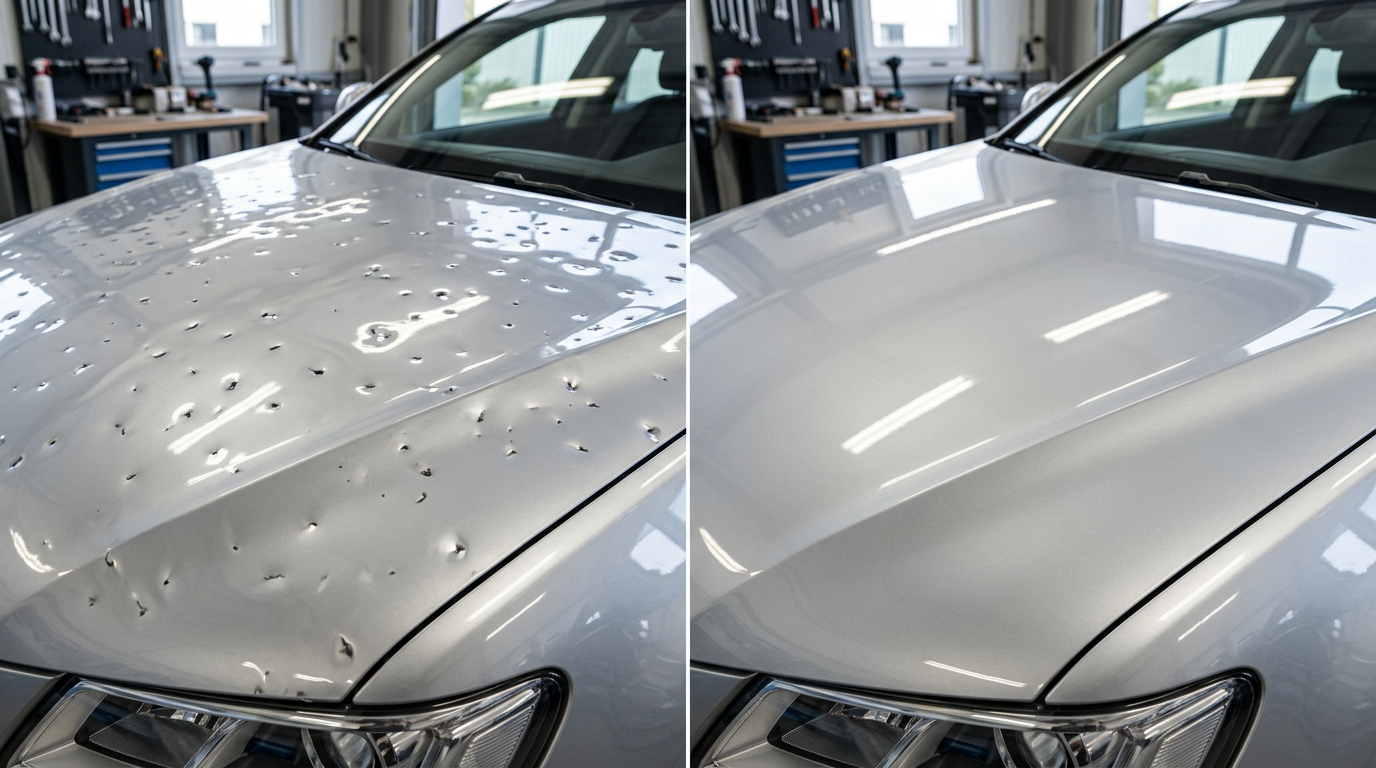
PDR (Paintless Dent Repair) is a method of body restoration in which a specialist uses special levers, hooks, and adhesive-vacuum systems to carefully push out the metal from the inside, returning it to its original shape without putty or paint.
Main advantages:
The factory paint is preserved, the protective layer is not damaged and color transitions do not appear.
Repairs are usually faster than traditional bodywork and painting and are cheaper for moderate damage.
A car does not lose value due to "paint" repairs, which is especially true for relatively new cars.
Which hail dents are suitable for PDR?
The technology works best in cases such as:
Small and medium dents without broken varnish and without paint cracks.
Surfaces without sharp creases along the stiffening ribs.
Steel or aluminum of normal thickness, not excessively stretched by repeated impacts.
Free or created access to the inside of the panel.
Examples of cost:
A single small dent up to 5 cm in diameter on a door caused by hail can cost around 500–700 UAH. A medium-sized dent of approximately 10 cm on the hood costs 800–2,000 UAH, depending on the difficulty of access and the material used. Large-scale small dents on the roof and hood caused by hail are often priced as a package—from 3,000 UAH and up, depending on the number of dents.
Which elements are more difficult to repair using PDR?
A roof with multiple dents on the reinforcements means difficult access and the risk of not removing individual points.
Hoods and trunk lids with reinforcements and dual metal - sometimes partial disassembly is required, which affects the price.
The pillars (A, B, C) and areas near welds pose a high risk of damage to the metal structure, and the result will not always be ideal.
How to determine if a hail dent can be removed without painting
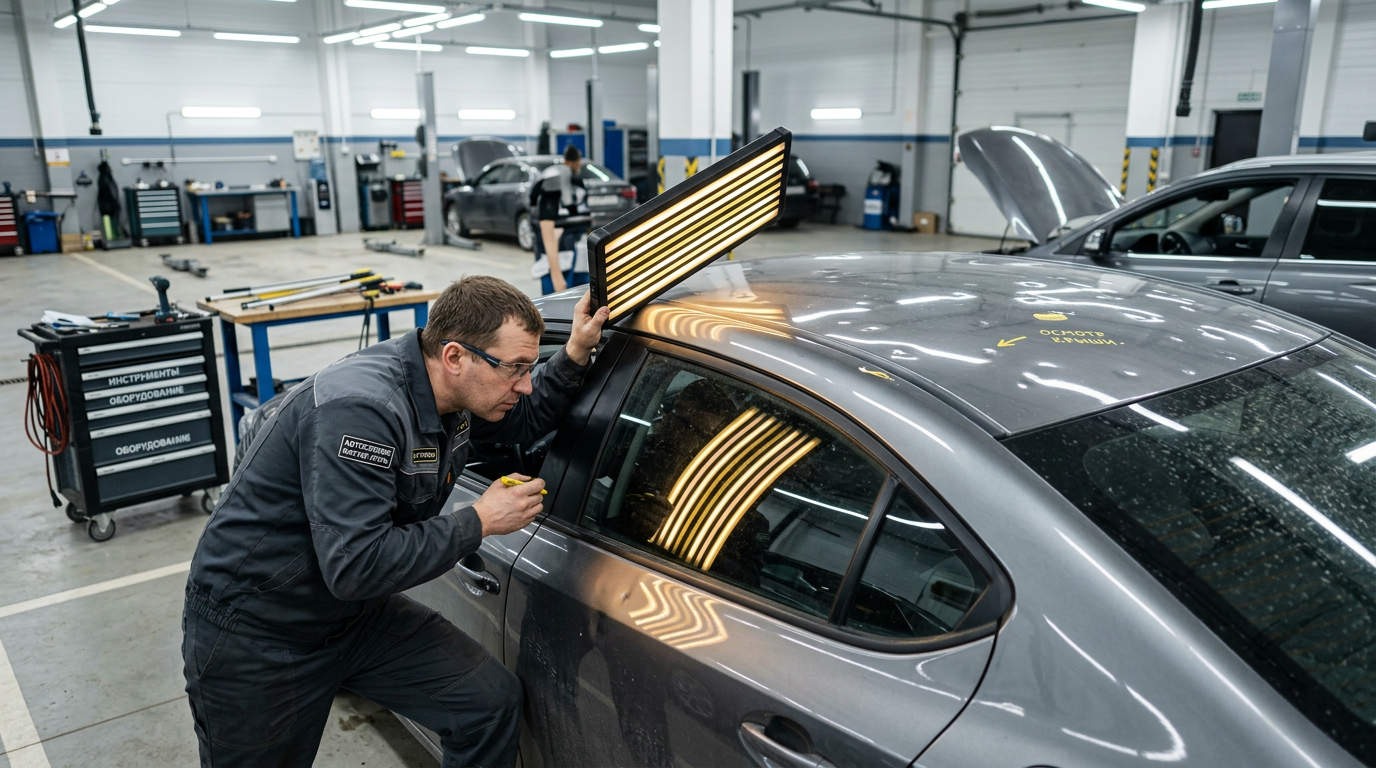
Inspect the paintwork under good light to see if there are any cracks, chips, or penetrations to the primer or metal.
Assess the depth of the dent visually: a light spot or a noticeable sunken area.
Check the location of the deformation: a flat surface or a stiffener, a bend, a weld.
Compare the number of dents: single spots or dense damage, when the entire panel is in an “orange peel”.
If the paint is intact, the dents are shallow, and located in flat areas, the chances of a quality PDR repair are very high. If there is extensive and severe damage to a single part, it's reasonable to consider replacing it with a used original, especially if it concerns the hood or trunk lid.
Table: when is a PDR part and when is a used original part
Situation | PDR repair without painting | Replace with a used original from a dismantling yard |
5-10 small dents on the roof | Yes, we keep the factory paint | Usually not necessary |
30+ deep dents on the hood | Difficult, expensive, possible traces | It is often more cost effective to replace the hood |
Single dents on the door | Excellent candidate for PDR | Replacement is not advisable |
Broken varnish, initial corrosion | Painting required after renovation | A used part is often better |
Dents on the stiffener | It's difficult, the result depends on the master | Replacement is possible if the part is available. |
The car is new, a clean history is important | PDR with intact paint | Used part - only in case of serious damage |
Why you shouldn't straighten metal using "folk" methods
Popular advice on the internet like "pour boiling water over it and squeeze it out," "pull it out with a suction cup," or "heat it with a hairdryer and let it cool" seem simple, but they often lead to problems.
Main risks:
Overheating and damage to the paintwork: thermal shock can cause microcracks, clouding of the paint, and changes in color.
Metal upholstery: without understanding the body structure, it's easy to stretch the sheet metal so much that even a PDR specialist won't be able to restore it to its ideal shape.
Hidden creases: Rough work with suction cups and levers creates creases on the internal reinforcements that interfere with further repairs.
A professional PDR technician uses force control, specialized lighting, and an understanding of the panel's geometry, which can't be achieved by eye in a parking lot. Therefore, DIY hail dent repairs using boiling water or suction cups often end in cost savings.
What parts most affect the cost of hail damage repairs?
The hood is the visible part of the front of the car, a complex shape, often made of aluminum or thin steel; PDR is labor-intensive, and when painting, there are high risks in color matching.
The roof is a large area and difficult to access from the inside, a large number of dents greatly affects the total cost.
The trunk lid combines a decorative and functional role (seals, fasteners, often an integrated spoiler or lights).
Doors and fenders are more localized damage, the repair cost is usually lower, but there are many of them, which adds to the overall budget.
From a driver's perspective, the hood and trunk lid are often the most critical parts: a full PDR and possible paint job can cost as much as purchasing an original part from a car dismantler.
Common mistakes drivers make when repairing their vehicles after hail and how to do it right
Driver error | What is dangerous? | What is the correct way? |
Immediately agree to paint all panels | Loss of factory paint, increased cost | First, evaluate the PDR options without painting |
Trying to smooth out dents with boiling water and suction cups | Risk of cracking varnish and metal overstretching | Contact a specialized PDR service |
Ignore roof damage | Possible corrosion, cost reduction | Inspect the roof in good light |
Buy a used hood "from a photo in an ad" | Hidden damage, crooked gaps | Check the part in person, look at the fasteners |
Do not check the OEM number when purchasing a used part | Risk of incompatibility in fastenings and shape | Always check the OEM number against the original part. |
FAQ: Short and to the point
Can hail dents always be removed without painting?
No. If the paint is cracked, there are chips down to the metal, or severe creases on the stiffeners, painting will still be required after PDR, and sometimes it's more cost-effective to replace the entire part.
How much does it cost to remove hail dents using PDR?
The price depends on the number and complexity of the dents. A small, single dent can cost 500–700 UAH, while roof and hood restoration after severe hail can cost from 3,000 UAH and up.
When is it more logical to replace the hood or trunk lid with a used original?
When a panel is literally "gritted" by hail, there is paint damage and corrosion, and a comprehensive PDR with painting costs close to the price of a whole used original part.
Is it possible to buy used body parts after hail?
Yes, as long as the part hasn't undergone major repairs, matches the OEM part number, and its condition is confirmed by photos and inspection. It's important to avoid parts with thick filler or hidden deformations.
Is it dangerous to straighten out dents using folk methods?
Yes. Overheating the lid with boiling water or a hair dryer, or using primitive suction cups without proper supervision, often leads to cracks in the varnish and overstretching of the metal, complicating subsequent professional repairs.
Conclusion and practical recommendations
Hail damage isn't a death sentence for your car's body, but the right strategy is important: small and medium-sized dents without paint damage are often ideal for PDR repair, which preserves the factory paint and keeps your vehicle within a reasonable budget.
In many cases, it's more cost-effective to replace large, deep dents on the hood or trunk lid, especially those with damaged paint, with a genuine used part from a salvage yard, rather than invest in complex repairs and repainting.
To avoid overpaying and sacrificing quality, don't experiment with boiling water and suction cups. It's better to contact a trusted PDR service and simultaneously consider options for genuine body parts from a salvage yard, where you can find a hood, trunk lid, or door that matches your OEM number and condition.
This way, you'll preserve the car's appearance, avoid damaging the factory paint on the parts that are actually being repaired, and, if necessary, wisely use a used original where it's truly beneficial.