Why Brake Pads Fail Faster Than You Think
The service life of brake pads depends not only on mileage but also on driving style, conditions, and the quality of the components themselves. On average, manufacturers and service centers quote a range of 15,000–40,000 km, but in the city with heavy braking, the service life can drop to 10,000–20,000 km, and with moderate highway driving, it can increase to 50,000–80,000 km.
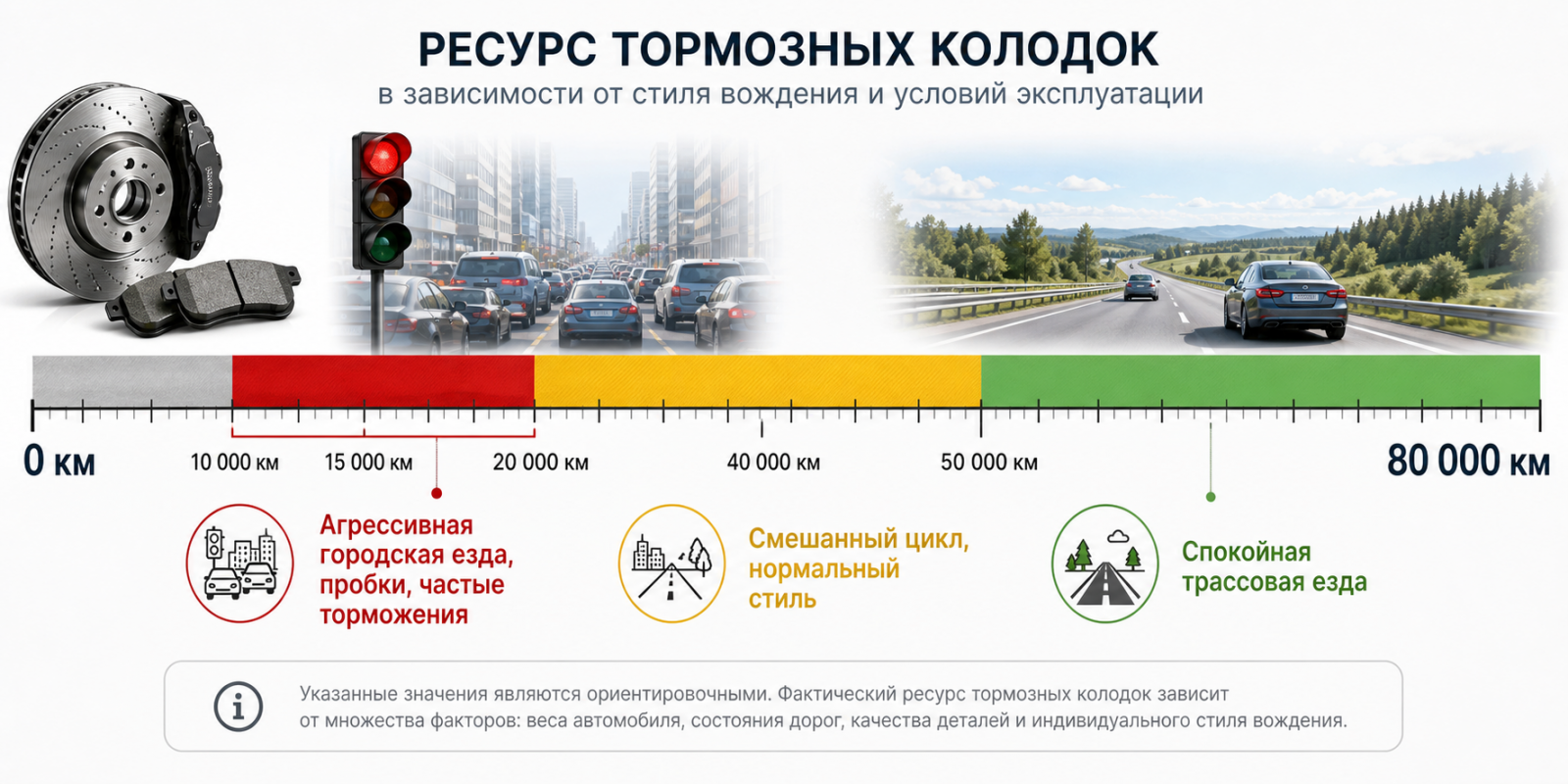
The main factors of accelerated wear:
Aggressive driving style: frequent abrupt braking, start-stop in the city.
Constant driving in traffic jams and mountains (frequent use of the brake pedal).
Cheap or counterfeit pads made from soft or, conversely, too hard compounds.
Worn brake discs, rusted caliper guides, faulty hoses.
Overheating of the brake system (long descents without using engine braking).
Illustrative example: for a typical urban crossover, with dynamic driving in Kyiv, the front brake pads can wear out after 15-20 thousand km, whereas with quiet highway driving, the same set often lasts up to 40-50 thousand km.
Signs and symptoms of worn brake pads
1. Sounds when braking
A creaking, squeaking, or squealing sound when pressing the pedal, especially at low speeds, is a classic sign that the friction layer is almost worn out or the pads are not working correctly on the disc.
A metallic grinding sound indicates that the friction material has already been worn down to the metal base, and the pad is literally scratching the disc.
Many modern brake pads have a metal wear indicator that starts beeping when the minimum pad thickness is reached.
2. Increased braking distance and a spongy pedal
The car began to slow down worse with the same pedal effort.
The pedal goes deeper than usual or feels spongy - braking is less intense.
Such changes may indicate worn pads, but they can also be the result of problems with the discs, air in the system, or a brake fluid leak, so it is important to conduct a comprehensive diagnosis.
3. Vibrations and beating when braking
A vibration in the pedal or steering wheel when braking is often associated with uneven wear of the pads or deformation of the disc.
If the vibrations disappear when you release the pedal, there is a high probability that the pads or disc are to blame.
4. Decrease in brake fluid level
When the brake pads are significantly worn, the pistons in the calipers extend further, causing the fluid level in the reservoir to drop slightly. A sudden drop in level is a reason to look for a leak, not just blame it on wear and tear.
5. Thickness of the friction layer
It is recommended to check the pads every 10–15 thousand km or at least once a year.
With a lining thickness of about 8–10 mm, it can be considered that the wear is about 50%, and it is still acceptable to drive.
When there is 3 mm left, it is time to plan a replacement.
The acceptable minimum, as stated by services, is 2–3 mm; any lower is unsafe for use.
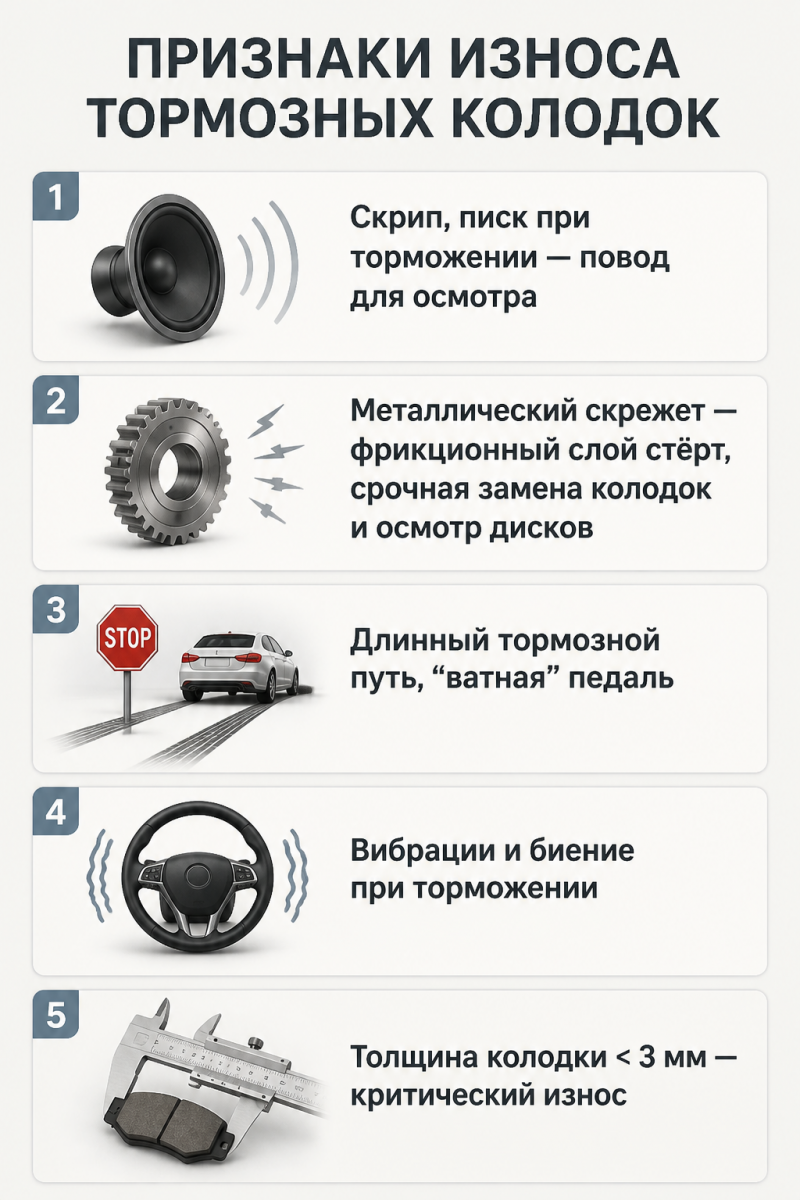
Chart: Key signs of wear and what they mean
Sign | Possible cause | Action |
Squeaking/squealing noise when braking | Lining wear, wear indicator, dirt | Inspection and measurement of brake pad thickness |
Metallic scraping | The friction layer is worn out, the brake pad is on metal | Urgent replacement of brake pads and inspection of discs |
Vibrations when braking | Uneven wear, disc deformation | Diagnostics of discs and calipers |
Long braking distance | Brake pad wear, overheating, system problems | Urgent check of the brake system |
Thickness < 3 mm | Critical wear | Plan for replacement immediately |
The dangers of ignoring brake pad wear
Increased braking distance and risk of accidents: if brake pads are critically worn, the braking distance can increase by several meters, which is enough to prevent you from stopping in time in front of a pedestrian or obstacle.
Overheating and brake failure: With a small friction material area, the pads become hotter, which can lead to pedal failure and partial loss of brake power.
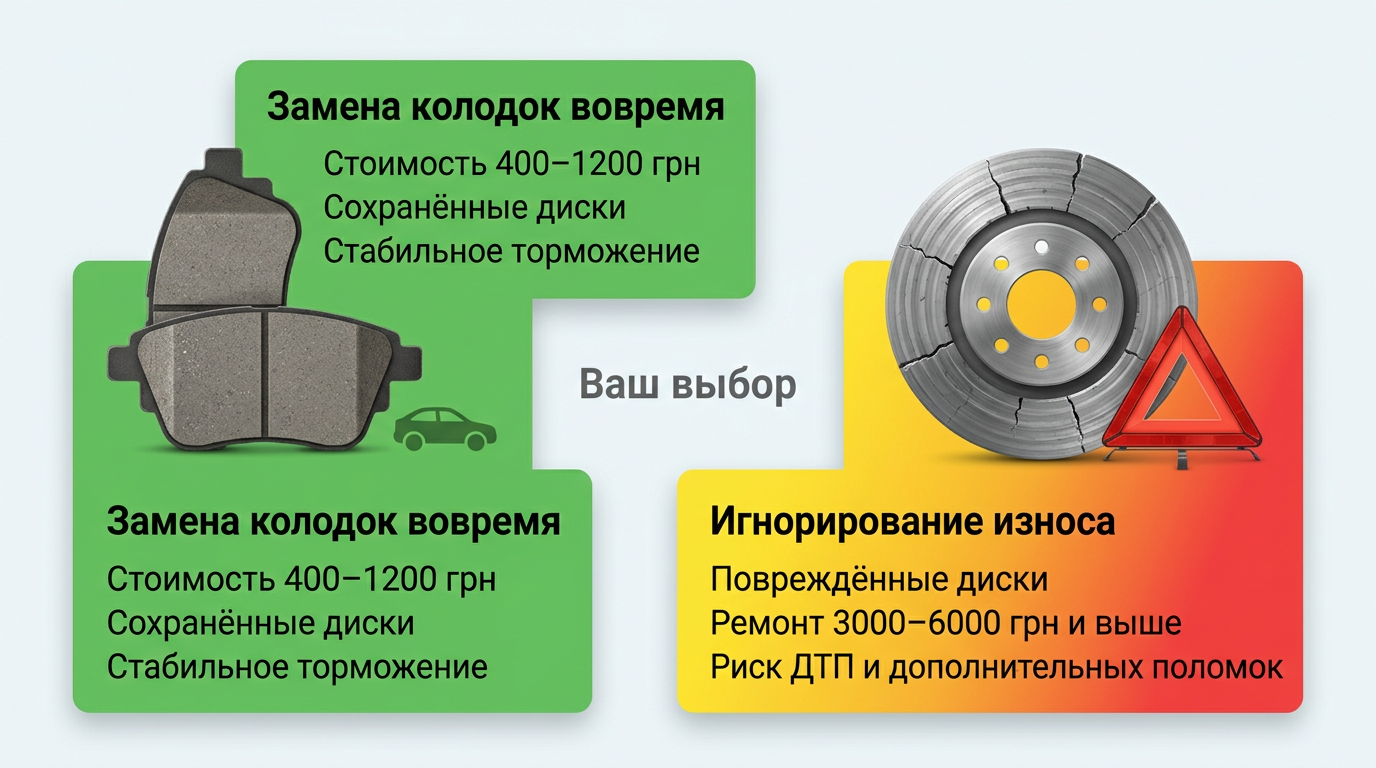
Worn brake pads quickly destroy brake discs: when only millimeters remain to the metal, the pad begins to act like a file, leaving grooves and overheating the disc. The cost of a set of discs and pads for mass-market models can easily exceed 3,000–6,000 UAH, while mid-range brake pads themselves cost approximately 400–1,200 UAH per set.
Additionally, if the system is heavily worn, uneven forces may appear on the wheels, which reduces the vehicle's stability and can lead to pulling to the side when braking.
What the driver can check himself
Visual assessment of the front brake pads
On most vehicles, it's recommended to inspect the brakes every 10,000–15,000 km or at least once a year. For a basic inspection, the following is sufficient:
Place the car on a level surface, turn the steering wheel to the side and look through the holes in the disc at the caliper.
Locate the friction lining and assess how much thicker it is than the metal base. If you're unsure, it's best to remove the wheel and check the thickness through the hole in the caliper.
Service recommendations often indicate that a remainder of 5–10 mm is considered normal, 3–4 mm indicates it is time to prepare for replacement, and 2–3 mm or less indicates unsafe operation.
Disc tarnish condition and pedal behavior
A uniform dark coating on the disc indicates that the lining is still present.
Shiny metallic inclusions in the coating are a sign that the pad is already rubbing the disc with metal.
If the brake pedal becomes "long" or vibrates, you should stop experimenting on your own and contact a service center for a comprehensive check.
Replacing brake pads yourself is possible, but requires a set of tools (a jack, stands, wrenches, special grease, calipers, etc.) and an understanding of the workflow—from removing the wheel and caliper to properly installing the new pads and checking the brakes. If in doubt, it's safer to entrust the job to a professional.
When is it necessary to go to a service center?
Contacting the service should not be delayed in the following situations:
A metallic grinding sound can be heard every time you brake.
The residual thickness of the friction layer is less than 3 mm or is visually almost indistinguishable from the metal base.
The braking distance has increased sharply, the pedal goes deep, and there is a pull to the side when braking.
When braking, a strong vibration or beating is felt in the pedal/steering wheel.
You have noticed cracks, chips, uneven wear on the brake pads or damage to the brake discs.
On modern cars, accurately assessing the wear of the rear drum brakes requires disassembling them; without this, it is impossible to see the linings, so it is worth having them professionally inspected on a lift at least periodically.
Checklist: When to Change Brake Pads
The mileage at the last replacement exceeded 15–30 thousand km in the combined cycle.
When braking, a persistent creaking/squeaking or metallic sound appears.
The braking distance has increased noticeably, the pedal has become spongy or too long.
Upon inspection, the remainder of the friction layer is less than 3 mm or cracks and chips are visible.
Vibrations, beating, and pulling to the side when braking are observed.
If at least one item from the checklist matches, plan a service visit soon; if two or more, it’s no longer safe to postpone.
Conclusion and practical recommendations
Don't rely solely on mileage: consider your riding style and actual symptoms—sound, pedal action, vibration.
Check the condition of the front brake pads every 10,000–15,000 km or at least once a year, and more often if you drive aggressively in the city.
Plan to replace when the friction layer remains at 3–4 mm, without waiting for metal grinding.
Don't skimp on diagnostics: sometimes problems are caused by guides, discs, or suspension and steering components, so it's a good idea to check these components periodically.
In the specialized sections on the brake system, you can select pads, discs, and other components for a specific car model. If necessary, combine replacement with a suspension and steering check, as well as order related engine or electrical parts.
FAQ
How often should brake pads be changed on average?
In Ukraine, replacement is typically required every 15,000–30,000 km, depending on driving style and operating conditions. However, it is important to focus primarily on the actual condition and signs of wear.
What is the minimum thickness of brake pads considered acceptable?
Most services recommend not to go below 2-3 mm of friction material, and when 3 mm remains, plan to replace it to avoid the risk of damaging the discs.
Is it possible to continue driving if the brake pads squeak but brake normally?
A short-term squeak may be due to moisture or dust, but a constant squeak or squeak with each braking is a reason for diagnosis and, most often, replacement of the pads.
Is it necessary to change brake discs along with the pads?
If the discs are thick enough and have no deep grooves or deformations, they can be left in place, with only the pads replaced. If they are heavily worn or have runout, the discs should be replaced or ground.
Is it worth installing used original brake pads?
Using brake pads that are already noticeably worn is not recommended, but used original brake system components (e.g., calipers, brackets) in good condition can be a reasonable alternative to cheaper alternatives - it is important that there is sufficient remaining pad material and the part has passed the inspection.



.jpg)