Where does the squealing in the brakes come from?
Squealing is caused by microvibrations of brake system components, which are transmitted through the pad and disc into the audible range and are heard as a squeal or squeal. Most often, they are caused by worn or dirty pads and discs, or seized calipers or guides, but sometimes the noise accompanies the normal bedding-in of new pads to the disc.
Main causes of malfunction
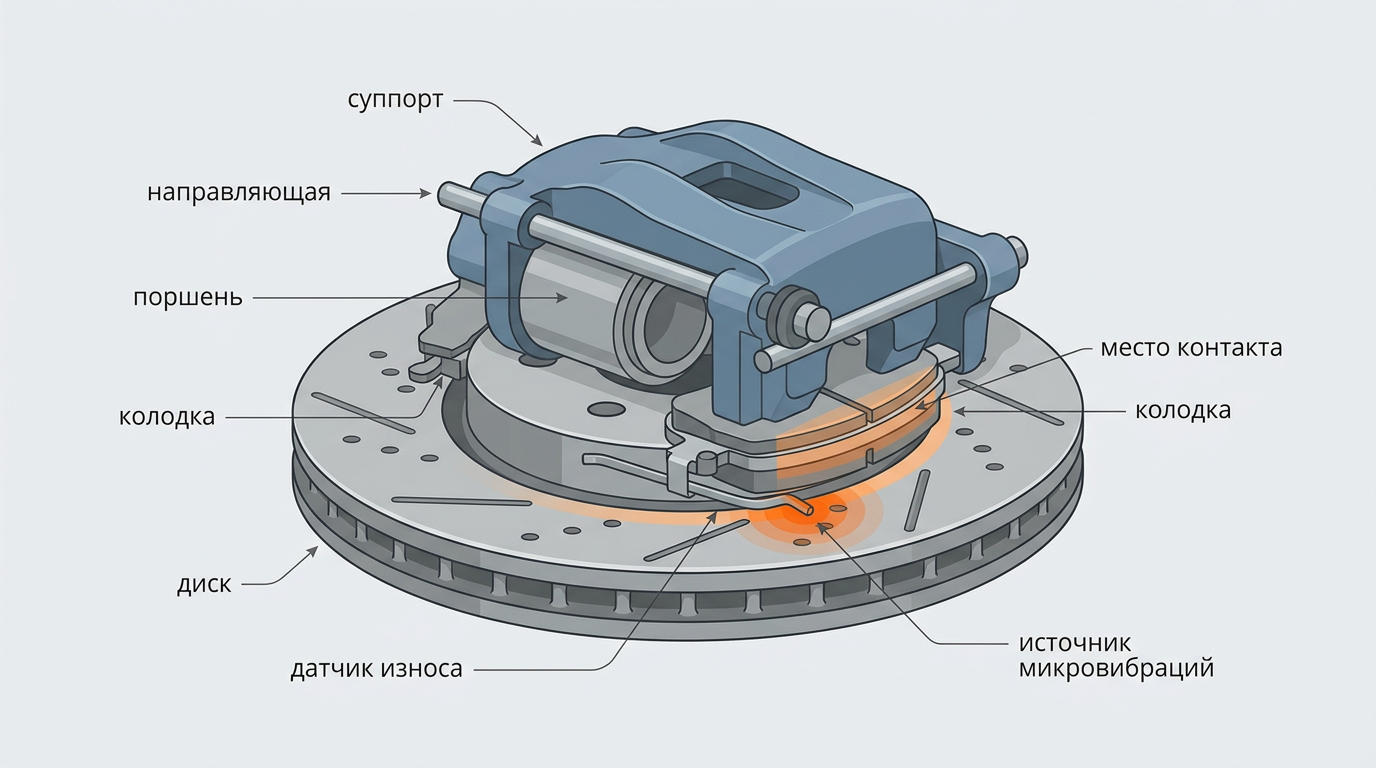
1. Worn brake components: pads and discs
When the friction material on the brake pad wears down to a critical level, manufacturers create special metal "petals" or indicators that begin to rub against the disc and produce an annoying grinding noise.
A heavily worn disc (ribs, grooves, reduced thickness) also causes whistling and vibrations when braking.
Important: When replacing discs, it is recommended to also replace the pads at the same time – installing new discs paired with worn pads increases the risk of noise and reduces braking efficiency.
2. Dirt, water and foreign objects
When small stones, sand, and street grime become lodged in the gap between the disc and the brake pad, this often results in a loud grinding or whining sound when braking, especially after driving on gravel or off-road. Dried clay or compacted mud then produces a persistent squeal with each pedal press.
In some cases, a thorough cleaning of the brake assembly using specialized disc cleaners is sufficient to completely eliminate extraneous noise.
3. Wedging of the caliper and guides
When the caliper piston or guides seize due to corrosion or a lack of lubrication, the brake pads fail to return to their original position and constantly touch the disc. This condition causes a persistent squeal, intense disc heating, and characteristic uneven wear of the pads, with one pad wearing out much faster than the other.
Manufacturers and specialized services recommend periodic maintenance of the calipers: disassembling, cleaning, renewing the guide lubricant, and checking the condition of the dust boots and seals.
4. Poor quality or incorrectly selected brake pads
Budget pads with a hard or unstable friction compound are often prone to constant whistling and accelerated disc wear.
Incompatibility of disc and pad materials (for example, a pad that is too “hard” on a soft disc) also increases noise and vibration.
Major manufacturers (Brembo, EBC, etc.) specifically point out the importance of using pads with noise-absorbing plates (washers, shim), as well as the correct installation of anti-noise springs and plates.
5. New, not yet broken-in pads
During the first 150–300 km of driving, new brake pads may produce a slight whistling or rustling sound—this is the process of bedding in and forming the working surface. With proper driving habits (avoiding sudden, emergency braking), this noise usually disappears on its own.
Manufacturers recommend avoiding severe overheating during this period – do not brake to the floor and do not drive at high speeds with frequent stops.
6. Overheating of brake system components
Repeated heavy braking, towing a heavy trailer, driving with an overload and long descents overheat the brake mechanisms, causing a whistling sound, a strong burning smell and the risk of thermal deformation of the disc.
If the brake pads become overheated, the friction layer can become “vitrified,” reducing the coefficient of friction and causing a constant squealing sound every time the pedal is pressed.
Signs and symptoms of brake problems
By sound
A short whistling sound when braking slightly at low speed is often explained by the fact that the brake pad is vibrating and its operation is affected by stuck dirt or the composition of the friction lining.
A constant metallic grinding sound when pressing the brake is considered a typical sign that the pads or disc are already worn to a dangerous level, or that a foreign solid object is trapped between them.
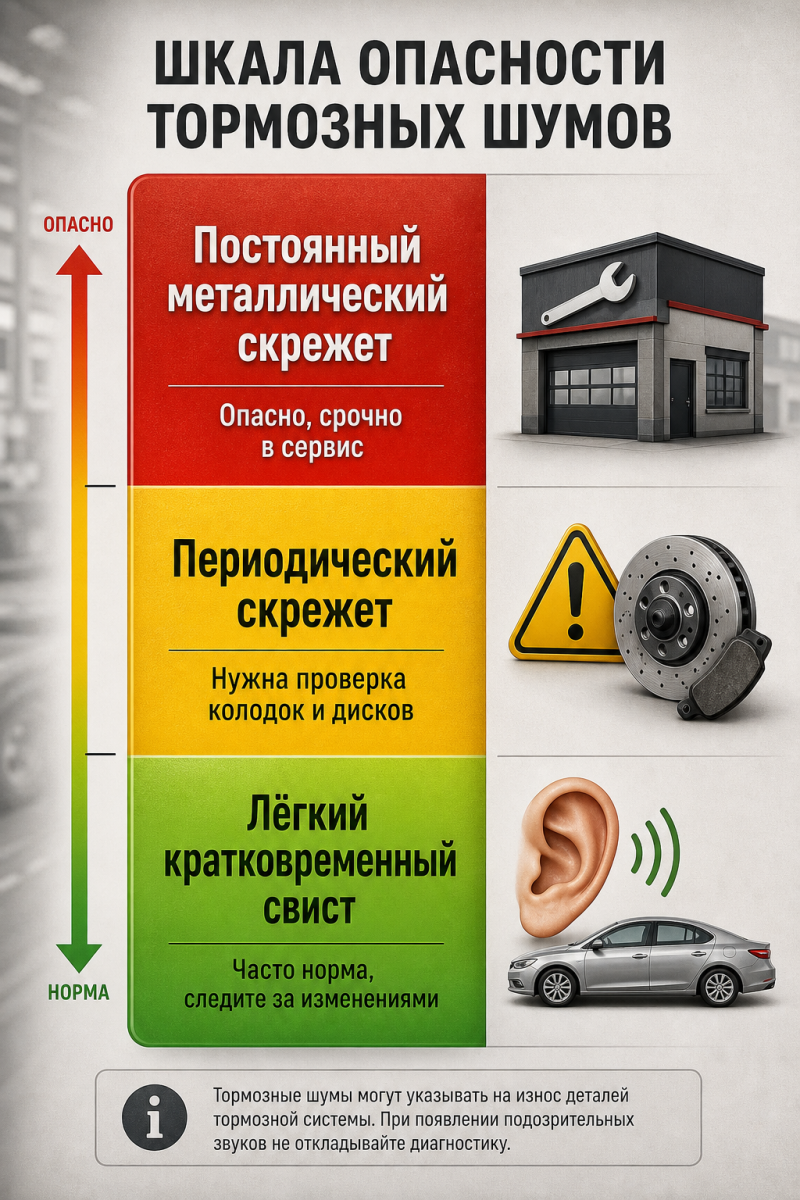
How it feels while driving
A vehicle pulling to one side when braking, an excessively soft and deep pedal feel, and noticeable pulsations indicate that there are serious deviations from the norm in the braking system.
When the steering wheel or body starts to shake when braking at speed, this in most cases indicates deformation or severe uneven wear of the brake discs.
External symptoms of wear and tear and malfunctions
A brake pad with less than 3–4 mm of remaining friction layer, a disc with cracks, scratches, noticeable grooves and a high flange are considered visual signs that indicate that replacement is no longer possible.
Brake fluid stains near the caliper or on the inside of the rim, combined with an excessively hot disc after a short run, indicate a leak or frequent hesitation due to binding.
What are the consequences of squealing brakes left unattended?
In most cases, a creaking sound is an early sign of an impending malfunction: the sooner you “hear” it, the cheaper and safer the repair will be.
When the brake pads and discs wear to their limit, the car's braking performance becomes significantly worse, the distance to a complete stop increases, and the likelihood of brake failure when pressing the pedal suddenly becomes critically high.
Constant overheating and working with a sticking caliper accelerates the destruction of wheel bearings and chassis components and can warp the disc, making repairs several times more expensive than a regular scheduled replacement.
What can you check yourself?
Important: Perform any work on the brakes only when the vehicle is securely supported, using a jack and supports, and observe safety precautions.
1. Visual inspection of pads and discs
Rotate the wheel so that the working part of the brake pad is visible through the windows in the disc or caliper, and assess the remaining thickness of the linings - on many cars, this can be done without removing the wheel.
Then carefully inspect the brake disc: the presence of deep grooves, cracks and other damage is already considered a reason for replacement.
2. Check for contamination
After driving on mud or gravel, inspect the space between the disc and the pad: sometimes a foreign stone or a dense lump of dirt can be seen visually.
If a slight creaking sound occurs precisely after such conditions, it is sometimes sufficient to carefully rinse the unit with low-pressure water and then, after drying, test the brakes while driving.
3. Evaluation of pedal and machine behavior
Assess how the pedal's operation has changed: if it becomes too stiff, requires a lot of effort, or, conversely, easily goes almost to the floor, the brake system needs to be urgently checked by a specialist.
If a squeal or whistle occurs only in wet weather, after washing or rain, and disappears after a couple of brakings on dry asphalt, this is usually due to condensation and a thin layer of rust on the discs and is not considered a malfunction.
Only external observation and basic diagnostics are allowed on your own, without disassembling the brake mechanisms, unless you have the relevant experience.
When is it necessary to contact service?
Situations when you can't delay
A loud, continuous metallic noise whenever you apply the brakes.
The car starts to pull to the left or right, vibrations appear on the steering wheel or pedals when slowing down, and it takes much longer to come to a complete stop than before.
One wheel is very hot compared to the others, there is a burning smell and smoke.
Traces of brake fluid or a sharp drop in its level in the reservoir.
In such cases, a full diagnostic at a service station is required, including disassembling the components, measuring the thickness of the discs and pads, and checking the operation of the calipers and hydraulics.
What will a professional service do?
The wheels will be removed and the actual wear, runout and surface condition of the discs will be assessed using measuring instruments.
They will clean and service the calipers: guides, pistons, dust boots, replace worn parts if necessary, and apply special high-temperature lubricants and anti-squeak pastes.
They will select the correct brake pads and discs in terms of composition and size, and also perform the required bedding-in and test drive.
Approximate costs of squeaking repair in Ukraine
Actual prices depend on the car model and region, but based on data from Ukrainian stores and service stations, you can get a general idea of the following:
Replacing a pair of front brake pads: from 700 to 2500 UAH per set plus 600–1200 UAH for labor.
Replacing a pair of front discs with pads: from 3500–8000 UAH for a set of parts plus 1200–2000 UAH for labor.
Maintenance and lubrication of calipers (without replacing large parts): from 800 to 1800 UAH per axle.
Repairs using high-quality used original parts (e.g., calipers or brackets ) can reduce the final budget by 20–40% compared to installing new originals, while maintaining a level of safety with proper selection and maintenance.
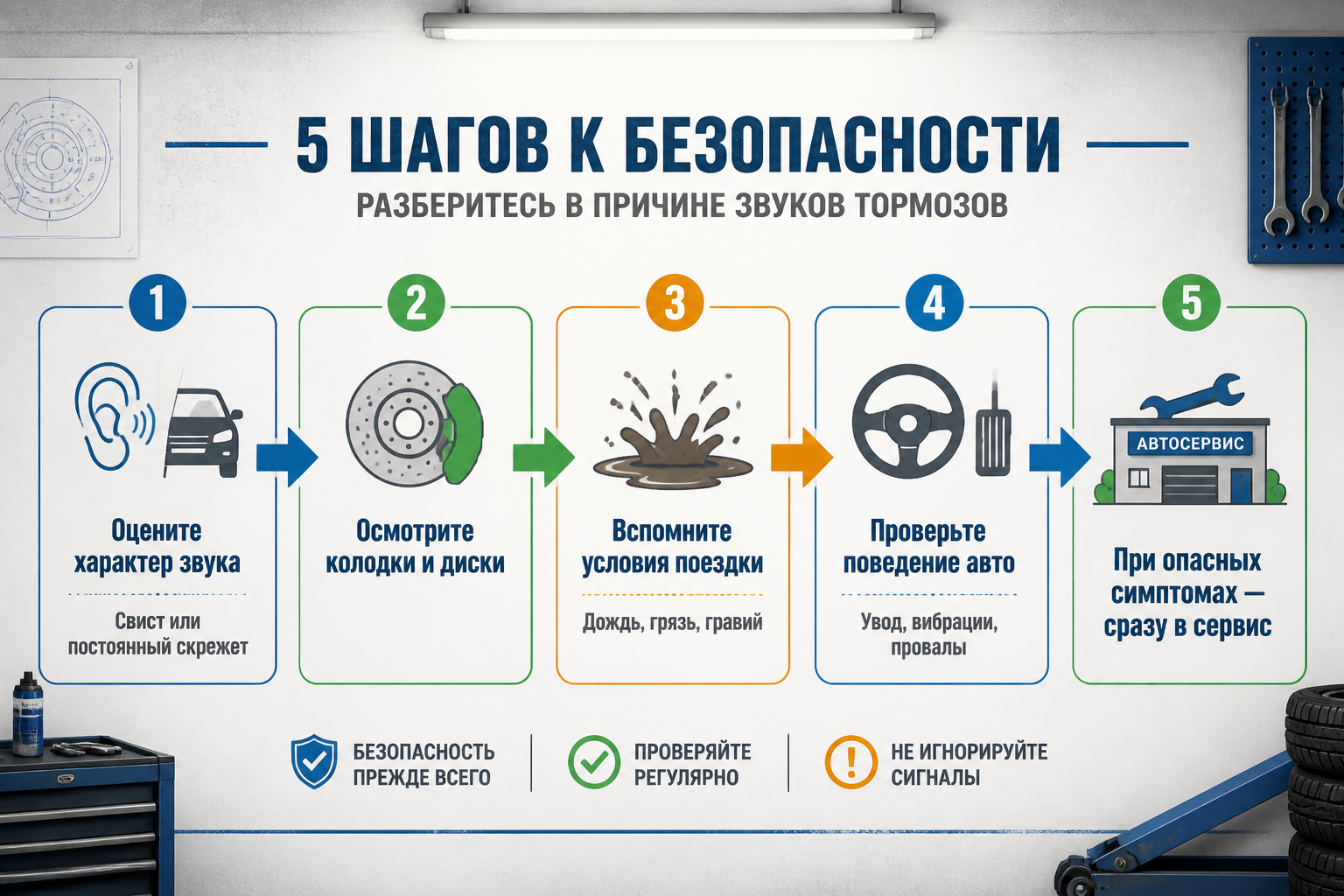
Checklist: What to do if your brakes start squealing
Step | What to do | Comment |
1 | Evaluate the character of the sound | A constant grinding noise is more dangerous than a short whistle. |
2 | Inspect the pads and discs | Look for severe wear, grooves, ridges, and cracks. |
3 | Remember the conditions | After mud and rain the noise may be temporary |
4 | Check the car's behavior | Pulling, vibrations, pedal failures – take it straight to the service center |
5 | Don't overheat the brakes | Avoid sudden braking before diagnosis |
When repairing a brake system, it's important not only to eliminate squeal but also to restore the original braking performance. This means carefully selecting the right pads and rotors for the specific model, inspecting the calipers and guides, and, in some cases, replacing brackets, boots, and other components that are difficult to find new at a reasonable price.
Here, a car dismantling shop with access to a wide range of used original parts can be the optimal solution: you can select original calipers, brackets, dust covers, suspension components, and even hubs based on the VIN and actual operating conditions.
When selecting components for brake repair, it is advisable to immediately check the suspension and steering components , since some vibrations during braking are caused by broken levers and steering components (see the section "suspension and steering").
If, after replacing the discs and pads, vibrations are still felt in the steering wheel, it is worth diagnosing the tires and wheels . After serious impacts or accidents, it may be necessary to replace the steering knuckles, levers, and damaged body elements at the attachment points of the suspension and brake mechanisms.
FAQ
Why do new brake pads whistle - is this a cause for concern?
No, a moderate whistle during the first 150-300 km after installing new pads is usually associated with bedding-in and is acceptable if there is no vibration, sideways pull, or characteristic metallic grinding.
Is it safe to continue driving if the brakes just squeal a little?
If the sound is short-lived, appears in damp weather, and disappears after several braking operations, this is often normal, but if the noise increases, diagnostics are needed.
Why is it dangerous to drive with completely worn brake pads?
The metal pads begin to rub against the disc, braking efficiency drops sharply, braking distance increases, and the risk of complete brake failure increases.
Will anti-squeak grease help with brake pads?
Anti-squeak gels and pastes are only allowed to be applied to the non-working side of the pad and the contact areas in the caliper, but in the case of actual wear or seizure of the component, they do not solve the problem and do not eliminate the need for repair.
Is it possible to pour water on hot discs to help them cool down faster?
No, sudden temperature changes can deform the disc and lead to vibrations and cracks.