Why does the battery drain quickly?
Rapid battery discharge is almost always due to either wear or problems with the vehicle's electrical system or operating conditions. It's important to understand the root cause, otherwise even a new battery will die overnight or within a couple of days.
Natural aging and battery life
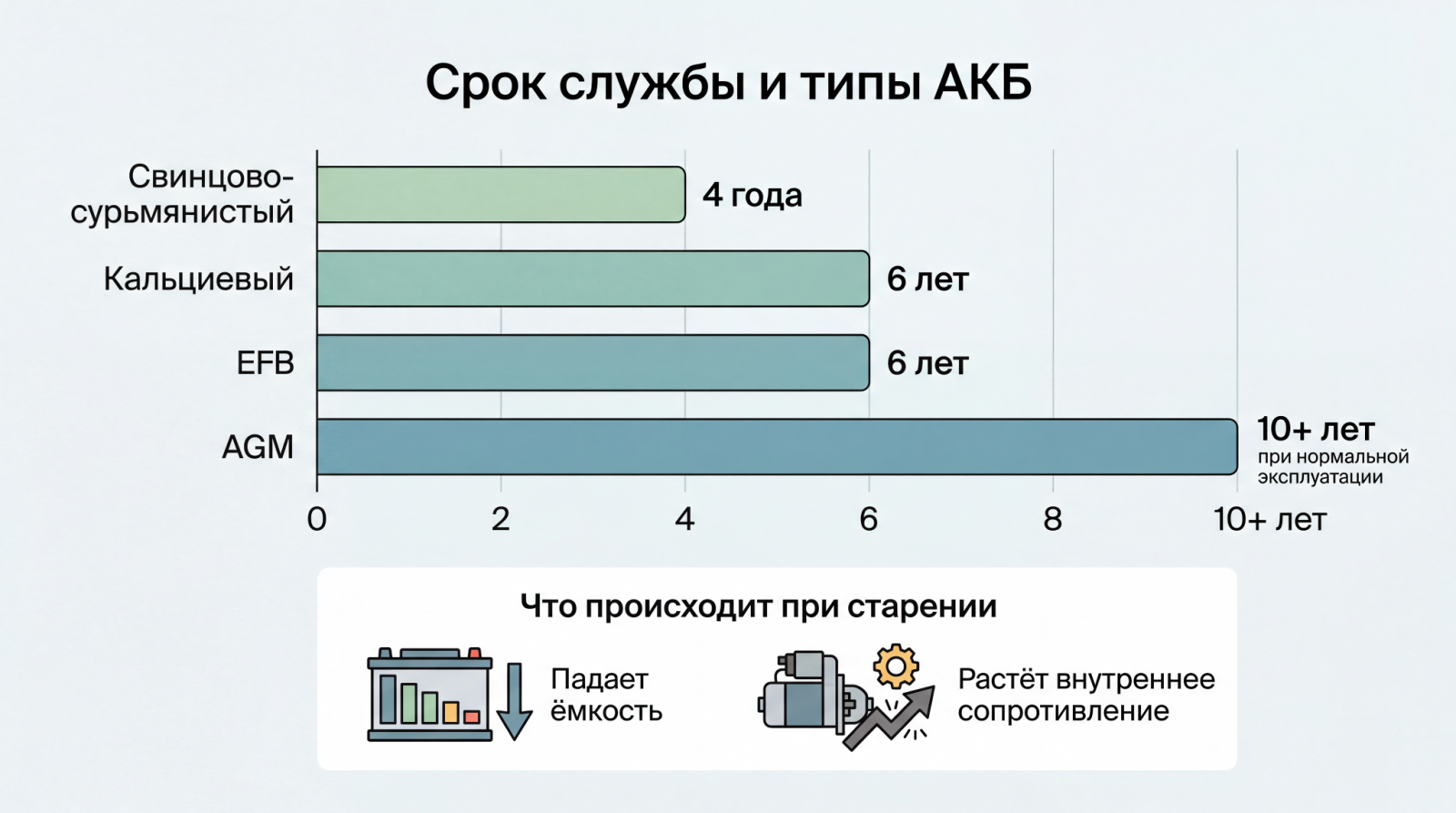
A car battery has a limited lifespan: on average, about 4–5 years under normal use. This lifespan varies for different battery types: lead-antimony batteries last approximately 4 years, calcium and EFB batteries last up to 6 years, and AGM batteries last up to 10 years or more under ideal conditions.
As we age:
the capacity drops and the battery discharges faster even without any obvious faults;
Internal resistance increases, making it more difficult for the starter to turn the engine.
If your battery is 4-5 years old or older, regular rapid discharge often indicates that its lifespan has been exhausted, rather than a “breakdown.”
Incorrect operation of the generator and drive belt
Even a healthy battery will discharge if the alternator isn't charging it enough. Reasons:
weak tension or wear of the alternator belt - it slips and the charge drops;
worn brushes or diode bridge of the generator;
problematic voltage regulator (overcharged or undercharged).
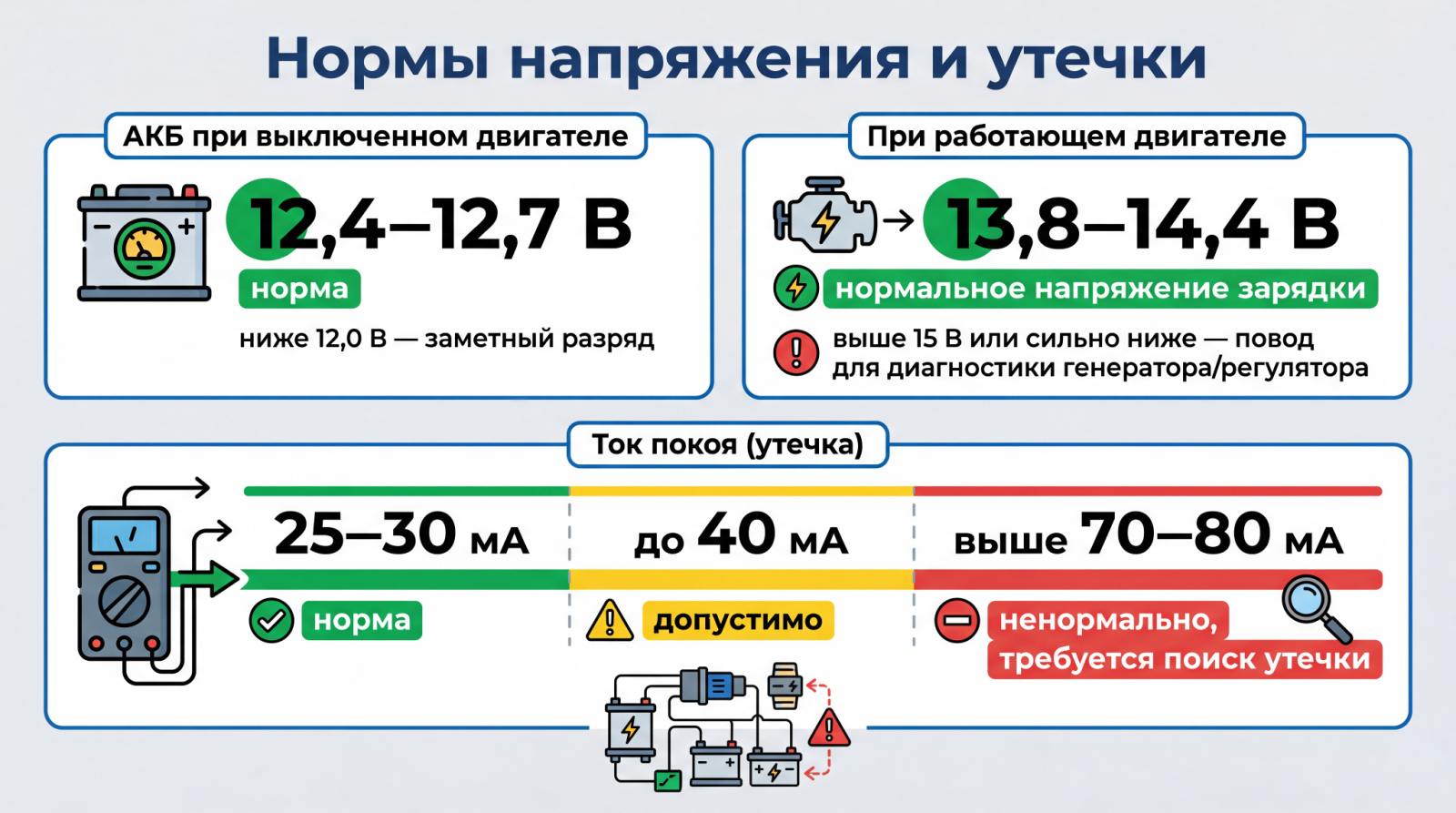
The normal charging voltage for most passenger cars is approximately 13.8–14.4 V with the engine running and all main loads on. If the voltage is significantly lower, the battery is chronically undercharged and quickly discharges; if it's higher, it deteriorates rapidly.
Constant current leaks in the on-board network
Even in sleep mode, a car still draws a small amount of current—for example, for the radio memory, alarm system, and control units. For a passenger car, a drain of around 25–30 mA is considered normal, with a maximum of around 40 mA. Values above 70–80 mA are considered abnormal and require investigation.
Typical sources of leaks:
Incorrectly connected alarm system or GPS tracker;
aftermarket audio system connected "directly";
a constantly burning light in the trunk or interior;
rotten wiring, "smudges" along wet paths or oxidized connectors.
Operating mode: short trips and idle periods
If a car is frequently driven only short distances, the battery simply doesn't have time to recharge from the alternator. Each engine start consumes a significant portion of the charge, resulting in even a healthy battery living in a state of constant undercharge.
Additionally, they cause harm:
long periods of downtime without recharging;
operation in cold weather during short trips;
constant driving with a large number of consumers turned on (heaters, powerful audio system, etc.).
Driver inattention and the "human factor"
Common causes include forgotten parking lights, dome lights, and cigarette lighter ports with devices plugged in. Even a small trunk light left on can drain the battery in a night or two.
The main signs and symptoms of the problem
Early detection of symptoms can help avoid serious and costly consequences.
Typical manifestations of rapid discharge
The engine turns sluggishly, the starter “pulls” slowly, especially in the morning or in cold weather.
When the engine is off, the voltage at the terminals is below approximately 12.2–12.4 V, which indicates an incomplete charge.
After overnight parking, the engine does not start, although the battery was charged or recently changed.
Indirect signals from electrical equipment
The headlights flicker or dim when a major consumer (heater, heated glass) is turned on.
If you notice a distinct smell of burnt plastic or insulation, this is a reason to stop immediately and check the wiring.
The battery/generator icon on the dashboard lights up periodically, especially when idling.
The dangers of ignoring rapid discharge
Ignoring a battery problem rarely ends in inconvenience alone—at the very least, you risk ending up with a dead car somewhere on the highway.
Risk of a complete vehicle stop
If the battery is severely discharged, the starter will not be able to crank the engine, making starting impossible. If deeply discharged, the battery may fail completely, especially in winter, and may be irreparable.
Generator and wiring overload
With constant undercharging, the system strives to "fill" the battery back to normal, and the generator operates under increased load. This accelerates wear and tear on its components and increases the risk of wiring overheating, especially if there are improper connections.
Danger to other vehicle systems
Unstable power supply can lead to failures of control units, ABS, power steering, and other important systems. In modern cars, this not only increases the risk of an accident but also increases the cost of diagnostics and reprogramming of the units.
What can you check yourself?
Many basic checks are easy to perform even for drivers without specialized training. However, it's important to follow basic safety precautions: work with the ignition off, avoid short circuits, and be careful not to reverse polarity.
Visual inspection of the battery and terminals
Inspect the battery case: cracks, electrolyte leaks, swelling are a reason to replace the battery immediately.
Check the terminals for oxidation; green or white deposits impair contact and increase voltage drop.
Make sure the terminals are tightly tightened and do not heat up during operation - heating indicates poor contact.
For most vehicles, the minimum acceptable voltage for a fully charged and idle (rested) battery is around 12.5 V; below 12.0 V, the battery is already noticeably discharged.
Checking voltage and charging with a multimeter
With the engine off, measure the voltage at the battery terminals - the normal value is about 12.4–12.7 V.
Start the engine and measure again: with the generator running, the reading should rise to approximately 13.8–14.4 V.
Turn on several consumers (headlights, heater) and make sure that the voltage does not drop significantly below 13.5 V.
If the voltage does not increase while driving or, on the contrary, exceeds 15 V, there is likely a faulty generator or voltage regulator.
Sample leakage current test
You will need a multimeter with the ability to measure DC current and a basic set of keys.
Turn off the ignition and all consumers, close the doors.
Remove the negative terminal and connect the multimeter to the gap between the terminal and the battery terminal in the current measurement mode.
After a few minutes, when the units fall asleep, a current of approximately 25–30 mA, with a maximum of around 40 mA, is considered normal for a passenger car; some experts allow up to 70–80 mA, depending on the configuration.
If the current is significantly higher, it is better to entrust further leak detection to professionals, especially on a modern car with a large number of electronic units.
Quick Self-Diagnosis Checklist
Self-check step | What to do | |
1. | Inspection of the battery case | Check for cracks, leaks, and swelling. |
2. | Inspection of terminals | Clean oxidation, tighten connections. |
3. | Voltage control | Measure 12.4–12.7 V with the engine off. |
4. | Checking the charge | Check for 13.8-14.4V with the engine running. |
5. | Leak assessment | Measure the quiescent current; approximate value is 25–40 mA. |
When is it necessary to go to a service center?
Not every battery problem can be safely solved on the spot. In some cases, taking your car to a specialized service center is a matter of safety and vehicle life.
Situations when it is better not to delay
You have detected increased current leakage, but cannot identify the culprit circuit.
The charging voltage is outside the normal range (too low or too high).
There are traces of melted wires, a burning smell, and periodic shutdowns of electrical equipment.
The car regularly “dies” completely overnight or within a couple of days, despite having a charged or new battery.
What do they do in the service?
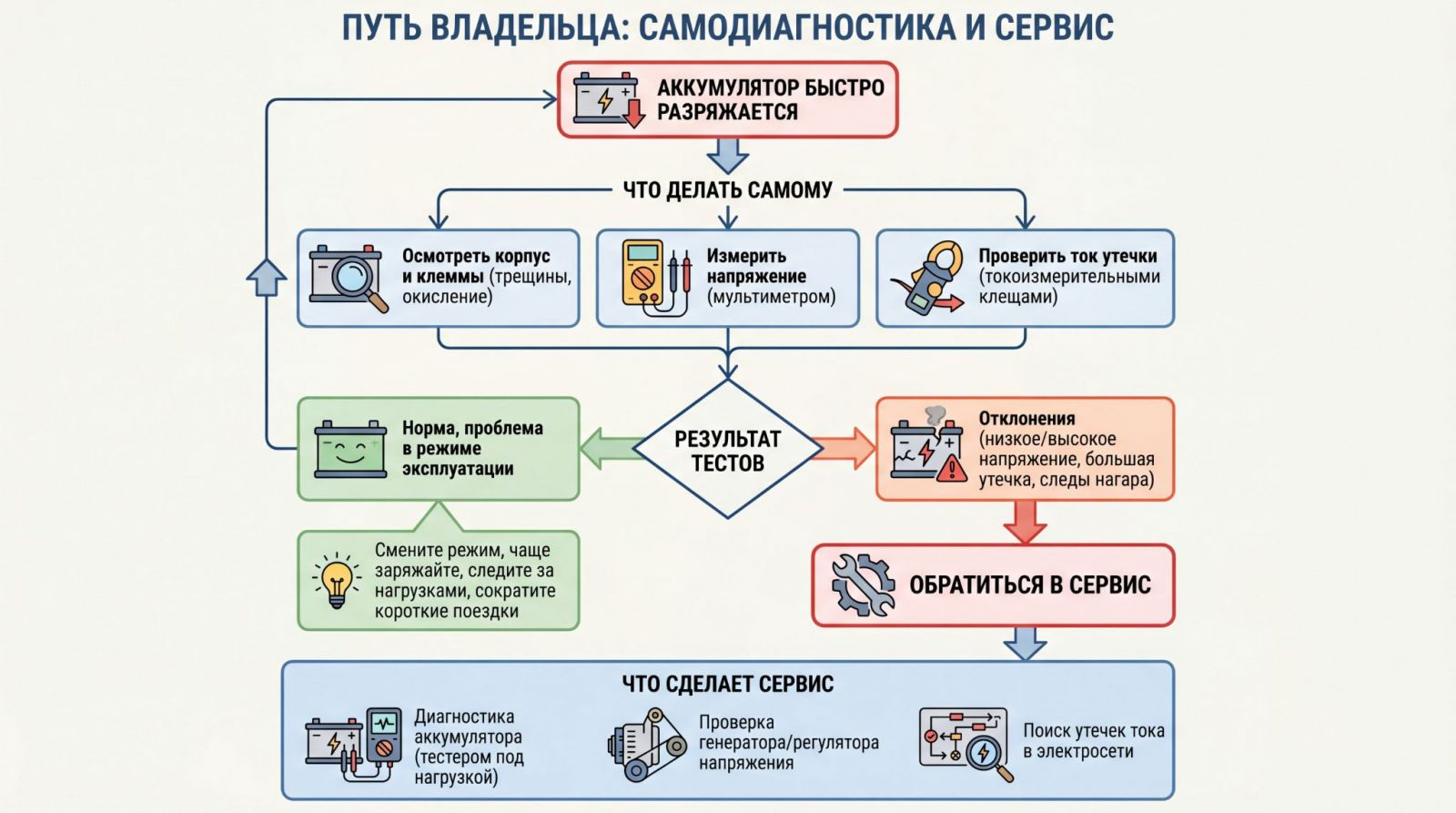
Full battery diagnostics: capacity measurement, internal resistance, load test.
Checking the generator, voltage regulator, belt and the entire charging circuit on special stands.
Search for leaks using current clamps and step-by-step disconnection of circuits, including hidden wiring.
If the problem isn't just with the battery but also with other systems (starter, wiring, corroded body components that compromise grounding), individual components may need to be replaced. High-quality original parts from a salvage yard are helpful. For such cases, you can pre-select components by electrical , suspension , and other systems.
Conclusion and practical recommendations
In most cases, rapid battery discharge is not a coincidence, but a consequence of a combination of factors: battery age, driving style, and the condition of the alternator and wiring. The sooner you detect changes in battery behavior, the cheaper and safer the solution will be.
A brief prevention checklist
Check the charging voltage and current leakage at least with a multimeter every 6-12 months.
Avoid long periods of inactivity without recharging; if used infrequently, periodically charge the battery with a low current.
Keep the terminals clean and in good condition, and promptly eliminate oxidation and loose contacts.
If your battery is 4-5 years old, plan to replace it in advance, especially before the winter season.
FAQ
How long does the average car battery last?
Under normal conditions, most batteries last about 4–5 years; some modern calcium, EFB, and AGM batteries can last longer if properly maintained.
What current leakage is considered normal for a passenger car?
For most passenger cars, the normal idle current is around 25–30 mA, the maximum permissible is often considered to be around 40 mA, sometimes up to 70–80 mA for configurations with a large number of electronic units.
Is it possible to drive with a constantly discharging battery if you recharge it periodically?
This mode accelerates battery aging and overloads the generator; in addition, the risk of a sudden start failure increases at the most inopportune moment.
How do you know if the generator is at fault and not the battery?
If, when the engine is running, the voltage at the terminals remains low or fluctuates significantly, and problems with lighting and indicators also occur, the generator or voltage regulator is most often suspect.
Does it make sense to install a more capacious battery?
Installing a battery with a capacity higher than recommended will not solve leakage or undercharging problems and may even overload the charging system; a properly functioning alternator, proper wiring, and the absence of persistent leaks are more important.