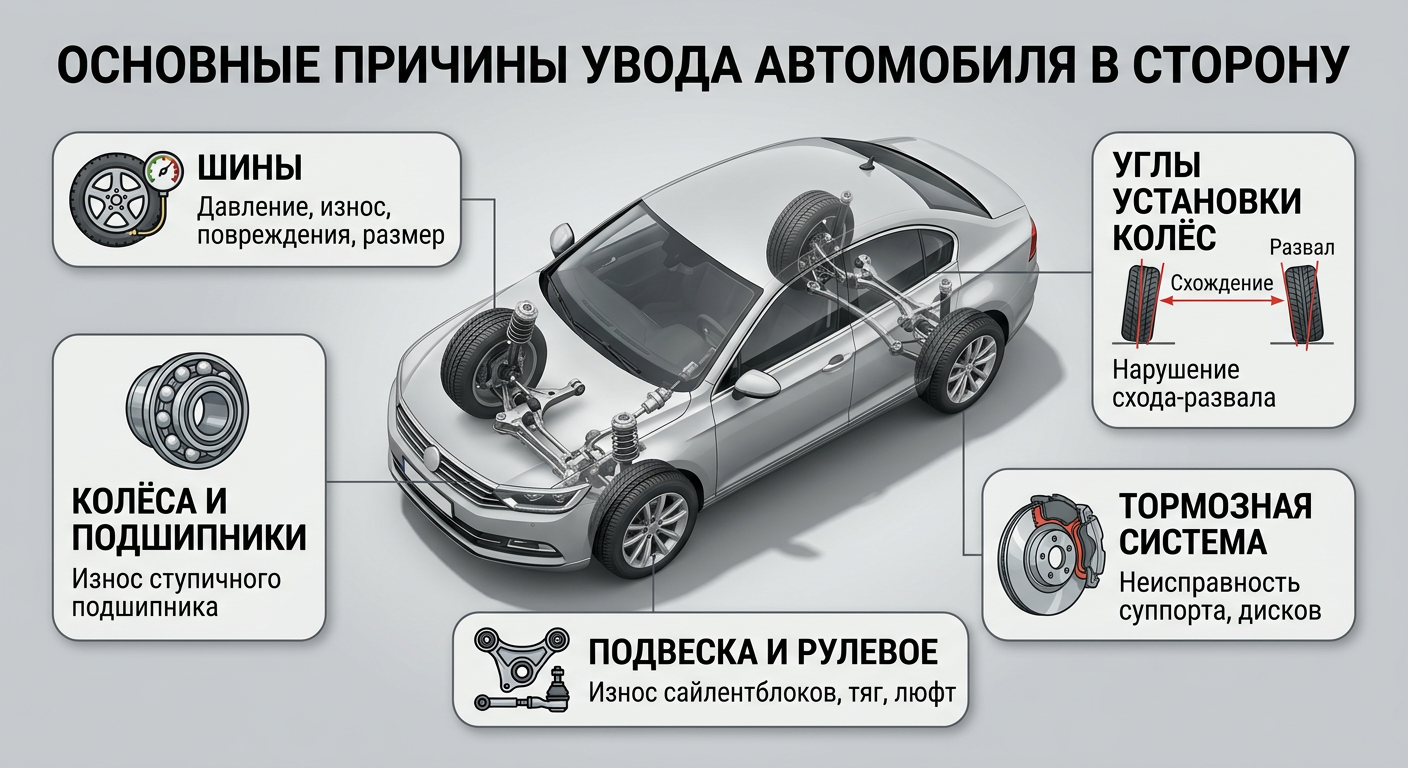
The shock absorbers and springs form the core of the suspension; they are responsible for comfort, stability, and safety while driving. If these components have worn out, the car will sway more over uneven surfaces, the tires will have less grip, and braking distances and the risk of skidding will increase significantly.
The problem of wear on shock absorbers and springs occurs in most vehicles after 50,000–80,000 km, especially when driven on poor roads, with overload, and with an aggressive driving style.
It's important to notice the first signs in time: excessive rocking, suspension impacts, uneven tire wear, and "sticking" when braking, in order to prevent accidents and expensive repairs.
The main causes of wear on shock absorbers and springs
Natural wear and tear due to mileage and time
Shock absorbers contain oil or gas, which degrade over time, and the seals begin to leak. Manufacturers and service centers recommend inspecting and replacing shock absorbers frequently after approximately 50,000–75,000 kilometers, depending on operating conditions.
Over time, springs “sag”—they lose elasticity, which causes ground clearance to decrease and the suspension to “break through” more often.
Poor roads and impact loads
Frequent driving over potholes, speed bumps, dirt roads, and off-road conditions places significant shock loads on shock absorbers and springs. This accelerates wear on the shock absorber piston rods, valves, and mounts, can lead to leaks, and can cause springs to crack or break.
Overloading a vehicle
Constantly driving with an overload (many passengers, heavy luggage, or a trailer) pushes the suspension to its limits. As a result, the springs sag and lose ride height more quickly, and the shock absorbers are unable to dampen body vibrations, leading to overheating and wear.
Corrosion and mechanical damage
Corrosion of the spring metal (caustic chemicals, moisture, dirt) can lead to cracks and broken coils. Additionally, damage to the shock absorber body, piston rod, or fasteners from impacts with obstacles also reduces the service life of the unit.
Incorrect repairs and poor quality parts
Installing cheap or inadequate shock absorbers and springs degrades suspension performance and reduces service life. Installation errors, distortions, or improperly tightened fasteners can lead to knocking, leaks, and accelerated wear.
Signs and symptoms of worn shock absorbers and springs
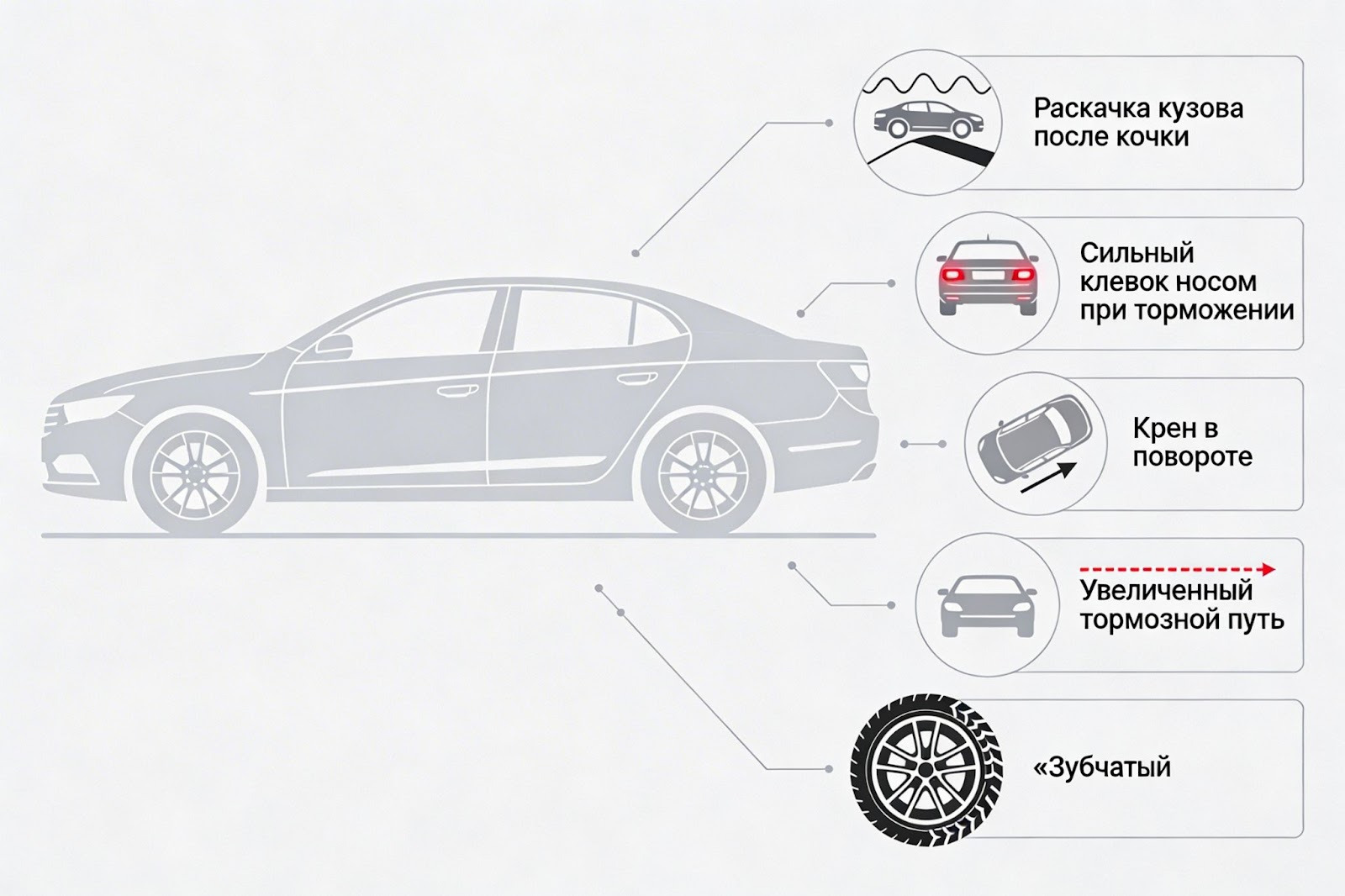
How to tell if your shock absorbers are worn out
The driver should first of all pay attention to the following symptoms:
Excessive swinging and "bucking"
The car rocks for a long time after hitting a bump or speed bump, instead of quickly settling down.
When you press on the wing, the body makes more than 1–2 up-and-down oscillations.
"Dive" when braking and squatting when accelerating
The front of the car dives heavily when braking, and the rear squats noticeably during sharp acceleration.
The car becomes less predictable during emergency braking.
Increased braking distance
Due to poor contact of the wheels with the road, the braking distance increases, especially on uneven or slippery surfaces.
Deterioration of controllability
The car "swerves" along the lane, rolls heavily on turns, and sways noticeably when changing lanes and in crosswinds.
Uneven tire wear
Cups, spots, and jagged wear appear on the tread, which is associated with wheel bouncing and poor contact with the road.
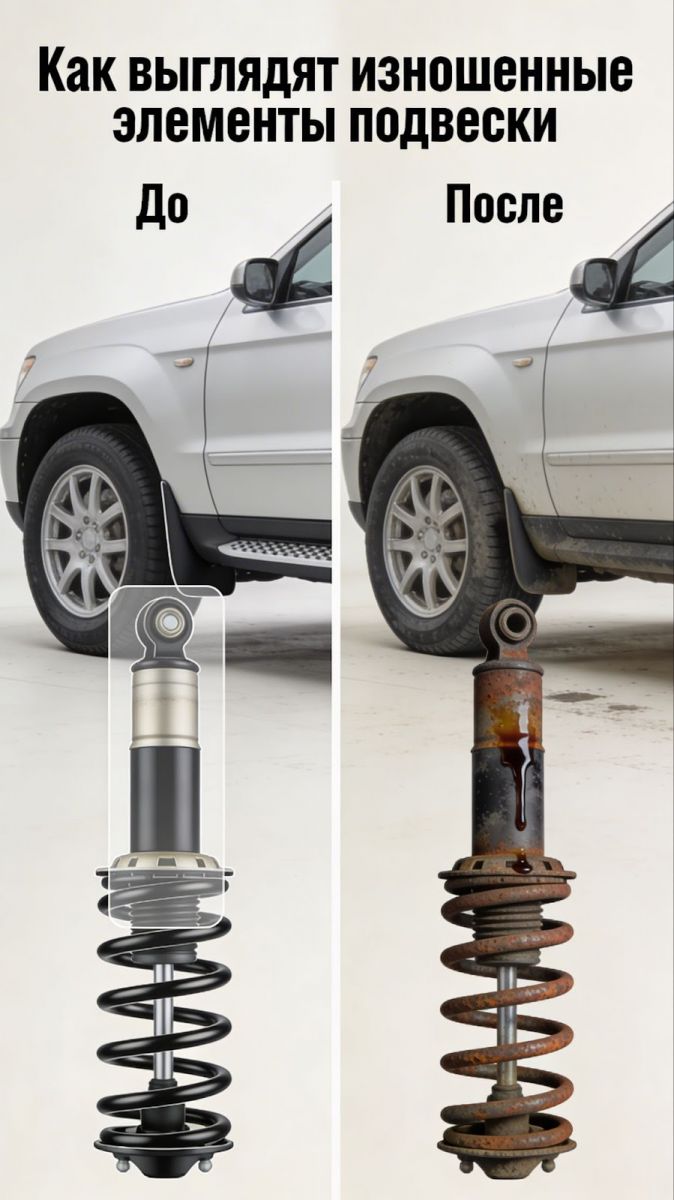
Oil leaks on the shock absorber body
Wet traces of oil are visible on the body, the shock absorber is covered with an oil-dirt film - this is a clear sign of a leak and loss of functionality.
Extraneous sounds
A knocking, dull thud, or clanking sound when driving over uneven surfaces may indicate wear in the shock absorber or its mountings.
Signs of spring problems
A car's sagging is one of the most noticeable signs: one corner or the entire axle of the car becomes noticeably lower than the other, as if the car is "slanting" to the side.
If you regularly hear hard impacts when driving over uneven surfaces, and the suspension easily “breaks through” to the limiters, this also indicates wear of the springs and/or shock absorbers.
Additionally, you can visually notice cracks or broken coils, rust, chipped paint, and impact marks on the springs. Another common symptom is additional noise: crackling, creaking, or metallic clanking when the suspension is operating.
What should a driver pay attention to?
The driver should assess the car's behavior: has it become more "rolling," nervous, prone to swaying, and rolling? When braking, it's important to notice whether the braking distance has increased or whether the nose is noticeably "bucking."
During a visual inspection, check for leaks on the shock absorbers, rusty or cracked springs, and sagging bodywork. You should also check your tires periodically: if the tread shows unusual wear areas, cupping, or uneven tread pattern, this is often due to suspension issues.
The dangers of ignoring shock absorber and spring wear
Decreased controllability and stability
When the shock absorbers have reached the end of their service life, the wheels press less against the road, and this is especially noticeable on uneven surfaces, when turning, and when slowing down.
The car becomes less predictable, the risk of skidding, understeering on turns and loss of control increases.
Increased braking distance
Poor tire contact with the road surface leads to increased braking distances, which is especially dangerous during emergency braking and on wet roads. A few extra meters of braking distance can be critical in urban environments or when driving in heavy traffic.
In such a situation, it is important to check not only the suspension, but also the condition of the brake system components - pads, discs and other components.
Increased risk of accidents
The combination of long braking distances, poor handling, and body roll clearly increases the likelihood of an accident. At high speeds and during aggressive maneuvers—swerving around an obstacle or changing lanes abruptly—the risk of losing control is especially high.
Accelerated wear of other components
Poor suspension performance accelerates tire wear, as does steering linkage, ball joints, bushings, and other chassis components. Impacts from uneven surfaces begin to be transmitted to the body, which can eventually cause cracks and squeaks.
Spring failure and loss of ground clearance
A broken spring can cause the car to suddenly drop in corner, causing the wheel to contact the wheel arch, and causing a loss of control. A noticeable drop in ground clearance increases the risk of hitting a road obstacle, damaging the crankcase, exhaust system, and other components.
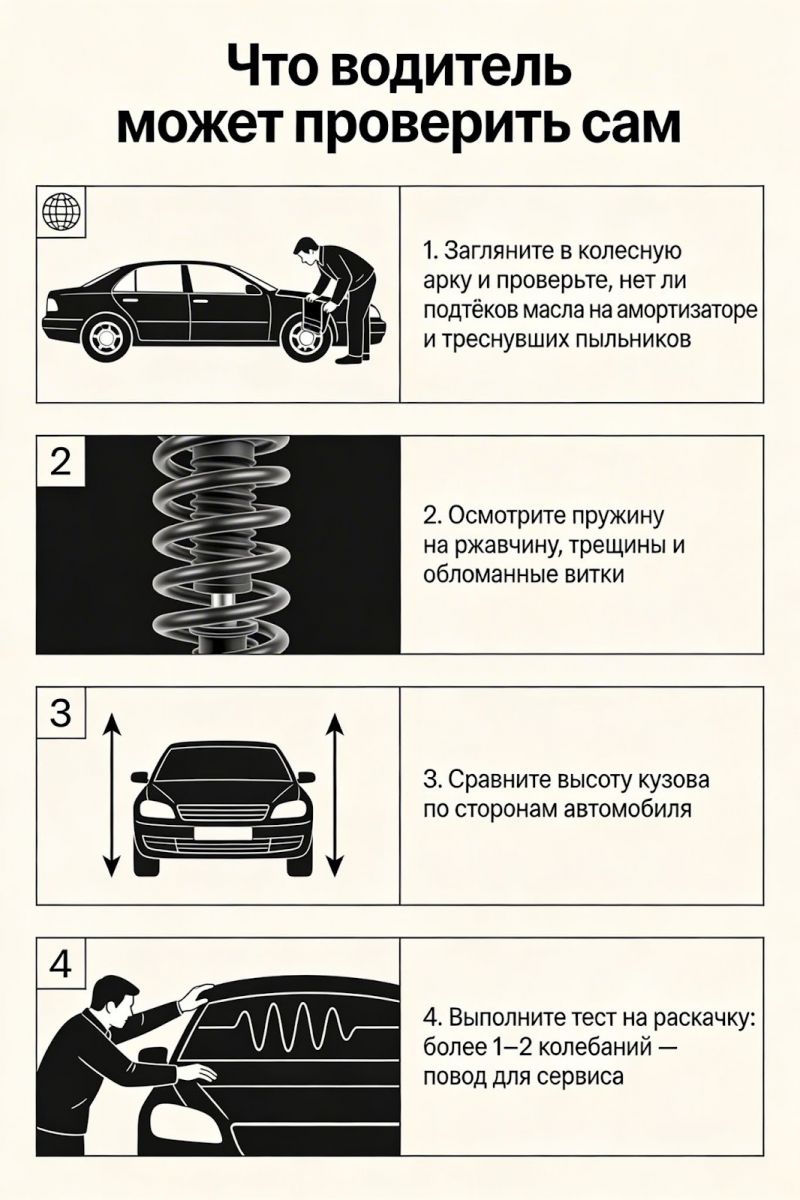
What can you check yourself?
Visual inspection of shock absorbers
Look into the wheel arch and inspect the shock absorber housing for oil leaks, wet or very dirty areas.
Pay attention to the condition of the rubber boots and supports: cracks and tears are a reason for diagnostics.
Inspection of springs
Check for visible cracks, chips, broken threads, or heavy rust.
Compare the distance from the wheel to the arch on both sides - a significant difference indicates subsidence.
Swing test
With the vehicle stationary, push down on the fender or bumper and release.
The body should return to its original position within 1–2 oscillations; prolonged rocking indicates wear of the shock absorber.
Checking tires
Inspect the tread: look for uneven wear spots, cupping, and jagged patterns.
When one tire wears out faster than the others, it's time to take it to a service center and have the suspension and wheel alignment checked.
Test drive on a familiar route
Take a drive on a familiar road and assess whether the car has become more inclined to roll, to swerve on bumps, or to require constant steering corrections.
Check for increased braking distances and any suspension shocks. In addition to the suspension, it's also a good idea to periodically check the car's electrical systems —lighting, sensors, and wiring—to prevent any unexpected failures while driving.
When is it necessary to contact service?
Below are situations where continued vehicle operation is dangerous and an urgent visit to the service center is required:
Visible leaks in shock absorbers
The shock absorber housing is wet with oil, there are leaks - the part has essentially lost its ability to dampen vibrations.
Strong rocking and loss of stability
The car “floats” along the road, rolls on turns, and requires constant steering corrections, especially at speed.
Hard hits and frequent "breakdowns"
Every time you hit a bump, you hear a loud thud, creating the feeling that the suspension is “ending.”
Broken or cracked spring
A broken coil, a sharp sag in one corner, a metallic ringing or grinding sound were detected.
A sharp increase in braking distance
The car brakes poorly, especially on uneven or wet roads, but the pedal and brake system are in good working order.
Strong uneven roll when braking or turning
The car clearly leans to one side, nosedives, or squats when accelerating.
A combination of several symptoms
The simultaneous presence of knocking, leaks, rocking and uneven tire wear indicates not only wear of the shock absorbers, but also of other suspension elements.
In these cases, diagnostics cannot be postponed: it is a matter of safety, not just comfort.
Sign | Possible cause | Recommended action |
Strong rocking on bumps | Worn shock absorbers, sagging springs | Suspension diagnostics, possible replacement of shock absorbers and/or springs |
"Dive" when braking | Weak front shock absorbers | Checking the front suspension, replacing a pair of shock absorbers |
Uneven tire wear | Poor shock absorber performance, geometry violation | Checking shock absorbers, wheel alignment, and tires |
Wet shock absorber | Oil leak, damaged seals | Urgent replacement of shock absorber |
Sagging corner of the body | Sagging or broken spring | Replacing the spring (usually a pair per axle) |
Hard hits, "breakthroughs" | Worn shock absorbers, sagging springs | Diagnostics and replacement of worn suspension parts |
Strong roll in corners | Weak shock absorbers, suspension problems | Suspension diagnostics, shock absorber and stabilizer check |
FAQ
Is it possible to drive with worn shock absorbers if the car has simply become stiffer?
Even if it seems like the problem is only about comfort, worn shock absorbers reduce road grip and increase braking distances, which directly impacts safety.
After what mileage are shock absorbers usually changed?
Many service centers recommend inspecting the suspension after 50,000 km and replacing the shock absorbers frequently, approximately every 50,000–75,000 km under normal use. Actual service life depends on the road conditions and driving style.
Should shock absorbers be replaced in pairs?
Yes, shock absorbers on one axle (two front or two rear) are changed at the same time to maintain the same suspension operation and predictable vehicle behavior.
Can worn shock absorbers cause uneven tire wear?
Yes, when the shock absorbers are not working properly, the wheel bounces and has less grip on the road, causing cups and spots to appear on the tread.
Is it dangerous to drive with a cracked spring if the car is still running?
Danger: the spring may break completely, the ground clearance and handling will change dramatically, contact between the wheel and the body and loss of control are possible.
Conclusion and recommendations for prevention
If you notice early signs of wear on your shock absorbers and springs—such as the car swaying, making clunking noises, nosediving when braking, and uneven tire wear—it's best to get it diagnosed immediately, as your driving safety and braking distance directly depend on the condition of your suspension.
It's best to have your suspension checked every 10,000–15,000 km, and your shock absorbers every 50,000 km, especially if you drive on poor roads or frequently haul heavy loads.
Try to avoid hitting potholes at speed, don't overload the vehicle, monitor the condition of your tires, and react to any changes in vehicle handling. Regular maintenance and timely replacement of shock absorbers and springs will help maintain control, reduce braking distances, and extend the life of the entire suspension.