Exhaust Smoke Color: Identifying Car Problems
A car's exhaust can reveal a lot about the engine's condition: the color of the smoke, its thickness, and its smell help determine which components are malfunctioning and the potential consequences for the owner.
Below is a detailed practical guide that will help you determine the type of malfunction based on the color of the smoke and determine the next steps and possible costs.
- Examine the exhaust on a hot engine. Goal: Determine the root cause of the smoke (excess fuel, oil burn, or coolant leak).
Check the remaining fluids in the lubrication and cooling systems. Goal: Identify hidden losses and possible internal leaks.
Observe whether the smoke disappears after the engine has fully warmed up. The goal is to distinguish normal condensation from a real malfunction.
Listen to the engine's sound and evaluate its traction. Goal: notice misfires, loss of power, and unstable idle speed.
Take a photo or video of the exhaust. The goal is to make it easier to explain the symptoms to the mechanic at the service center.
If thick exhaust smoke persists, immediately take your vehicle to a service center or to a specialist for a used engine. The goal is to reduce the risk of a costly engine overhaul.
Why does smoke appear at all?
The temporary appearance of light-colored steam when starting a cold engine is caused by condensation evaporating in the exhaust system and is not a defect. A persistent, thick exhaust note after reaching operating temperature is a sign of malfunction. This indicates destructive combustion of the fuel mixture or the penetration of engine oil or antifreeze into the combustion chambers.
Main types of smoke
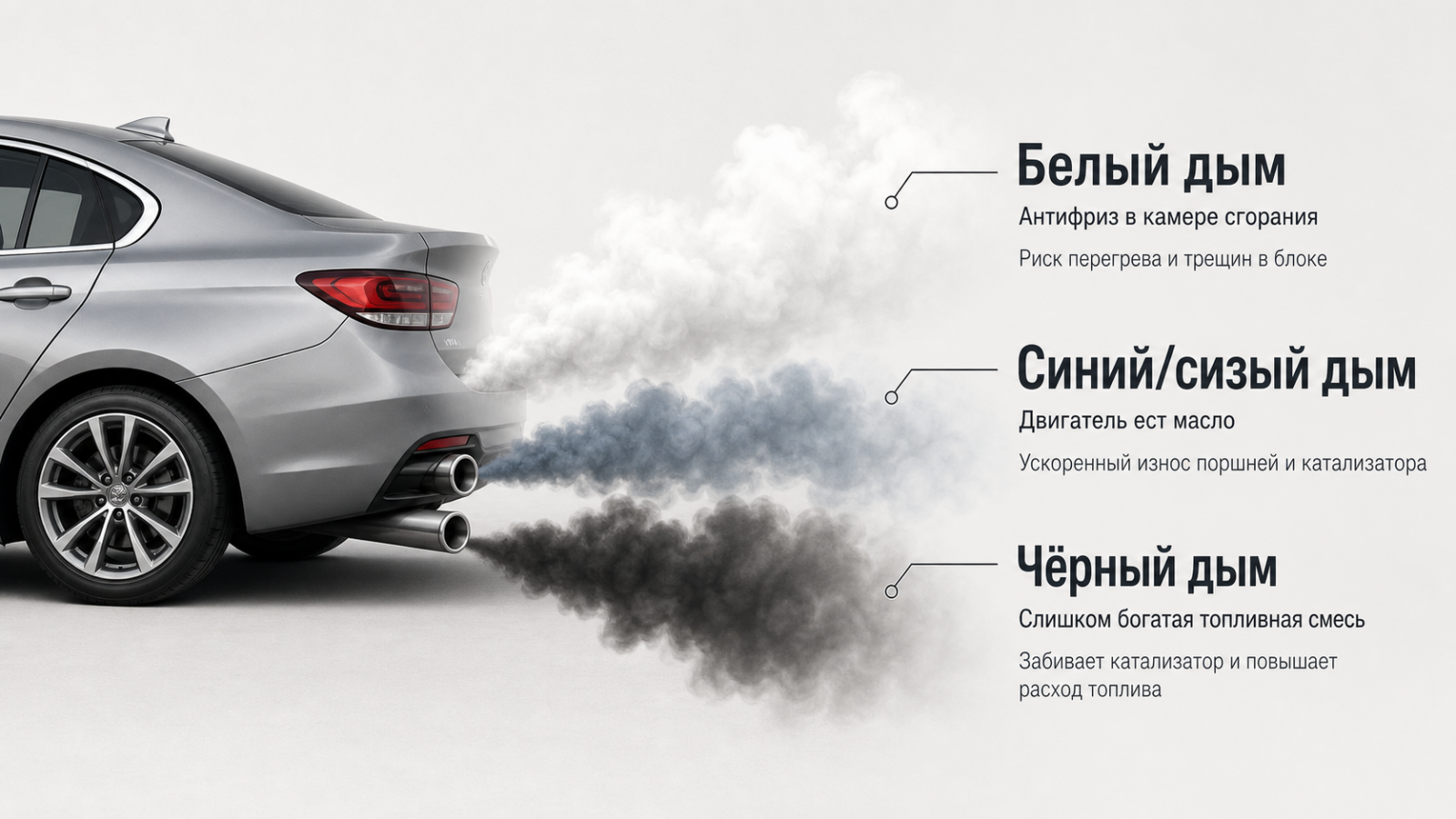
White exhaust: normal or abnormal?
White or milky smoke from the muffler can be either harmless or a sign of serious repairs.
When everything is fine:
When the engine is cold, light steam comes out.
The cloud quickly dissipates after warming up.
Antifreeze is in place, there is no burning smell.
When it's time to go to the service station:
The smoke is thick, grey or white, even when the engine is hot.
The exhaust smells like sweetish chemicals.
The coolant level is constantly dropping.
What broke:
The cylinder head gasket is broken.
A crack appeared in the cylinder head.
The cylinder block itself is damaged, and antifreeze is leaking into the combustion chambers.
Blue/gray smoke: the engine is "eating" oil
The appearance of blue, gray, or gray smoke almost always indicates one problem: engine oil entering the combustion chambers. Burning with the fuel-air mixture, the lubricant dramatically increases the vehicle's smoke output. The exhaust turns grayish-blue, and a distinctive, easily recognizable burning smell appears.
What is this accompanied by:
- Increased oil consumption (frequent top-ups).
- Oil deposits on spark plugs.
- Oily deposits on the inner surface of the exhaust pipe.
The main sources of the problem:
- Worn piston rings that have lost their seal.
- Cylinder mirror with pronounced wear.
- Old, hardened valve stem seals.
- Damaged turbine or its seals.
- Incorrect filtration and removal of gases from the crankcase due to a failure of the PCV valve.
Black smoke: too rich fuel mixture
Dark exhaust indicates that too much fuel is entering the engine and isn't being burned properly. This results in a lot of soot, and the tailpipe smells of unburned fuel.
Associated symptoms:
- Gasoline or diesel fuel consumption has increased sharply.
- A soot deposit appeared on the bumper near the muffler.
- There is a distinct smell of damp fuel around the car.
Why this happens:
- The injectors are overfilled (they have lost their seal).
- The oxygen sensor (lambda probe) is lying.
- The mass air flow sensor (MAF) is faulty.
- The air filter is completely clogged.
- The pressure in the fuel system is broken.
- There was a glitch in the engine control unit (ECU).
Additional signs of malfunction
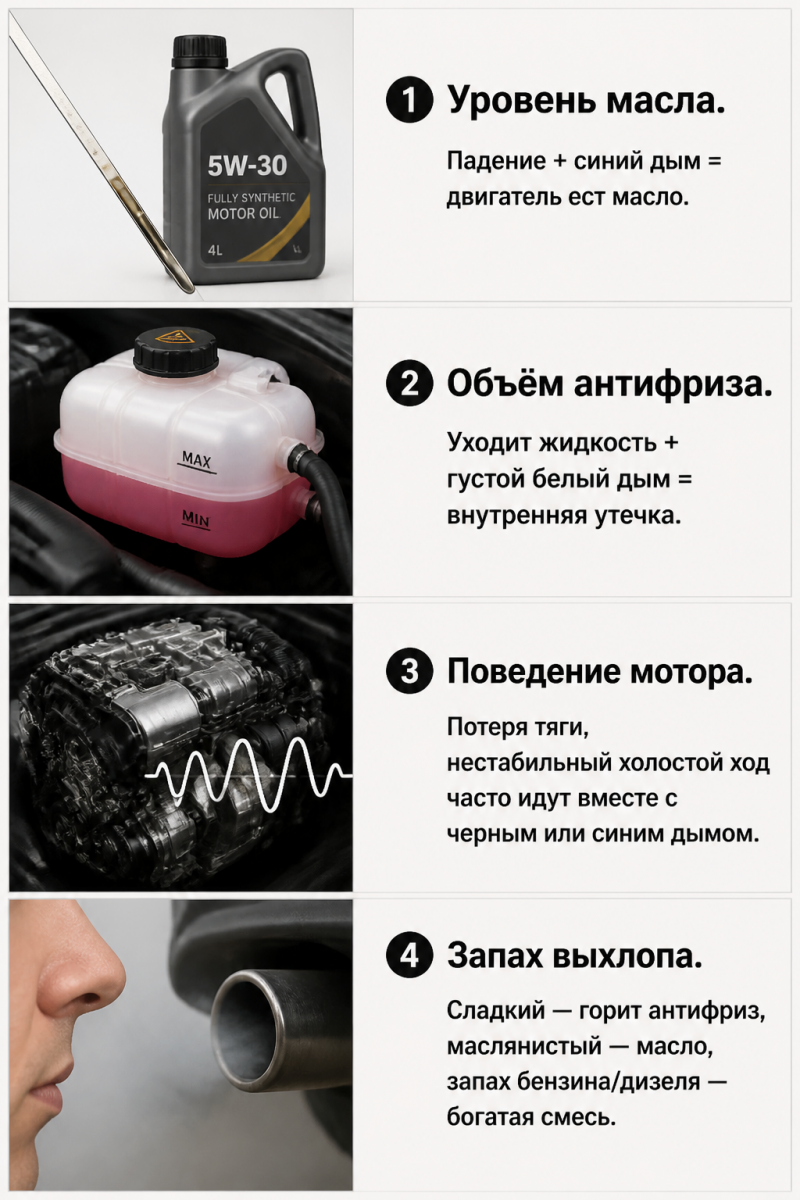
What to look for besides the color of smoke
To analyze the situation, it is important to go beyond just a visual assessment of the exhaust.
Please note:
- Oil level: its drop in the presence of blue exhaust is an alarm signal.
- Antifreeze volume: a decrease with thick white exhaust without external leaks indicates an internal leak.
- Engine behavior: Rough idle, hesitation during acceleration, and loss of power often go hand in hand with black and blue smoke.
- Exhaust odor: sweet—a sign of burning antifreeze; oily—burning oil. Smells like gasoline or diesel—an over-rich mixture.
Typical situations from practice
Car owners often face similar scenarios.
- White steam in the morning: appears immediately after starting and disappears within 3-5 minutes. This is normal condensation; there's no need to worry.
- Blue exhaust smoke when accelerating: smoke billows out when you accelerate sharply, and the engine oil level drops. Most often, worn piston rings or hardened valve stem seals are the culprit.
- Black cloud during acceleration: The exhaust pipe smokes with every hard press of the pedal, and the car has started consuming 15-25% more fuel. Look for the problem in the overflowing injectors or the air and fuel sensors.
The dangers of ignoring smoke
Risk of serious engine damage
Regular operation of a car with abnormal emissions almost always ends in expensive repairs.
What happens when you ignore the problem:
- If the antifreeze burns, the engine will begin to overheat, which will lead to warping of the cylinder head or the appearance of cracks in the cylinder block itself.
- If oil burns, pistons and cylinders will wear out much faster, and the catalytic converter and lambda probes will quickly become clogged with carbon deposits.
- If the mixture is too rich, the excess fuel will destroy the catalytic converter, coat the exhaust system with a thick layer of soot, and quickly kill the spark plugs.
Financial risks for the owner
Driving for a long time with a smoking engine almost always costs significantly more than timely diagnostic procedures and repairs.
Estimated amounts:
- Restoring an engine after operation with a blown cylinder head gasket can cost around 40,000–80,000 UAH or more, depending on the model and the scope of work.
- Replacing piston rings, gaskets, and valve stem seals, including labor, often costs between UAH 25,000 and UAH 50,000 or more, especially on modern turbocharged engines.
- If the catalytic converter fails due to constant black smoke, its replacement on many foreign cars will cost approximately 15,000–30,000 UAH or more.
What you can check yourself
Basic under-hood inspection
The car owner can perform some diagnostic steps without visiting a service center.
Simple rules of prevention:
Keep an eye on your fluids. Regularly check the oil level on the dipstick and the antifreeze level in the reservoir, especially if you notice any unusual exhaust emissions.
Look for leaks. Look under the hood and underneath the car. Fresh puddles and streaks of grease or coolant are a sign to take action.
Assess the oil quality. Remove the dipstick and look under the oil filler cap. A light emulsion, similar to mayonnaise, indicates antifreeze has entered the oil.
Visual inspection of the exhaust system
A few more simple steps will help you prepare for your visit to the service station.
Recommended:
Assess the color and density of smoke on a fully warmed-up engine; if necessary, take a photo or video for subsequent demonstration to the technician.
Inspect the inside of the exhaust pipe: a thick layer of soot indicates a rich mixture, and an oily coating indicates burning oil.
If you have an OBD-II scanner, read the engine errors (oxygen sensor, MAF, misfires) to facilitate diagnostics.
When service is essential: cases requiring urgent diagnostics
There are situations in which delaying a visit to the service station can be dangerous for the engine.
Contact a specialist immediately if:
If a thick white cloud is pouring out of the exhaust pipe even when the engine is hot, and the coolant reservoir is empty, this most likely means a blown head gasket or a cracked block.
When bluish smoke constantly comes out of the muffler and the oil level on the dipstick drops visibly, you need to add a liter every 1,000–1,500 km. This is a clear sign of critical wear of the piston components—the pistons, valve seals, and turbocharger need to be inspected.
If there is black smoke, increased fuel consumption and the smell of unburned gasoline, it is necessary to diagnose the injectors, fuel supply system, sensors and the condition of the catalytic converter.
A car owner's checklist when smoke appears
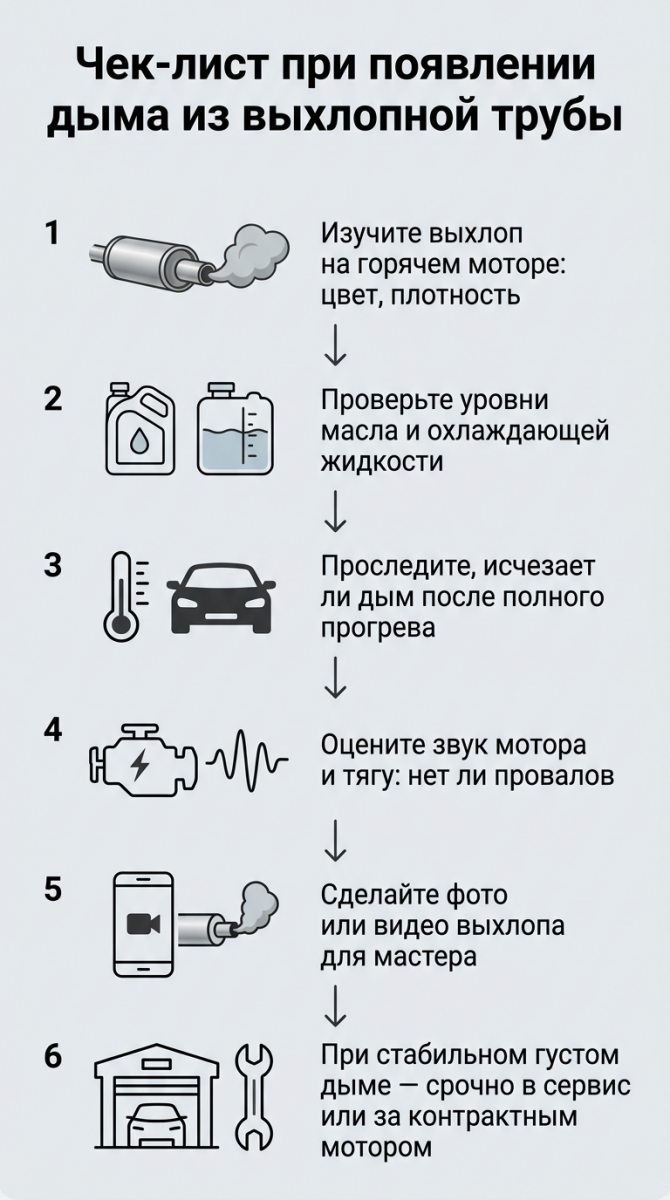
Below is a short step-by-step algorithm that will help you not get confused when smoke appears from the exhaust pipe.
Final recommendations
Thick white, black or blue smoke from the exhaust pipe is not a normal “feature” of the car, but a signal of problems with the engine, fuel system or cooling system.
Ignoring such signs is dangerous: the sooner the owner notices changes in the color, smell, and density of the exhaust, the higher the chance of getting by with replacing individual components ( sensors , gaskets, turbochargers , cylinder heads), without resorting to a major overhaul costing tens of thousands of hryvnias.
To reduce costs, it makes sense to consider options for genuine used parts in advance at reputable auto dismantlers, where parts are selected based on the VIN and vehicle history.
It's best to buy new consumables (oils, filters, gaskets, brake pads): this helps preserve the life of used components and the overall reliability of the vehicle.
FAQ
What is the cause of white emission during cold start of internal combustion engine?
If it's cool outside and the steam is thin and quickly disappears as the car warms up, everything is fine. This is normal evaporation of moisture that has accumulated in the muffler overnight.
What is the danger of blue exhaust?
A bluish tint indicates the engine is "consuming" oil. This causes pistons and cylinders to wear faster, clogs the catalytic converter, and puts the owner at risk of expensive overhauls.
Is it permissible to drive if the exhaust has turned black?
You definitely shouldn't delay repairs. Excess unburned fuel immediately hits your wallet due to exorbitant fuel consumption, quickly kills spark plugs, and literally burns out the catalytic converter.
How can you tell if the pipe is leaking harmless steam or if the antifreeze is burning?
Take a closer look at the exhaust after warming up. If the smoke remains thick, there's a sweet chemical smell, and the coolant level in the expansion tank is decreasing, antifreeze is definitely leaking into the cylinders.