A knocking sound in the suspension is one of the most common warning signs that car owners encounter, especially on uneven roads and when driving over speed bumps.
Such sounds usually indicate that one or more suspension components are worn, weakened, or damaged and no longer provide proper operation. Knocking noises should not be ignored: they affect handling, the life of tires and other components, and in extreme cases, can lead to loss of control of the vehicle.
Below, we'll examine the main causes of knocking, typical symptoms, and possible consequences, as well as provide a simple algorithm for determining what you can check yourself and when it's safest to immediately take your car to a service center.
The main causes of knocking in the suspension
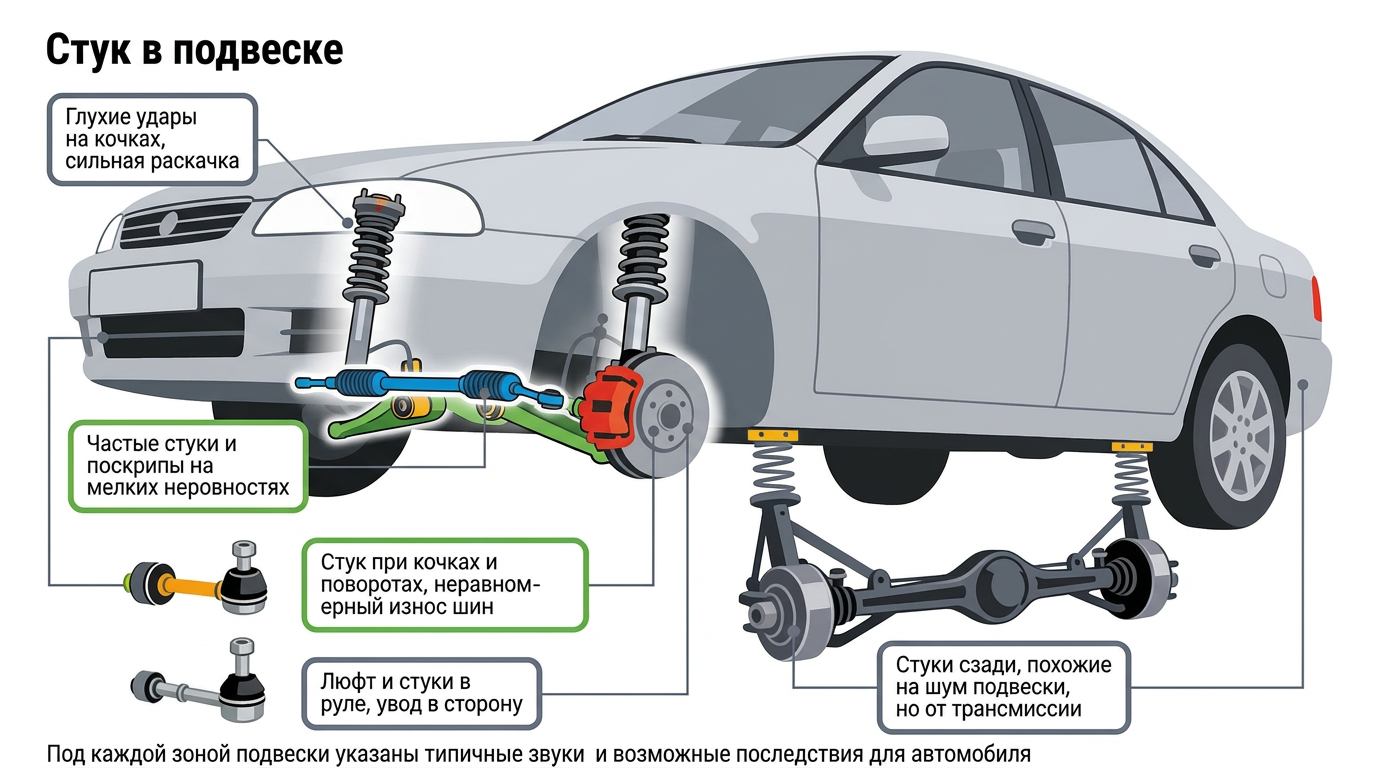
Worn struts and shock absorbers
When the struts/shock absorbers wear out, the car begins to bob excessively on bumps, and dull thuds are heard inside when the suspension is compressed and straightened.
The cause is weakening of internal hydraulic elements or destruction of rubber bushings and supports, which causes metal parts to hit each other.
Broken silent blocks and rubber bushings
Over time, control arm bushings, stabilizer bushings, and other rubber components crack, harden, and lose elasticity, which leads to knocking and creaking sounds when the suspension is operating.
When severely worn, the metal of the levers and body begins to shift and impact, especially on small bumps and when the car rocks.
Play in the ball joints
Ball joints connect the control arms to the steering knuckles and ensure flexibility during cornering and suspension travel; wear on them is indicated by a knocking sound when driving over bumps and maneuvering, as well as uneven tire wear.
Free play (backlash) in a ball joint is a critical defect: if it progresses, the support may be destroyed and the wheel may lose its movement.
Worn stabilizer bar struts and bushings
When there is play in the stabilizer struts or bushings, frequent, repetitive knocking and “clacking” sounds appear on small bumps and when driving over speed bumps.
Accompanying symptoms: increased roll when turning and a feeling of the car “rolling”.
Loose or damaged suspension mounts
Loosely tightened bolts on control arms, struts, subframes or supports can cause a dull knocking noise, especially when changing direction (starting/braking) and under lateral loads.
Similar noise can be caused by damaged or worn strut mounts (upper bearings/cushions).
Problems with steering rods and ends
Wear of the steering rods and ends can cause knocking sounds when driving over bumps and turning the steering wheel, as well as a feeling of a “loose” steering wheel.
Often such faults are accompanied by the vehicle pulling to the side and uneven tread wear.
Rear suspension and transmission components
In the rear, characteristic knocking sounds may be associated with wear of bushings and levers, beam mounts, silent blocks, as well as suspension bearings and drive elements.
Sometimes drivers mistakenly perceive knocking sounds from the rear axle, driveshaft, or differential as “suspension noise.”
Table: Typical causes, symptoms and first steps
Cause | Character of knocking/symptoms | What can a driver do? |
Worn struts/shock absorbers | Dull thuds on bumps, strong rocking, multiple “rocking” after potholes | Perform a rocking test and inspect for oil leaks. |
Silent blocks, stabilizer bushings | Frequent knocking and creaking noises on small bumps, vibrations in the steering wheel | Visually inspect the rubber for cracks and tears |
Ball joints | Knocking noises when driving over bumps and turning corners, vehicle pull, uneven tire wear | Check the wheel play when hanging (only with reliable insurance) |
Steering rods and ends | Knocking and clicking sounds when turning the steering wheel, play in the steering wheel, pulling to the side | Assess the steering wheel play and visually inspect the dust boots. |
Loose fasteners, pillar supports | Single or periodic dull knocks when starting/braking, on road bends | Check for any obviously loose parts or broken fasteners (no tightening required) |
Signs and symptoms of a faulty suspension
Accompanying symptoms help to understand that the knocking is coming from the suspension.
Main signals:
A knocking/clunking sound when driving over potholes, speed bumps and road joints, especially at the same speed or with the same vehicle load.
Frequent "crushing" or rattling in the front/rear on small bumps.
Increased knocking noise when turning the steering wheel or when driving over diagonal uneven surfaces (when only one side “works”).
Changes in vehicle behavior: increased roll, swaying, bucking, instability at speed, pulling to the side.
Uneven tire wear, increased vibration in the steering wheel or body.
When problems with the mechanical suspension occur, errors usually do not appear on the dashboard, but the stabilization system or ABS indicators may light up if the sensors are not working properly due to significant play or impacts.
The dangers of ignoring suspension knocking
Loss of control and increased braking distance. Worn suspension components reduce wheel contact with the road, impairing vehicle directional stability and causing unpredictable drift in emergency situations.
Risk of accidental failure. Severely damaged ball joints, tie rods, or mounts can fail while driving, which can result in the loss of a wheel or a sudden change in direction.
Accelerated wear of tires and other components. Incorrect geometry due to play leads to uneven and accelerated tire wear, as well as increased loads on the steering and body.
Increased repair costs. A small amount of play in the stabilizer link, if not addressed promptly, can lead to damage to the bushings and control arms, deformation of the fasteners, and, as a result, expensive, complex repairs.
If the suspension is already making noise, the chances that the problem will "go away on its own" are extremely low: as a rule, wear will only increase.
What can you check yourself?
Anything involving lifting a vehicle and working underneath it requires strict adherence to safety precautions; if you're inexperienced, it's best to limit yourself to a visual inspection.
Basic checklist:
Tire inspection
Check for uneven wear, tread "steps", impact marks or bulges.
Visual inspection of the suspension
With the car turned off, inspect the accessible suspension components: levers, silent blocks, stabilizer bushings, struts/shock absorbers.
Pay attention to cracks and tears in the rubber, oil leaks on the struts, traces of impacts or rust around the fasteners.
Swing test
On a level surface, press on each corner of the car body in turn and release sharply: if the car makes more than one or two rocking sounds or you hear knocking/creaking sounds, the struts or supports may be worn out.
Checking for obvious play
With the engine completely off, the handbrake on, and the gear engaged (for manual transmissions), gently try to rock the wheel by hand; significant play may indicate problems with the suspension or steering components.
If inspection reveals that struts, shock absorbers, control arms, or silent blocks require replacement, it makes sense to select new suspension parts and steering components in advance , and also, if there is characteristic uneven wear or damage to the rubber, to immediately select new tires .
What is not recommended to do without experience:
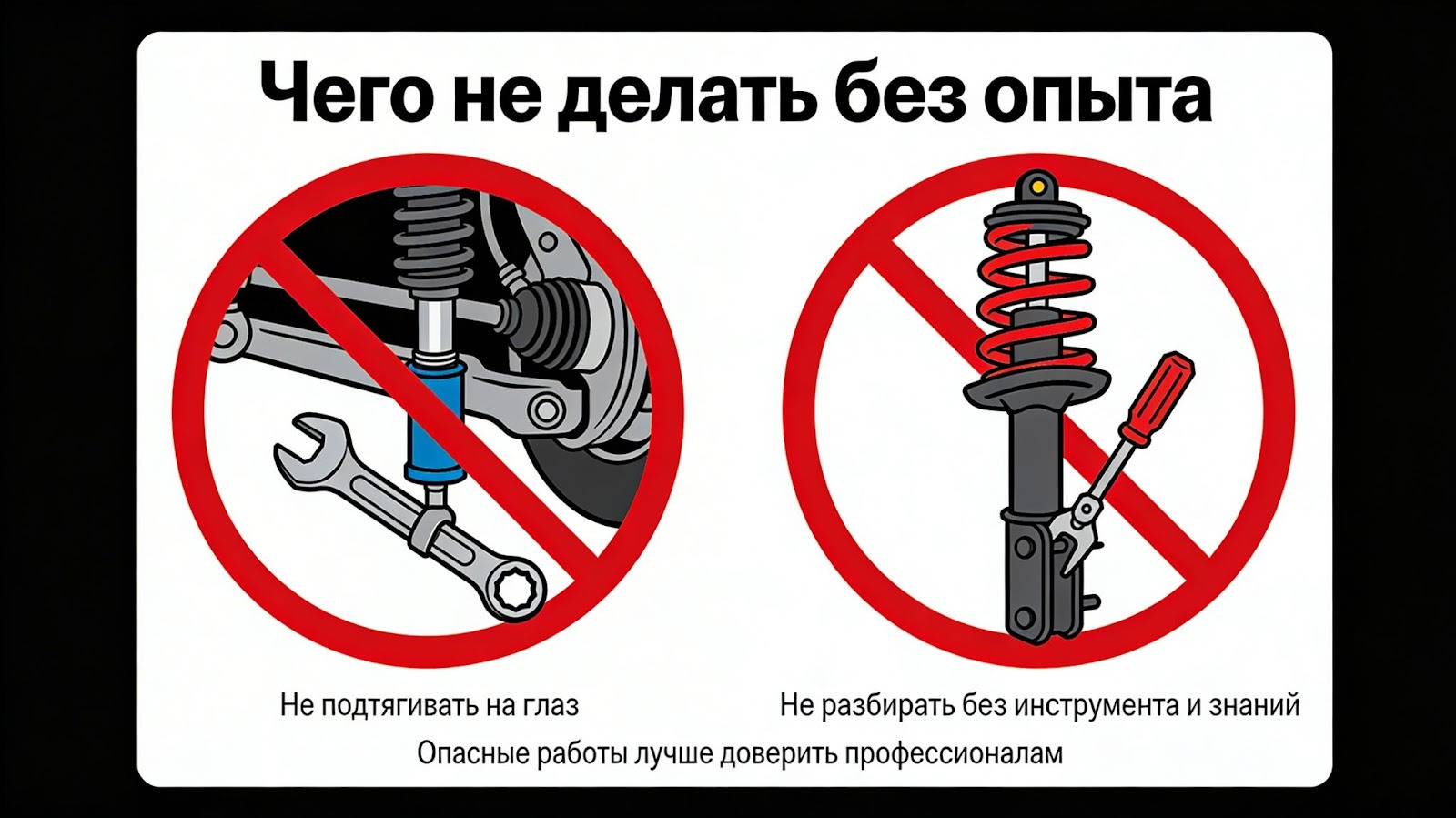
Tighten suspension bolts and nuts "by eye" - incorrect tightening torque can lead to damage to parts or jamming.
Trying to disassemble the struts, levers and ball joints on your own without the appropriate tools and knowledge.
When is it necessary to contact service?
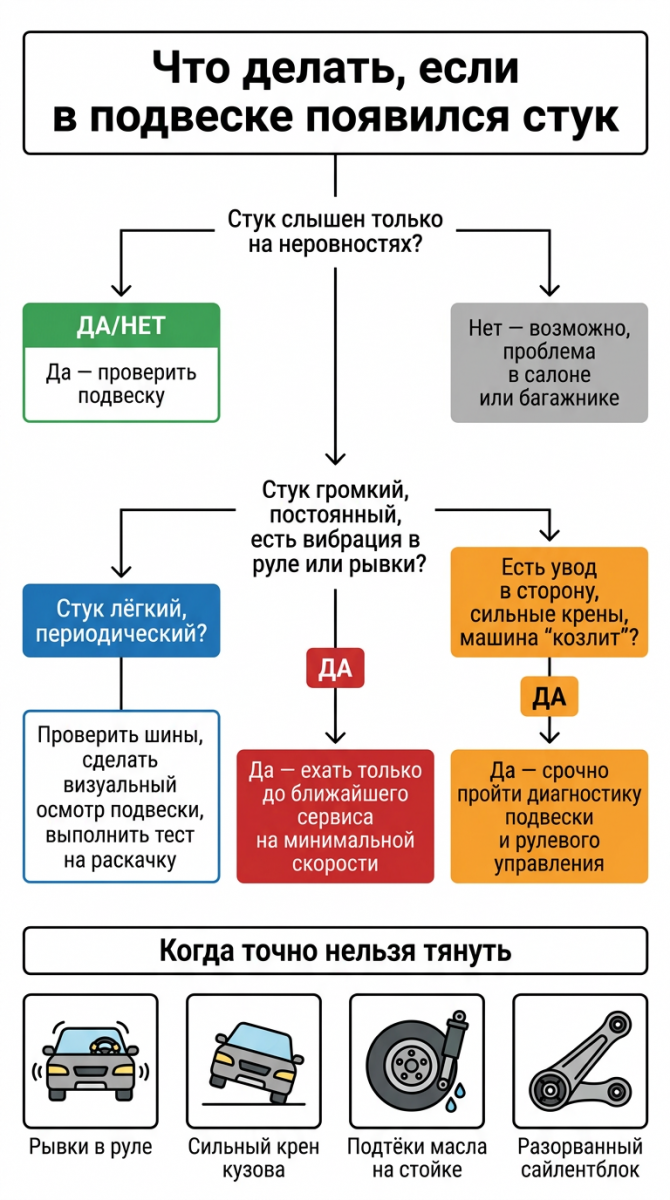
You should stop driving immediately (or at least drive only to the nearest service station at minimum speed) in the following cases:
The knocking has become loud, constant and is accompanied by noticeable vibration or jerking in the steering wheel.
The car pulls to the side, weaves in the lane, or requires constant steering corrections.
There was a strong roll, a feeling that the car was “floating” or “bucking” on any uneven surface.
There is obvious damage: torn silent blocks, torn or heavily rusted fasteners, oil leaks on the struts.
The knocking sound appeared unexpectedly after a strong impact (falling into a deep hole, running into an obstacle).
Professional diagnostics are also useful in less critical situations, if the knocking noise cannot be localized independently or it persists after a visual inspection.
FAQ
Is it possible to drive if the suspension starts to make a slight knock when driving over bumps?
Driving a short distance to a service center is usually acceptable, but don't delay diagnostics: even a slight knock indicates wear and tear, which will worsen over time.
The knocking sound is only heard on small bumps - is this necessarily a serious breakdown?
Often, this sound is caused by stabilizer bushings or small play in the struts, but without inspection, wear of more important components, such as ball joints or steering rods, cannot be ruled out.
If the knocking noise disappears on a smooth road, can the repair be postponed?
No: the suspension works precisely on uneven surfaces, and the disappearance of the sound on a level surface does not mean the problem is gone; it is better to conduct diagnostics at the first sign of a problem.
Could the knocking noise in the suspension be coming from the trunk or the interior?
Yes, sometimes the source of the noise is loose objects in the trunk, a jack, a spare tire, or trim elements, so it’s worth first eliminating “extraneous” noises.
Is it necessary to do a wheel alignment after suspension repair?
After replacing control arms, struts, and a number of other parts, it is recommended to check and, if necessary, adjust the wheel alignment angles to ensure proper tire wear and vehicle stability.
Conclusion and recommendations
A knocking sound in the suspension isn't a "vehicle peculiarity," but a signal that one or more components are no longer operating normally and require inspection. The sooner you diagnose and fix the cause, the safer you'll be driving and the less likely you'll need costly repairs down the road.
Practical tips for prevention:
Avoid sudden shocks to the suspension: reduce speed before potholes and speed bumps.
Regularly inspect tires and suspension during seasonal tire changes or maintenance.
Monitor extraneous noises, do not ignore new sounds, and if necessary, seek diagnostics immediately.