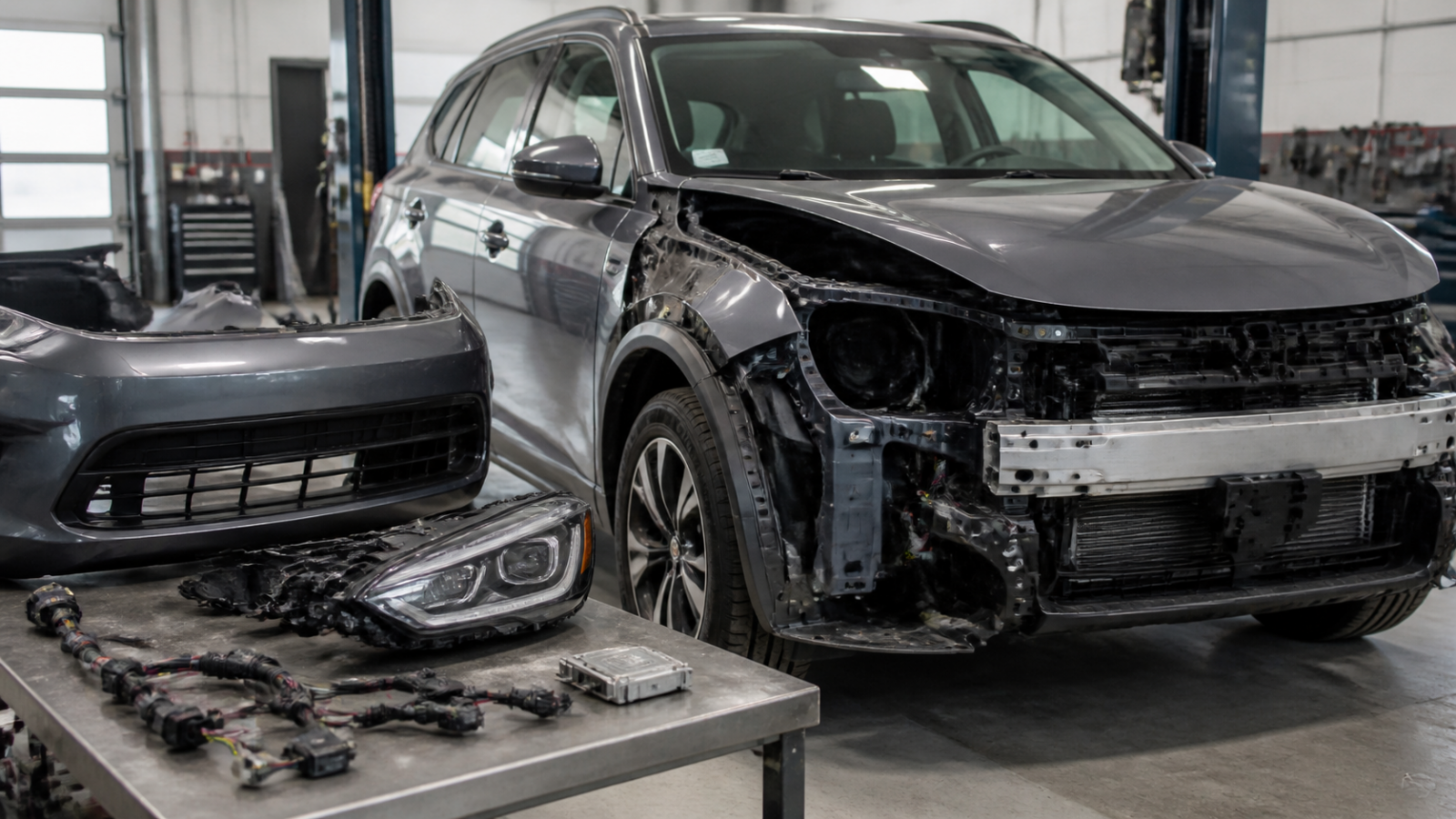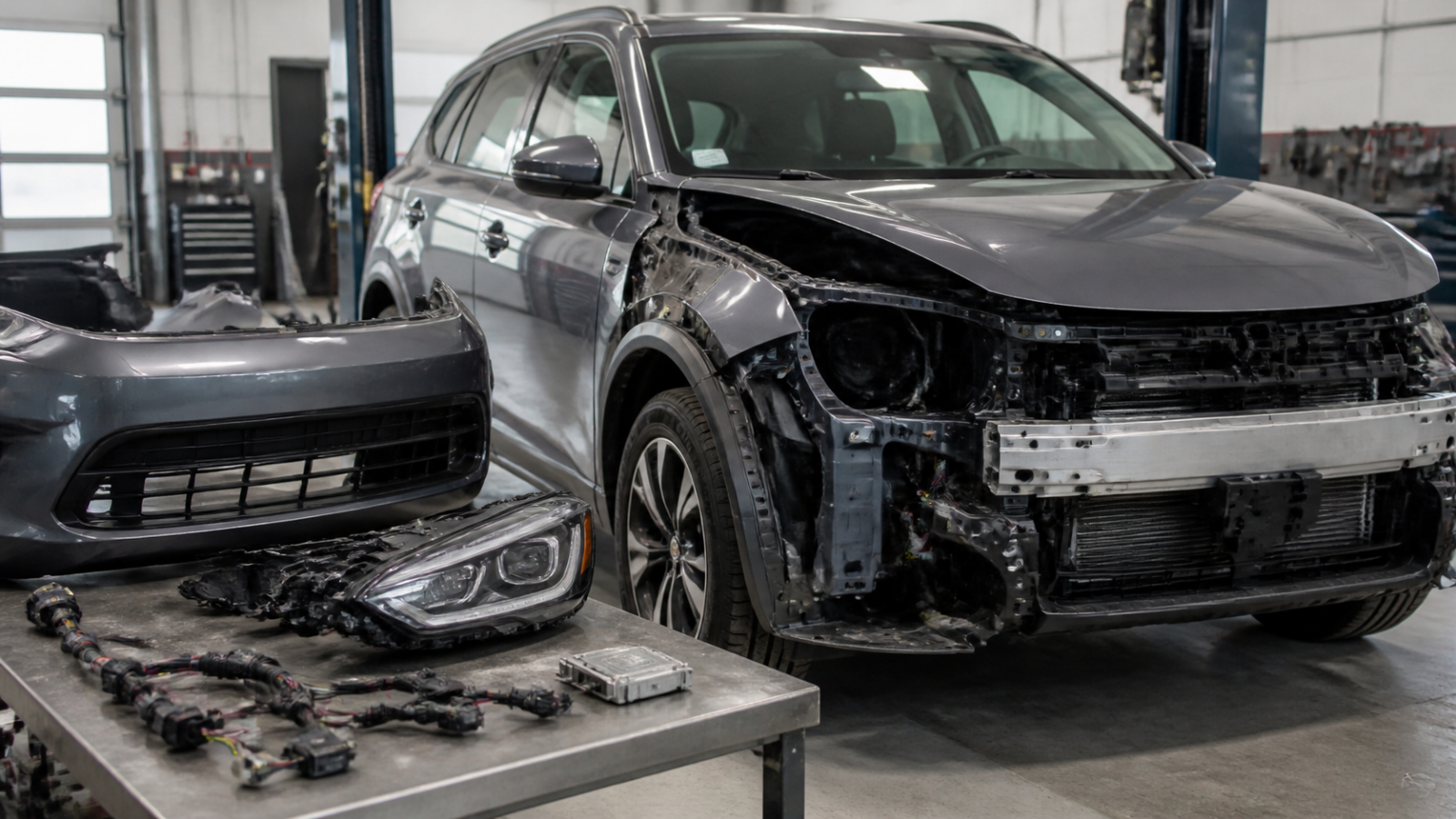
A minor impact to a door or front corner of an electric vehicle often results in more than just a dent and a cracked headlight. Along with the metal, the radars, cameras, inverter, charging module, and a ton of wiring are damaged, and the repair bill unexpectedly runs into hundreds of thousands of hryvnias.
In this article, we'll explore which electric vehicle parts are logical to look for at a salvage yard after an accident, how to choose a used part, where hidden risks lurk, and why a "bargain" battery can turn into the most expensive repair of your life.
Why the topic has become relevant
The electric vehicle fleet in Europe and neighboring countries is growing at a record pace: BEV sales jumped by approximately a third in key markets by 2026, and their share of registrations is already approaching a fifth. This means the obvious: the number of accidents involving electric vehicles is also rising.
The design of modern EVs is more complex than that of traditional cars: a high-voltage battery, inverter, power electronics, charging modules, a host of sensors and cameras, and radars and LiDARs embedded in body elements like bumpers and doors. Even a minor accident often damages expensive electronics, not just metal and plastic.
New, genuine parts for electric vehicles are expensive and not always available. Official deliveries of some modules stretch out over weeks, prices are tied to the euro and dollar, and owners are increasingly turning to used car dismantlers and used original parts to avoid overpaying and waiting months.
What can you take from an electric car dismantling site?
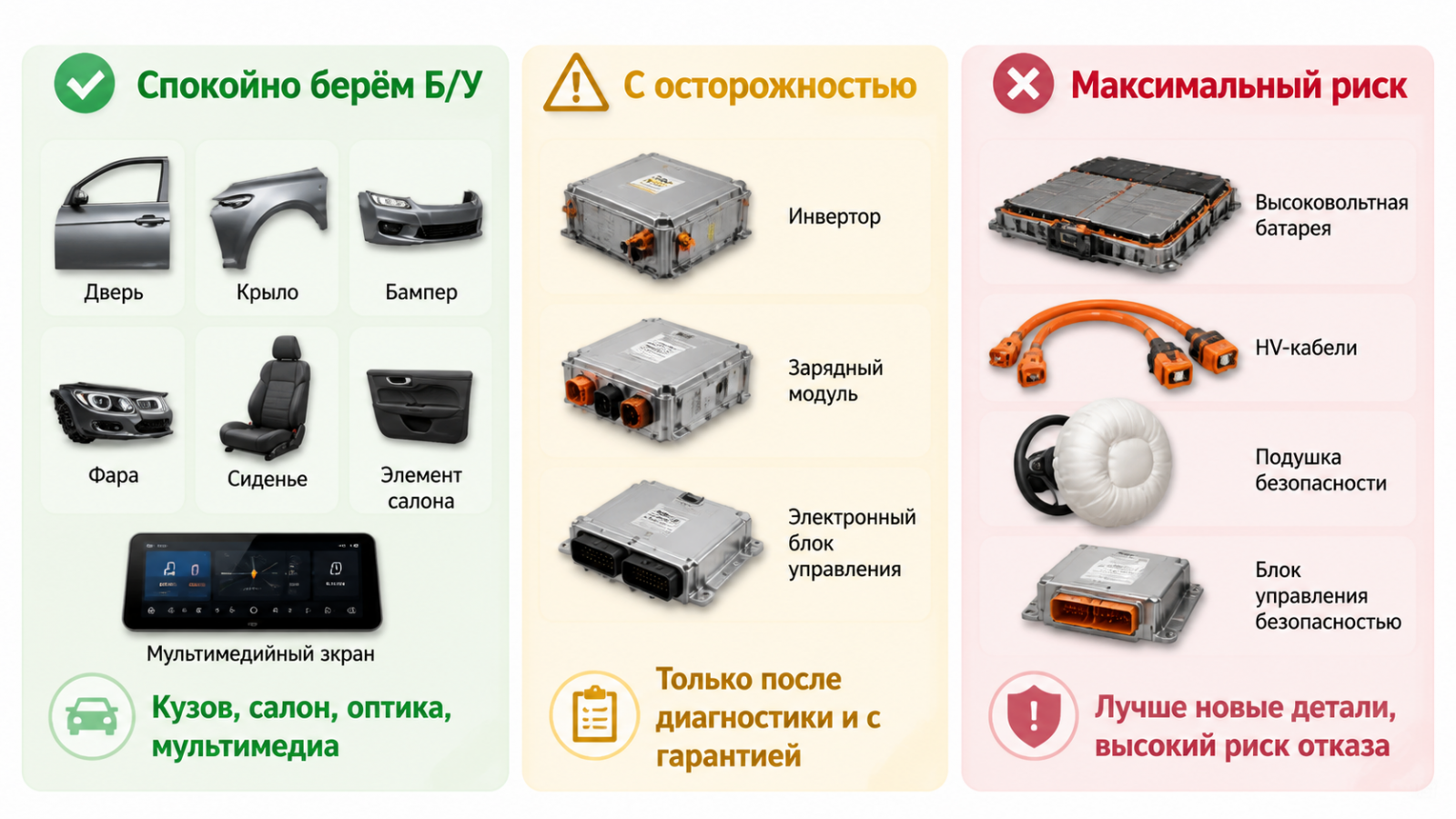
Body parts: doors, fenders, hoods, bumpers
Body parts are one of the safest options for used originals, provided the part is free of significant geometry and corrosion. Doors, fenders, trunk lids, and hoods often remain intact after an accident, especially if the impact occurred on another part of the body.
What to look for:
geometry (gaps, traces of drawing, multiple layers of putty);
corrosion along edges and seams;
condition of fastenings and hinges;
presence of factory sealant.
A bumper from a salvage yard can also be used, but with caution regarding sensors and radars. If the bumper was equipped with parking sensors or an ADAS radar, it's important to check that the mounting points are intact and there are no cracks near the mounting points.
Optics: headlights and taillights
A new headlight for a popular electric crossover can cost between 25,000 and 60,000 UAH, while a used original from a salvage yard costs 8,000–25,000 UAH, depending on the model and configuration.
Optics from a salvage yard will work if:
all fasteners are intact;
the body is free of cracks and traces of homemade soldering;
no severe glass clouding;
no fogging inside.
Interior elements: seats, door panels, dashboard without AIRBAG
Interior components rarely impact driving safety and often survive accidents well. Door panels, trim, parts of the dashboard, center console, multimedia components, and climate control units—all of these can be safely found as used originals.
The exception is elements related to airbags (airbags, squib cartridges, steering wheel with airbag, belt tensioners).
Multimedia and comfort units
Head units, displays, multimedia units, climate control units, window or seat control units usually survive even a fairly severe accident well, if the impact does not fall in their area.
Used multimedia is profitable when:
your screen is broken or your head unit is out of order;
an original new block costs from 20,000 to 40,000 UAH and up;
There are virtually no analogues (especially for new EVs).
It is important to check the unit number and firmware, and also to check with an electrician in advance whether it can be linked to the car.
Inverters, charging modules and auxiliary power electronics
Some power electronics can theoretically be purchased used, but only if several conditions are met: the vehicle's history is clear, there has been no impact to the battery area or high-voltage cables, and the casing is apparently intact without any punctures or signs of overheating.
These include:
separate charging modules (on-board charger, DC-DC converters);
power plant control units;
some inverters.
But such units should come complete with the ability to test, OBD diagnostics and, if possible, a short warranty on the test.
For many owners, it's easier to buy a used, original inverter from a salvage yard and budget 5,000–10,000 UAH for diagnostics than to pay 70,000–120,000 UAH for a new module—but the decision should be made in consultation with a qualified electrician.
What you need to be especially careful with
High-voltage traction circuit battery
The main "scary" component of any electric vehicle is the traction battery. After an accident, it may appear intact on the outside, but still contain microcracks, damaged modules, or hidden moisture. Any intervention without experience and protective equipment carries the risk of fire, short circuit, and serious injury.
Buying a whole used battery without: a detailed diagnostic of the modules and cells, a capacity report, a leak test of the case, and an inspection on a lift is extremely dangerous.
It's often wiser to look for individual modules rather than "the entire battery assembly" from specialists who professionally restore batteries with a warranty and document their tests.
High-voltage cables, connections, relays
Orange HV cables, connectors, contactors, and circuit breakers—everything that operates under high voltage requires strict adherence to installation procedures. Any crack, trace of overheating, or improvised repairs can cause failure or fire.
It only makes sense to buy such a part from a salvage yard, where the component is removed from a relatively "minor" accident, visually inspected, photographed closely, and then checked by an electrician. If there's even the slightest doubt, it's better to pay extra for a new, original part.
Airbags and seat belts
Airbags and seat belts with explosive cartridges cannot be repaired after they've been deployed. Buying "refurbished" airbags is gambling with safety. For most owners, it's wiser to install new or officially refurbished components than to skimp on safety.
Control units
Electronic control units for the engine, battery, safety system, and driver assistance systems are very sensitive to impacts, moisture, and improper connections. Purchasing a car "from a photo" without checking for compatibility or return policy is one of the most common mistakes.
The minimum that should be required is:
OEM number and its complete match;
photo of connectors and housing;
the possibility of testing or returning if the unit does not “fit” or is not flashed.
What to look for when buying a used part
Checkpoint | What to do |
OEM part number | Check the number using the catalog number, VIN, or a special service. |
Compatibility by model and year | Specify the configuration, restyling/pre-restyling, battery type. |
Condition of the body and fastenings | Ask for large photos of all fastening points and seams. |
Signs of repair | We are looking for soldering, sealant, welding, putty, chips. |
Connectors and wiring | Check the “ears”, clamps, and absence of corrosion on the contacts. |
Equipment | Check if the control unit, sensors, covers, brackets are included. |
Photos from all sides | Minimum 6-8 photos, including back and markings. |
Markings and stickers | Take a photo of all stickers with numbers and dates. |
Guarantee for verification | Specify the test period (usually 7-14 days) and return conditions. |
New part, analog or used original
For electric vehicles, the golden mean is often used original parts: doors, fenders, headlights, interior components, and some comfort modules. New original parts are usually chosen for safety-critical components and complex high-voltage electronics.
A real example from a car dismantling yard
Let's imagine a typical situation: a Hyundai Kona Electric is brought to a car dealership after being struck in the front right corner. The car arrived from Europe with a damaged bumper, headlight, part of the power steering, and a deformed fender.
Injured:
front bumper with parking sensors;
right LED headlight;
wing;
part of the TV and amplifier mounts;
a piece of wiring in the front.
Remaining usable:
both front doors and rear doors;
rear bumper and lights;
interior, seats, multimedia, climate control unit;
traction battery and inverter (the impact occurred higher and did not hit the HV unit).
For the owner of a similar Kona Electric, repairs with new, original parts would easily cost 120,000–150,000 UAH. Using used, original parts from a salvage yard: a headlight costs 18,000–22,000 UAH instead of 45,000–55,000 UAH, a complete bumper costs 12,000–16,000 UAH instead of 35,000+ UAH, a fender costs 5,000–7,000 UAH—the total savings could reach 40–60% of the repair cost.
The conclusion from such cases is simple: even after a serious impact, a significant portion of the original electric vehicle parts remain valuable and safe to install if the damage area is properly assessed and diagnostics of the HV components are not skimped on.
Drivers' Mistakes When Buying Used Electric Vehicle Parts
Error | What is dangerous? | What is the correct way? |
Buying a battery based on a photo without testing it | Risk of hidden damage and loss of capacity | Buy only with a diagnostic report and warranty |
Ignore OEM part number | The part will not fit or will cause errors | Always check the catalog number |
Take the control unit without checking the return | You can get a “dead” block | Clarify the conditions of the test and return |
Don't ask for photos of fasteners and connectors | Cracked fasteners and broken clamps | Request large photos of all attachment points |
Save on diagnostics after installation | Risks of overheating, current leakage, HV system errors | Always budget for an electrician to check |
FAQ
Is it possible to buy used parts for an electric car?
Yes, if we are talking about body parts, optics, interior, multimedia parts and comfort units, subject to condition verification and matching OEM numbers.
What electric vehicle parts are dangerous to salvage?
Without diagnostics and a warranty, it is better not to touch the traction battery, high-voltage cables, contactors and complex power modules, as well as “suspicious” control units.
Why do identical used parts cost different amounts?
The price depends on the model, year, mileage, condition, configuration (for example, the presence of radars, LED modules), and the demand for a specific spare part in the region.
Do I need to check the OEM number when purchasing a used part?
It's essential. The OEM number is the part's "passport": without it, you could buy a part that won't physically fit or that will cause electronic errors.
Conclusions and recommendations
An electric car after an accident isn't a scrap metal wreck, but a source of fully functional, used, genuine parts. Doors, headlights, interior, multimedia system, and some electronics can continue to function reliably for many years, saving you tens of thousands of hryvnias compared to new parts.
But an electric vehicle is also a high-voltage vehicle, where a mistake in choosing a battery or power module can easily turn into a very expensive and dangerous experiment. Anything involving a high-voltage component should be purchased either new or with the most transparent diagnostics and the participation of a qualified electrician.
When choosing a used original part, it's important not only to find a good price but also to verify the OEM number, components, and condition. At a car dismantling yard, it's a good idea to immediately check whether the mounting hardware, connectors, and control units are included, whether photos from all sides are available, and whether there's a period for inspecting the part before final installation.