Main causes of malfunction
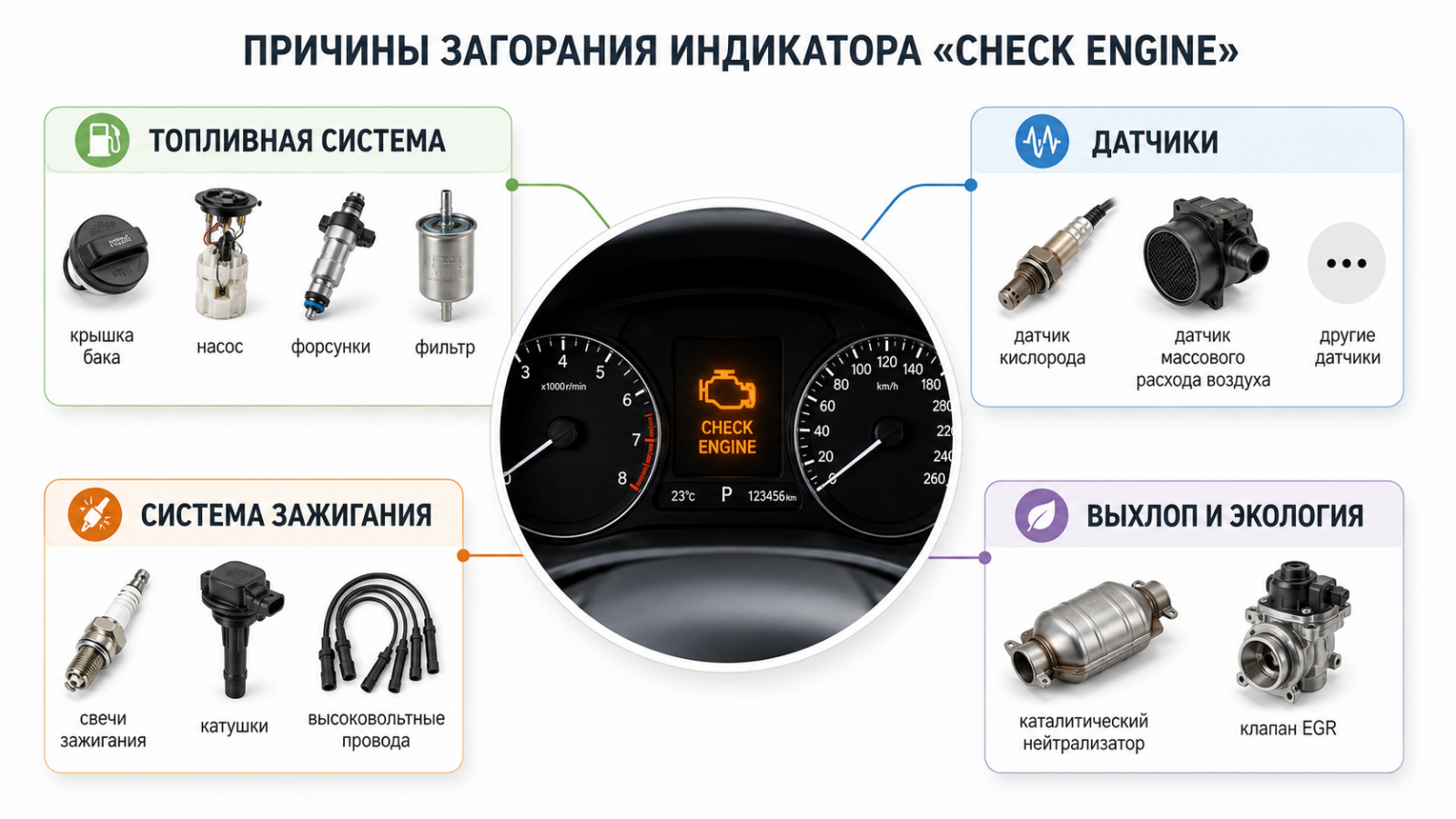
The Check Engine light (officially the Malfunction Indicator Light (MIL)) illuminates when the engine control unit detects a fault in the engine, transmission, or emissions systems. Most often, these are not due to a "faulty engine," but rather to malfunctions in the sensors and systems responsible for fuel mixture, ignition, and emissions.
Loose or faulty fuel tank cap
Even a slightly loose cap changes the pressure in the system, causing the ECU to detect a fuel vapor leak and turn on the Check Engine.
Faulty oxygen sensor (lambda probe)
The oxygen sensor monitors the exhaust gas composition, and the ECU uses it to adjust fuel delivery. If it fails, fuel consumption increases, performance deteriorates, and exhaust emissions become more toxic.
Misfires (spark plugs, coils, high-voltage wires)
Worn spark plugs or coils cause misfiring, vibration, loss of power and the indicator light coming on.
Faulty mass air flow (MAF) sensor
The MAF measures the amount of air entering the engine. When it fails, the mixture becomes too rich or too lean, causing dips and the Check Engine light to come on.
Exhaust Gas Recirculation (EGR) problems
A stuck EGR valve causes unstable engine operation and emissions errors.
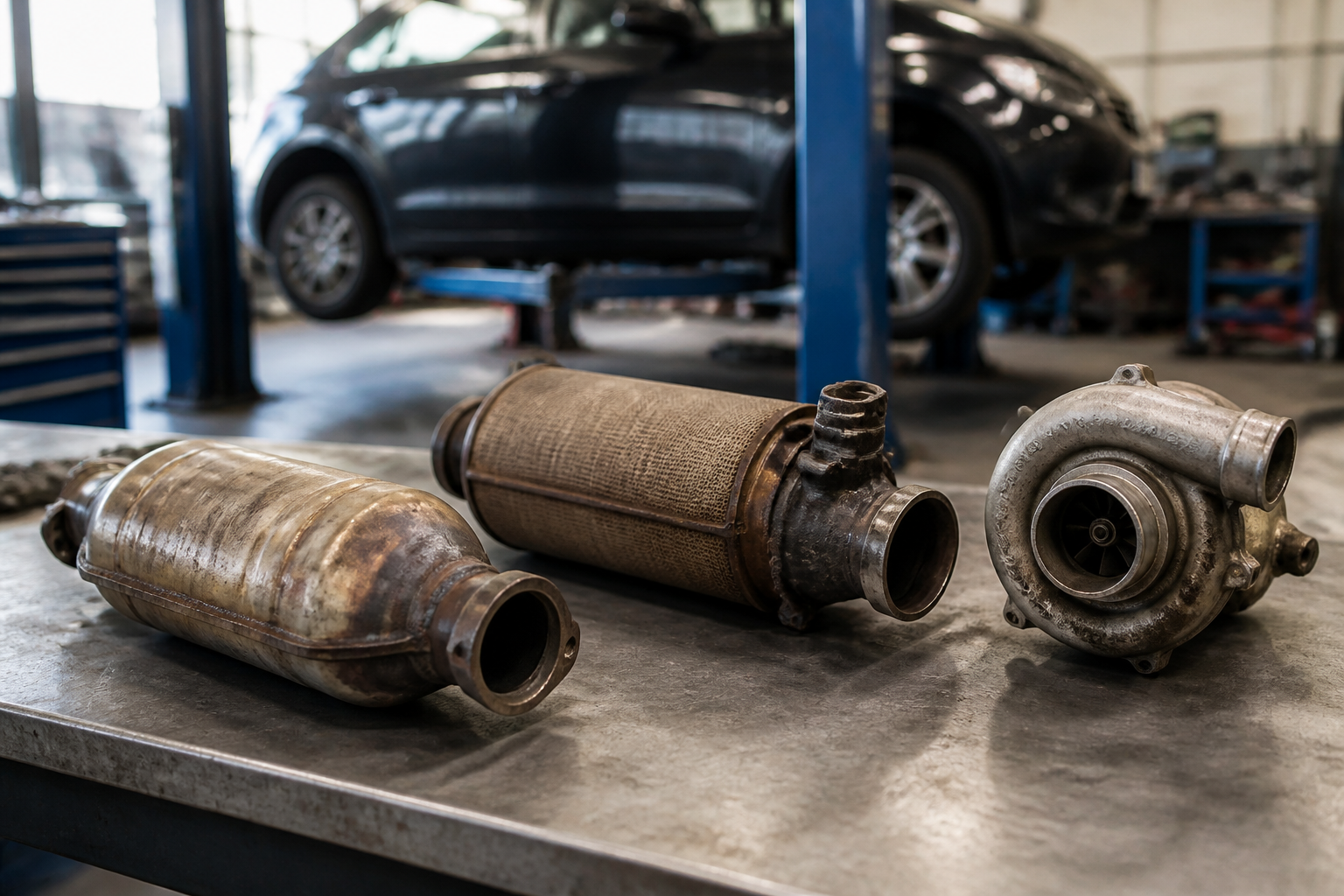
Catalytic converter malfunctions
When the catalytic converter overheats or is destroyed, the level of harmful substances increases, which is recorded by sensors and turns on the indicator.
Malfunctions in the fuel supply system (injectors, pump, filter)
Incorrect pressure or incorrect fuel atomization also lead to mixture errors and the Check Engine light.
An important point: the indicator itself only reports an error, and the specific cause is determined by the OBD-II code through diagnostics.
Signs and symptoms of malfunction
The driver's reaction depends not only on the indicator itself, but also on the vehicle's behavior.
How does the lamp behave?
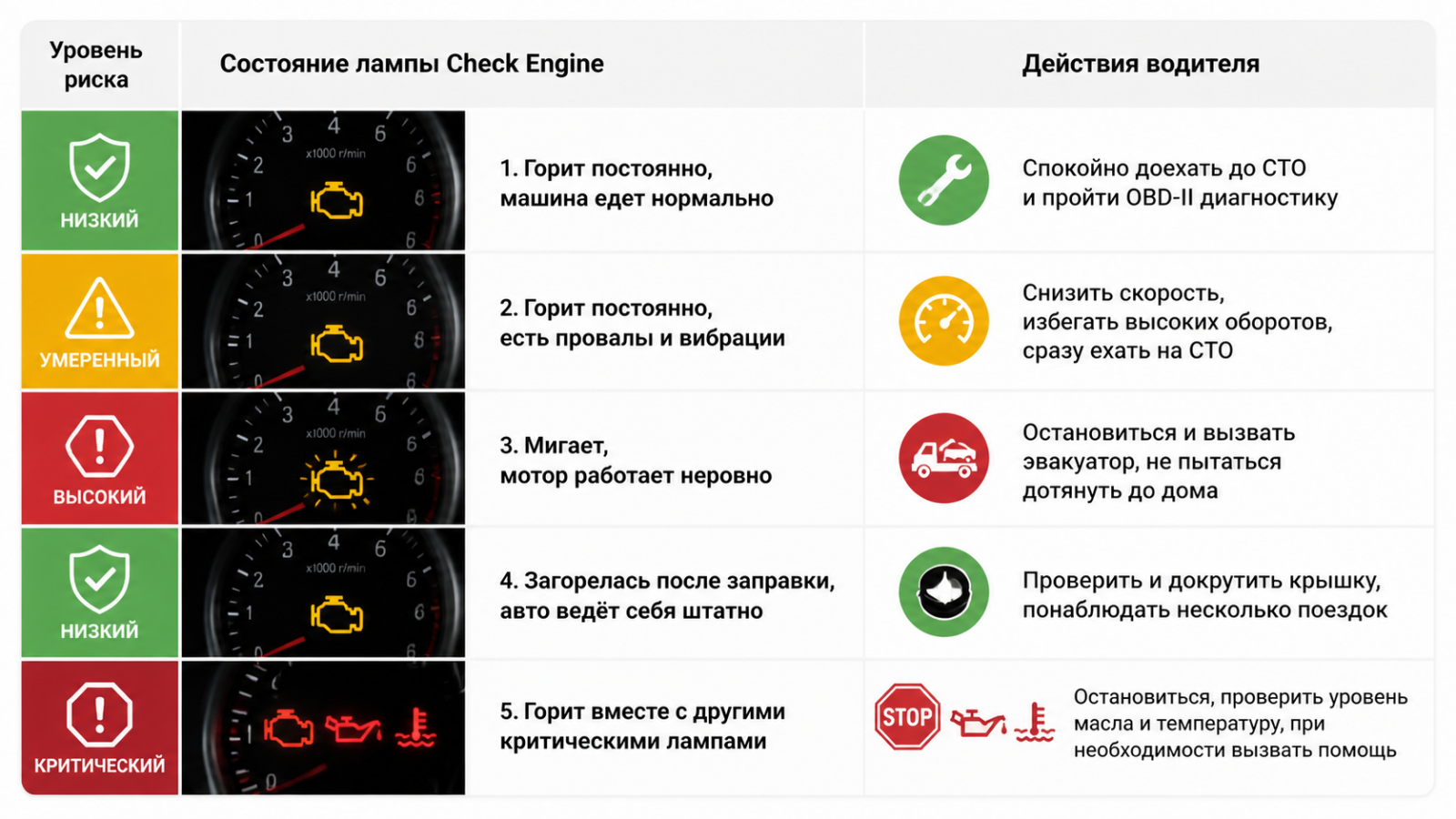
Constantly illuminated. This is usually a moderate-severity malfunction: the car is drivable, but the system requires diagnostics soon.
Flashing (blinking). Flashing almost always indicates a serious malfunction, such as severe misfires, which can quickly destroy the catalytic converter. In this case, you should immediately reduce speed and stop if possible.
Associated symptoms
Loss of power, the car doesn't go, accelerates poorly.
Rough idle, vibrations, engine misfiring.
Increased fuel consumption and the smell of gasoline from the exhaust.
Extraneous sounds: knocking, detonation, popping sounds in the exhaust.
Additional lights on the panel: overheating, oil, ESP, etc.
If the Check Engine light comes on, but the car drives normally and there are no unusual sounds or odors, it is usually acceptable to drive carefully to a service center.
The dangers of ignoring
Risk of serious damage
Catalytic converter damage. Prolonged driving with misfiring or improper fuel mixtures overheats the catalytic converter, which can be damaged. Replacing it will cost between 15,000 and 35,000 UAH or more, depending on the model.
Increased engine wear. A lean or rich mixture increases cylinder temperatures, accelerates piston wear, and can lead to a major engine overhaul, which can easily cost over 50,000 UAH.
Damage to spark plugs, coils, and other ignition components. Ignoring misfires leads to a chain of failures, each of which increases the service bill.
Financial and legal consequences
An increase in fuel consumption of 10–30% due to faulty sensors or the fuel supply system is a direct monthly additional expense for the owner.
Failure to pass technical inspection/ecotest due to exceeding exhaust toxicity standards.
It turns out that trying to "save" money on timely diagnostics for 500–800 UAH often results in costs of tens of thousands of UAH.
What can you check yourself?
Even without a garage or a professional scanner, a driver can perform basic diagnostics and rule out the most common causes.
Step 1: Assess the behavior of the machine and the lamp
Check to see if the indicator light is constantly on or flashing.
Assess the dynamics, engine sound, exhaust smell and the presence of other warnings on the panel.
If the light is flickering or there is a significant loss of power, it is best to stop and call a tow truck.
Step 2: Check the gas cap
Stop, turn off the engine and open the fuel tank cap.
Remove the cap and screw it back on until it clicks into place.
After a few trips, the ECU may reset the error itself if the cause was the cap.
Step 3: Connect an inexpensive OBD-II scanner
Most vehicles produced after 1996 are OBD-II compliant and can read error codes.
Locate the diagnostic connector under the steering column or in the center console area.
Connect the scanner, turn on the ignition (without starting the engine) and read the error codes.
The code (for example, P0300 - misfire, P0420 - catalytic converter efficiency) can help you determine which system the problem is related to.
Important: You cannot clear the codes without eliminating the cause—the indicator may go out, but the malfunction will remain and lead to more expensive repairs.
Step 4. Visual inspection of the underhood space
Check for any obvious breaks in connectors, damaged wires or hoses.
Look out for signs of fuel, oil or coolant leaks.
Even if you don't plan to repair the car yourself, such a preliminary check will help you better explain the problem to the mechanic and save time at the service station.
When is it necessary to contact service?
Situations when it is dangerous to continue driving
You must immediately stop the car and call a tow truck if:
The Check Engine light is flashing and the engine is running rough or has lost power.
There is a burning smell or smoke coming from under the hood or from the exhaust pipe.
The overheating, oil pressure or other critical indicator lights come on simultaneously.
Continuing to drive in such conditions can turn a relatively inexpensive repair into a major one in just a few kilometers.
When can I get there on my own?
In most cases, it is permissible to drive carefully to the service center if:
The lamp is constantly on (not blinking), but the car drives smoothly, without dips or vibrations.
There are no extraneous noises, smell of gasoline or smoke.
Even in such a situation, it is advisable to undergo diagnostics as quickly as possible, rather than delaying the visit for weeks.
How much does ignoring cost vs. repairing?
Replacing an oxygen sensor, as one of the common causes of the Check Engine light, is usually cheaper than replacing a damaged catalytic converter, which can cost several times more.
To save money, many owners choose used original sensors and other engine system components, which allow them to restore operation without overpaying for a new unit.
When the Check Engine light indicates a faulty sensor, ignition component, or engine itself, choosing high-quality parts becomes crucial. Used, genuine parts from auto salvage yards often last longer than cheaper alternatives and can significantly reduce the final repair cost without sacrificing reliability.
At the Aleto.ua auto dismantling site you can find:
Ignition system components and sensors for your engine in the Engine section - conveniently search by make and model;
components of the vehicle electronic system, harnesses, connectors and control units in the electrical category;
If fasteners, harnesses or body parts are damaged, suitable panels and parts are available in the body section.
This approach makes repairs more affordable while preserving the vehicle's lifespan and safety.
How to respond to the Check Engine light
Condition of the lamp and the car | What should the driver do? |
It's constantly on, the car drives normally. | Drive to the service center and schedule an OBD-II diagnostic in the next few days. |
It burns constantly, there are dips and vibrations | Reduce speed, avoid high revs, and if possible, go to a service station immediately. |
Flashing, engine runs unevenly | Stop immediately, call a tow truck, and don't try to drag it home. |
It lit up after refueling, everything is normal. | Check the gas cap, tighten it, and observe several trips. |
The lamp is on, other critical indicators are on | Stop, check oil level/temperature, call for help if necessary |
Conclusion and recommendations
The Check Engine light isn't a "dreadful death sentence" for your engine, but rather a signal that one of your vehicle's systems is malfunctioning and requires attention. The sooner you diagnose and fix the problem, the lower the risk of serious and costly breakdowns.
The optimal strategy for the average driver:
don't panic, but don't ignore the indicator either;
evaluate the machine's behavior and the lamp's condition;
check the gas cap and basic under-hood checks;
Have your vehicle OBD-II diagnosed at a service station as quickly as possible and have any faulty parts replaced, including using high-quality used original parts.
When performing a comprehensive repair, it's convenient to simultaneously address related issues with the suspension, steering, and braking systems—the relevant parts are available in the suspension and steering and braking system sections.
FAQ
Is it safe to drive if the Check Engine light is on but the car runs fine?
In most cases, a short drive to the service center is acceptable if the light is constantly on and the car behaves normally, without loss of power or extraneous sounds.
What does a flashing Check Engine light mean?
A flashing light usually indicates a serious misfire or other critical fault that could quickly damage the catalytic converter, so you should stop driving.
How long can you drive with the Check Engine light on?
Some sources allow for a mileage of 50–100 km with stable engine operation, but experts recommend conducting diagnostics as soon as possible to avoid increased repair costs.
Is it possible to simply reset the error and continue driving?
Clearing codes without addressing the underlying cause only temporarily turns off the light, but does not solve the problem and can lead to serious damage to the engine or exhaust system.
What's more profitable: new or used original parts for Check Engine repairs?
Used original parts from a reliable source often prove to be a good compromise: they retain their service life and compatibility, but cost significantly less than new originals.