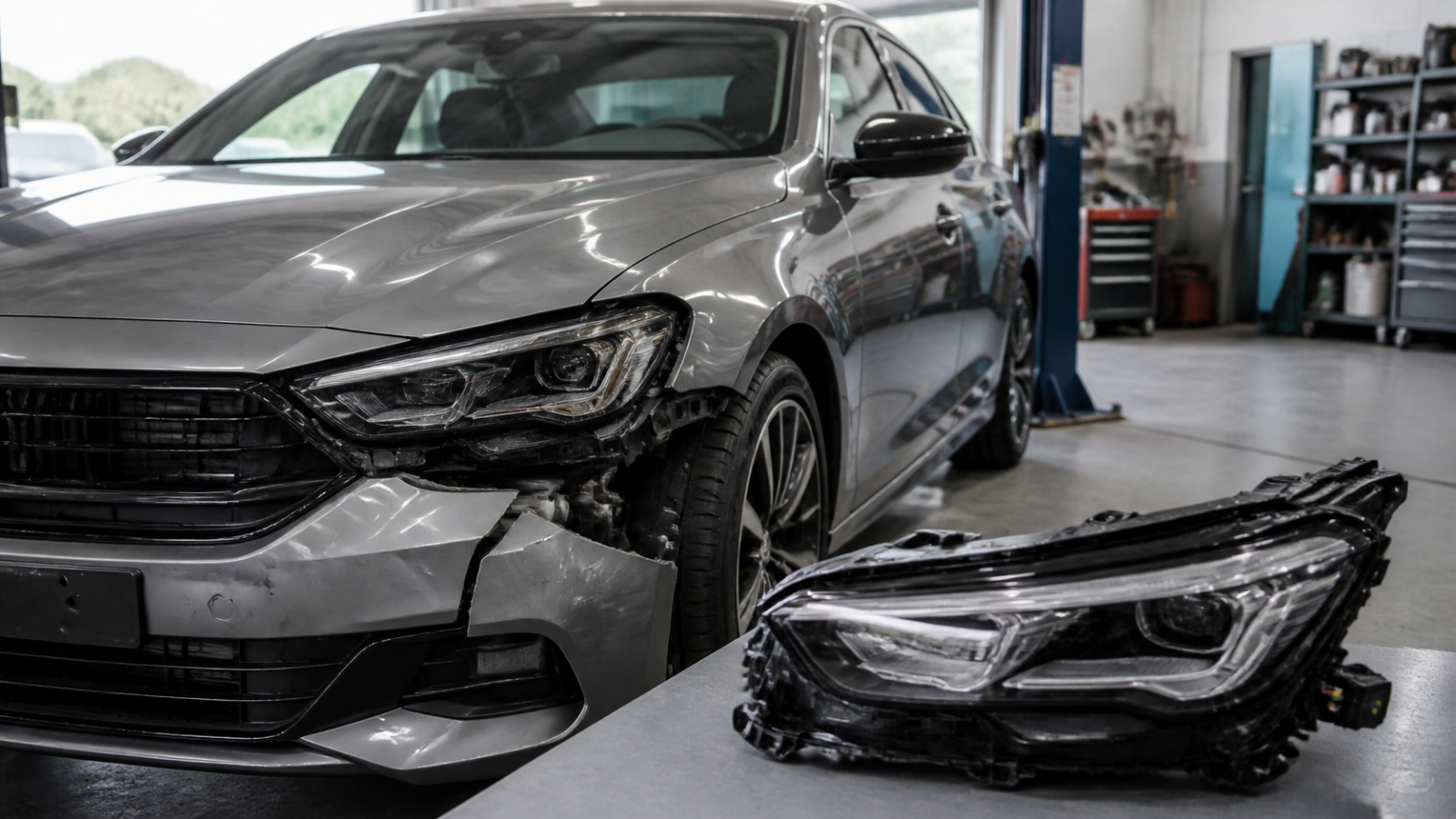
The situation is familiar to many: morning, traffic, a brief distraction—and a light "kiss" on the bumper of the car in front. On the outside, there are a couple of cracks and a dented license plate frame, but the service bill unexpectedly runs over a thousand euros: the bumper, grille, headlight, radiator, parking sensors, radar, mounts, and clips—all at the price of new, original parts.
Modern cars hide radars and cameras for assistance systems, control units, sensors, and wiring behind plastic. Therefore, even a minor accident turns into a comprehensive repair: body work, painting, adjustment of assistance systems, and adaptation of electronic units.
In this article, we'll explore which components inflate your bill the most, why repairs have become so expensive, and when it's best to buy genuine used parts from a car dismantler.

Why have repairs to modern cars become more expensive?
Even mass-market models have adaptive cruise control radars, parking sensors, and automatic braking sensors embedded in their bumpers and grilles. Any impact to the front or rear often damages not only the plastic but also expensive sensors and electronics.
Manufacturers are converting optics to LED and matrix technologies, using complex control units, and often supplying complete units only. Instead of a single headlight, the owner buys a complete kit: housing, glass, lenses, units, and sometimes wiring.
As a result, even a "minor" accident can easily cost 10-20% of a car's value, and the demand for used, original parts is steadily growing—a chance to stay within a reasonable budget without sacrificing safety.
Which details increase the bill the most?
Headlights and light units
LED and xenon headlights are expensive due to their complex optics and electronics, as well as their integration with driver assistance systems. In the event of an impact, the housing, glass, mountings, ignition units, or LED modules are damaged.
A new headlight for a popular mid-size car can cost anywhere from a few hundred to over a thousand euros, and even more in the premium segment. Therefore, a used, original headlight from a salvage yard, with intact mounts and original components, is often the best option.
Bumpers with sensors and radars
Parking sensors, radars, blind-spot sensors, headlight washers, and cameras are built into the bumper. Even a small impact can break fasteners, crack plastic, and damage hidden components.
A new bumper assembly is expensive: the plastic itself, reinforcement, grilles, fasteners, paint, and system calibration all need to be paid for separately. A used bumper from a salvage yard with factory sensor locations and correct geometry can save you a significant amount, especially if you can match the part to the color.
Mirrors with cameras and heating
A modern mirror may contain an electric motor, heating, repeaters, all-round cameras, and sensors. An impact can damage the housing, glass, and internal electronics, and the motors and wiring are also included.
Original mirrors are expensive, especially for complex configurations. At auto dismantlers, you can find a mirror assembly for the desired configuration—with the correct connectors and functions, without the need for modifications.
Hoods, fenders and doors
When impacted, body panels are often easier to replace than straighten and fill, as the geometry and reinforcements are compromised. New, original components are inherently expensive and require painting, adjusting gaps, and relocating fittings.
A used hood, fender, or door from a salvage yard provides factory geometry and often a standard coat of paint, and with a good color match, reduces painting costs.
Radiators, TVs and hanging items
A front-end impact often damages the engine radiator, intercooler, air conditioning condenser, fans, and plastic TV. Even with minor bumper damage, the radiators can be punctured or distorted, adding hundreds of euros to the cost.
Original radiators and TVs are quite expensive, but used originals allow you to preserve the standard design and correct geometry of the fasteners and pipes.
Electronic units and wiring
Even a light impact can cause hidden problems: broken wiring, oxidized connectors, and microcracks in circuit boards. Particularly vulnerable are the lighting units, parking sensors, stability control, and airbags.
New units are expensive and require programming for a specific vehicle. A genuine used unit from the same model and year can save money, but only if properly tested and adapted at a service station.
How to choose used parts
To really save money and avoid additional problems, it is important to approach your choice systematically.
Checklist before purchasing a used part:
OEM number: check the number against the catalog; it must match or have a confirmed equivalent.
Compatibility by body type and year: the same model in different restylings may have different mounts, shape, and connectors—see how this works with the example of selecting a used engine by model and year .
Fasteners: Carefully inspect all ears and mounting points, especially at headlights, bumpers and mirrors.
Signs of repair: soldering, thick putty and rough straightening worsen the geometry and service life.
Cracks and chips: microcracks in optics and plastic can develop after installation.
Connectors: eliminate oxidation, burnt contacts and poor wiring practices.
Equipment: check whether the headlight comes with an ignition unit, and the bumper with grilles and sensors.
Inspection and warranty: Find out about vehicle inspection conditions and return options.
New part, analog or used original
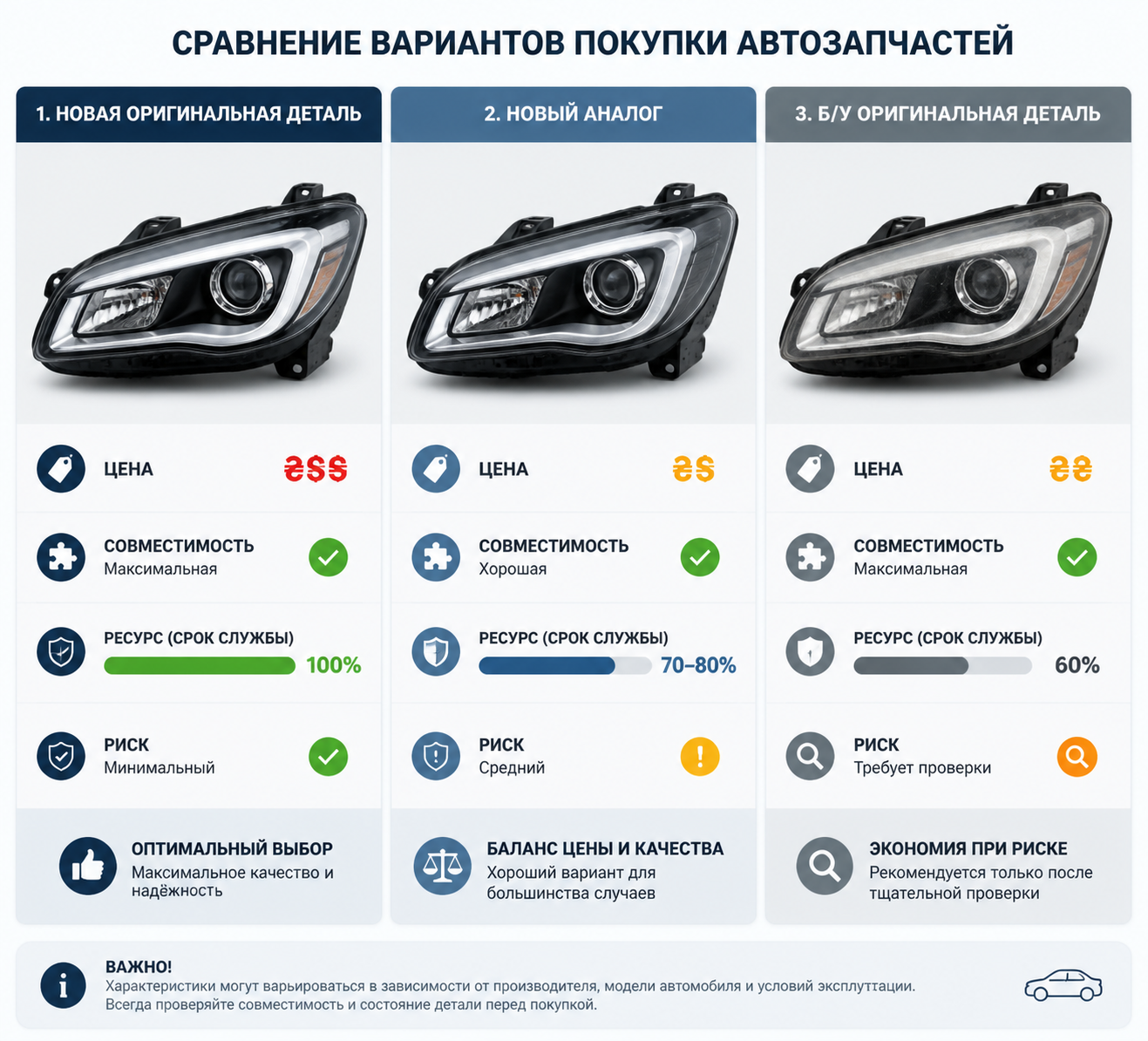
In many cases, the owner has three options: buy a new original part, use an aftermarket replacement, or find an original part from a salvage yard. This is especially true for complex components like transmissions—check out the Used Original Hyundai Gearbox section. Below is a general comparison of formats.
A real example from a car dismantling yard: a blow to the front left corner
A 2017 midsize sedan suffered a dented bumper edge, a broken headlight, and a slightly deformed fender after a collision with the front left corner. Inspection revealed damage to the headlight and control unit, the bumper with parking sensors, part of the TV mounts, and the decorative grille. The radiator grille and hood were intact.
A new set of original parts would cost the equivalent of several monthly salaries. However, when dismantling such a car, you can offer other used owners the original headlight, bumper, and fasteners, significantly reducing the cost of repairs.
Conclusion: Even after a serious impact, a significant portion of original parts remain usable and help other drivers save money.
Drivers' mistakes when choosing used parts
Mistakes when buying used parts often ruin savings. Below are common mistakes and how to avoid them.
Error | What is dangerous? | What is the correct way? |
Buying a headlight without checking the mountings | The headlight will not fit straight, gaps and vibrations will appear. | Ask for large photos of all the ears and attachment points. |
Ignoring the OEM number | The part may not fit properly in terms of connectors and fit. | Always check the part number against the catalog and VIN |
Buying a block "from a photo" without verification | The risk of receiving non-working electronics | Check the possibility of verification and return conditions |
Saving on sensors and radars | Errors in the operation of assistance systems, reduced security | Buy only original or tested used ones with a test guarantee |
Selecting a part with obvious traces of a collective farm | Complex installation, problems with further repairs | Prefer parts without "homemade" or rough modifications |
When a used part is a good solution, and when it is not
A used original part is usually justified if:
it is a body panel, bumper, headlight, mirror or interior element;
a part without hidden damage, with intact fasteners;
the OEM number and configuration match;
there are high-quality photos and the possibility of verification;
A new original part is disproportionately expensive, while similar parts are significantly inferior in quality.
You should be more careful or refuse to buy a used car if:
talking about airbags and seat belts after an accident;
the part belongs to the high-voltage part of a hybrid or electric vehicle;
the history of the part is unknown, there are traces of major repairs;
missing key fasteners or damaged geometry;
There is no way to test the electronic unit before installation.
FAQ
Is it possible to buy used headlights?
Yes, provided the OEM number matches, the mounts are intact, there are no cracks or fogging, and it is possible to check the functionality of all light modes.
How do I know if a used part will fit my car?
Check the OEM number, specify the model, year and body type, as well as the equipment (type of headlights, presence of sensors, camera, etc.), and, if necessary, consult with a service station.
What is better: a new analogue or a used original?
For complex optics, bumpers with sensors, and body parts, used originals are often more cost-effective; for simple components, a high-quality analog is sometimes sufficient.
Is it possible to return a used spare part if it doesn’t fit?
This depends on the specific auto dismantling company's policies, so check in advance for inspection conditions, return deadlines, and what exactly is considered a reason for an exchange.
What used parts are dangerous to buy after an accident?
Airbags and seat belts, high-voltage system components, and electronic units that cannot be diagnosed or tested on a test bench or in a vehicle.
Conclusions and recommendations
Minor accidents are increasingly turning into hefty bills due to complex optics, electronics, and sophisticated body parts, which are expensive to replace. However, a careful selection of used, original parts from a salvage yard can significantly reduce repair costs without sacrificing safety or quality, especially when it comes to headlights, bumpers, fenders, doors, and radiators.
When selecting a used part, it's important not to chase the lowest price, but to carefully check the OEM number, the condition of the fasteners, the part's history, the presence of blocks and connectors, and the ability to test before installation.
At a car dismantling center, it's worth clarifying not only the price, but also the component's components, warranty, and return policies—this helps avoid unnecessary expenses and unresolved issues after repairs.