Why does a car stall while driving: the main groups of reasons
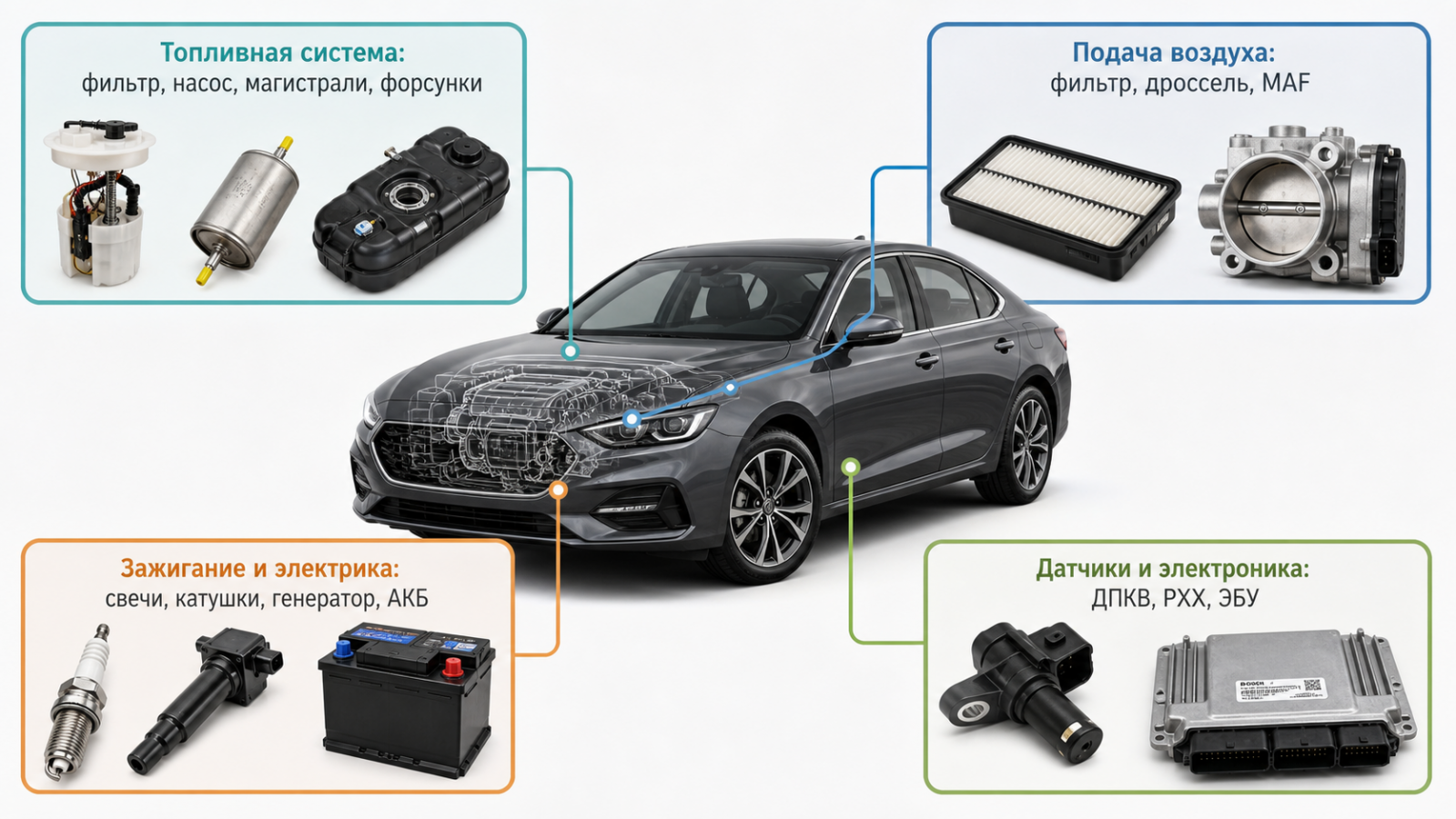
Engineers divide the causes of sudden engine stalls into four key groups: fuel, air, spark/ignition, and electronics/sensors. Any failure in even one of these components can cause the engine to suddenly "shut down" in traffic.
1. Problems with the fuel system
In practice, it is the fuel system that is most often to blame for the car stalling while driving.
Clogged fuel filter: the filter gradually becomes clogged with dirt from the tank, the throughput capacity decreases, under load the fuel pressure is insufficient, and the engine “starves” the engine.
A weak or overheating fuel pump: When worn out, the pump may work at idle, but when accelerating or after 15-20 minutes of driving, its performance drops—the car jerks and stalls, and then starts again after cooling down.
Air leaks and leaks: Leaky hoses, clamps or connections in petrol or diesel systems can cause pressure loss – especially critical for Common Rail.
Low-quality or absent fuel: diluted gasoline, water in diesel, or simply an empty tank with a faulty fuel level sensor.
Many of these problems will ultimately require replacement of the filter, pump, lines, or injectors—optionally, with a used original from the engine and fuel system section, where you can find factory pumps, rails, and injectors for a specific car model.
2. Air supply failure
The engine needs the correct mixture ratio—approximately 14.7 parts air to 1 part fuel for a gasoline engine. If there's too little air or the sensor readings are incorrect, the mixture becomes too rich or too lean, and the engine stalls.
Clogged air filter: not enough oxygen gets into the cylinders, the mixture overflows, and the spark plugs are flooded.
Dirty throttle valve: carbon deposits and dust prevent it from opening properly, especially noticeable at idle and when releasing the gas.
Mass Air Flow (MAF) Sensor: If dirty or faulty, the ECU receives incorrect data, prepares the wrong mixture, and the car may stall when accelerating or shifting gears.
The air filter and some sensors are classified under the Electrical and Sensors and Engine sections. It's often more cost-effective to buy a used original than a cheap, unpredictable replacement.
3. Ignition system and electrical part
For a gasoline engine, a stable spark and a properly functioning on-board network are critical.
Spark plugs: worn electrodes and thick carbon deposits impair spark formation; the engine begins to misfire and may stall while driving.
Ignition coils and high-voltage wires: breakdown under load causes dips and engine stalling; in case of widespread misfires, the ECU may even forcibly shut off the engine to protect the catalytic converter.
Corroded battery terminals or a weak alternator: resistance increases, voltage sags, the fuel pump and ECU operate erratically; when the battery discharges below ~9–10 V, the engine usually stalls.
Original coils, generators, and starters for popular models are conveniently found in the electrical section—standard wiring harnesses and connectors are often also available there.
4. Sensors and electronics
A modern car is controlled by an ECU, which critically requires correct signals from sensors.
Crankshaft position sensor (CPS): if the signal is lost, the control unit “loses” synchronization and immediately turns off the injection and ignition—a classic scenario when the car stalls as if the ignition was turned off.
Idle speed control valve (ISC): if dirty or faulty, the engine stalls when stopped, when releasing the gas, or at low speed.
ECU and other sensor errors (temperature, throttle position, rail pressure): incorrect data leads to an incorrect mixture and emergency engine shutdown.
Characteristic symptoms: how “behavior” hints at the cause
The way the car stalls is often a better clue than any theory as to where to look for the problem.
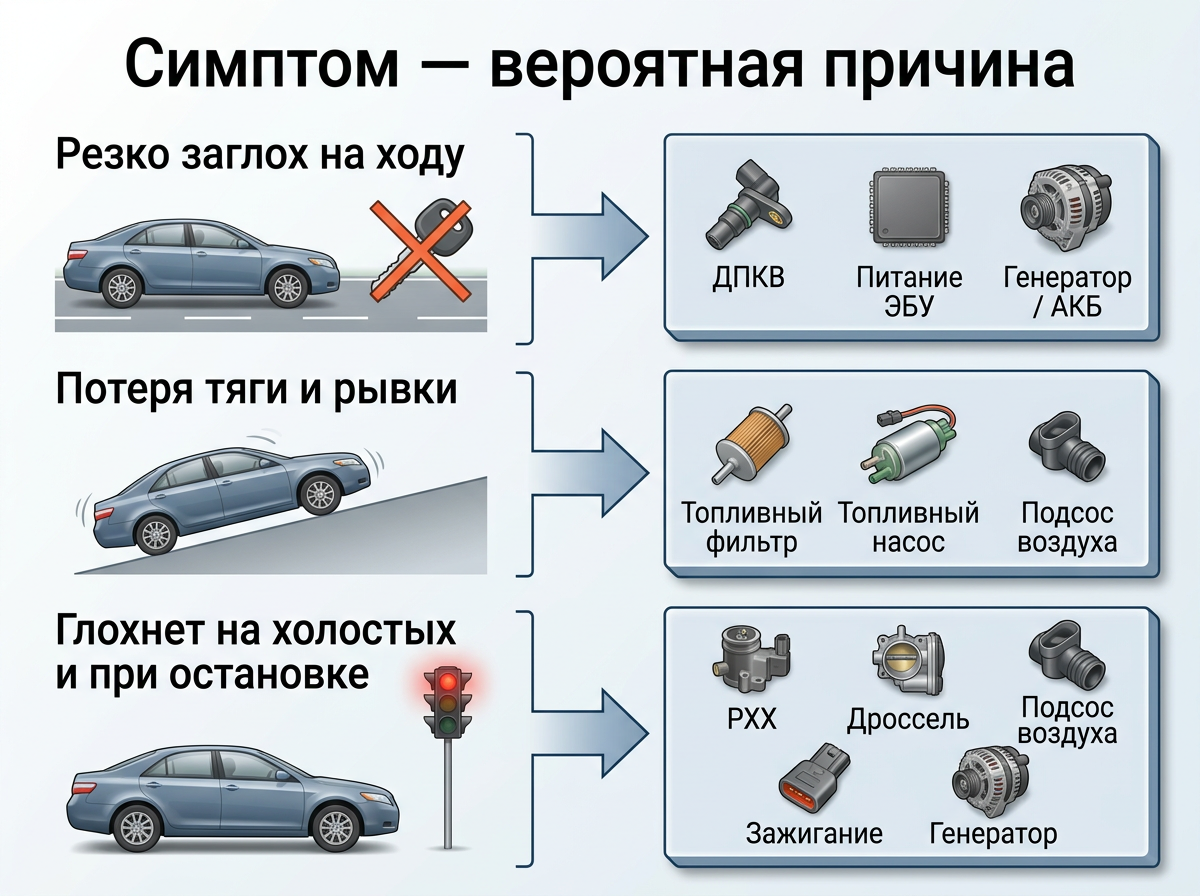
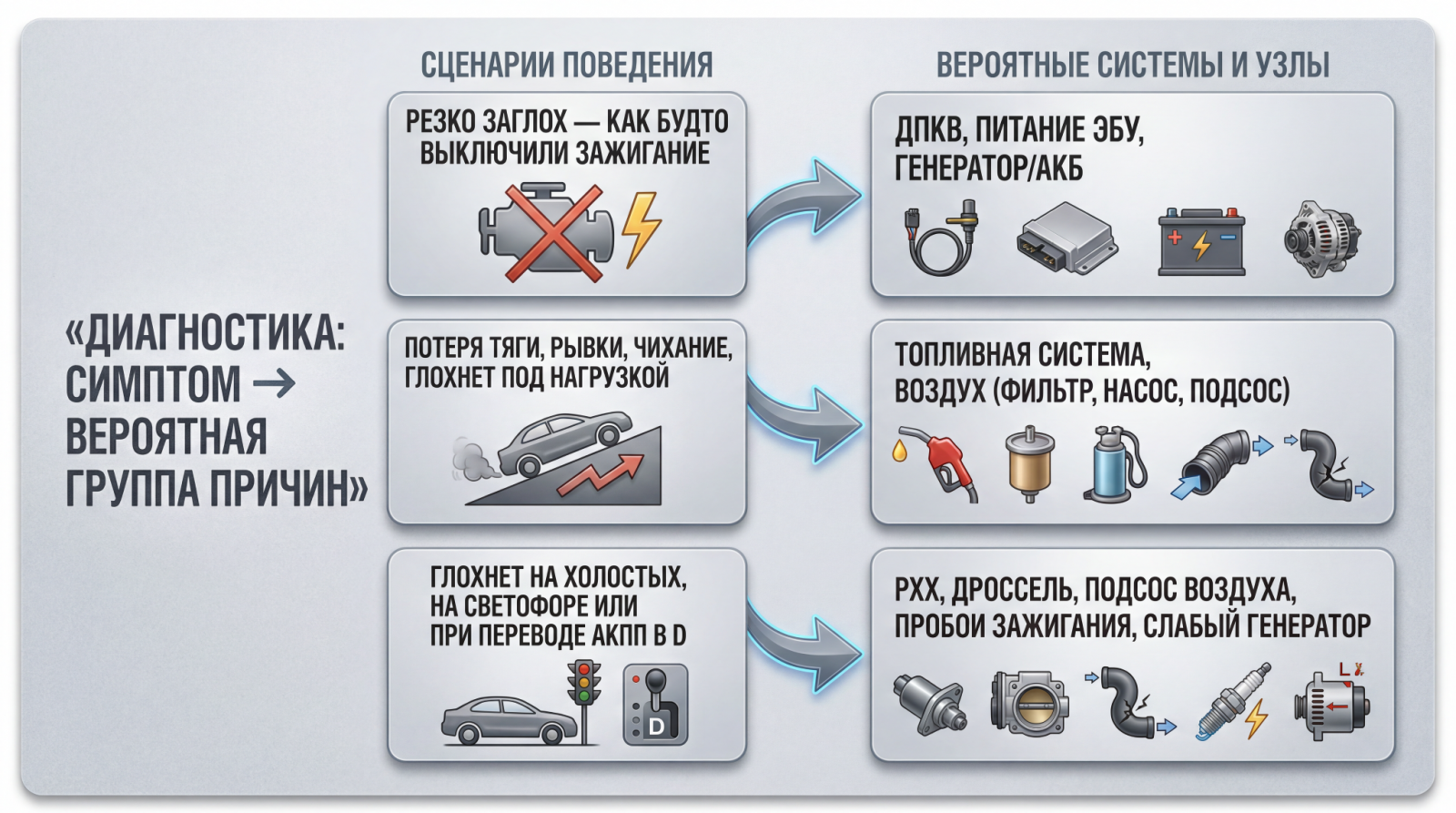
Instant stop "as if the ignition was turned off"
If the engine suddenly stops running without any jerking or dips, the most common culprits are:
Crankshaft position sensor or other key timing sensors.
Power failure of the ECU, coil, fuel pump relay (wiring, oxidation, “tired” alarm).
Critical voltage drop (generator/battery).
Gradual loss of traction, jerking and “sneezing”
A smooth stop with jerking usually indicates fuel or air.
The car jerks, doesn't pull uphill, and stalls—typically a clogged fuel filter, a worn-out pump, or an air leak.
If the engine stalls when you press the gas hard, but runs smoothly, there may be problems with the throttle valve, accelerator pump (on the carburetor), or MAF.
Stalls at idle and when stopped
When the engine turns off at a traffic light or when the automatic transmission is shifted into “D”:
The idle speed control valve is faulty or the throttle valve is dirty.
Air leaks, breakdowns in the ignition system, weak generator at low speeds.
The dangers of ignoring the problem
The only “good” thing about a car stalling while driving is that it’s a very clear signal that something is wrong with the car.
Risk of accident. When the engine stalls, the steering wheel becomes much heavier (the power steering/electrical steering loses its assist) and the brake pedal becomes stiff—you have to press much harder to stop.
Damage to engine components. Driving with regular misfires or a lean/rich mixture leads to overheating of the valves, destruction of the catalytic converter, and failure of the fuel injection pump and injectors.
Costly repairs. Ignoring the first symptoms often results in replacing the high-pressure pump, injectors, or a complete overhaul of the engine and fuel system.
Against this backdrop of costs, purchasing an original but used pump or injectors seems like a rational investment, especially if you choose parts with a clear history and a warranty from the seller.
What can you check yourself?
If your car has already stalled or stalls intermittently, there are a number of basic steps that an average driver can take without a professional scanner.
Step | What are we doing? | What does this give? |
1 | We check the fuel, oil and antifreeze levels | We rule out the banal “empty tank” and overheating |
2 | We inspect the battery terminals and ground | We are looking for oxides, weak contacts, breaks |
3 | Listen to the fuel pump when the ignition is turned on | Understanding whether the pump and relay are alive |
4 | We visually assess the condition of the filters (according to the mileage regulations) | Deciding whether it's time to change the fuel/air filter |
5 | Scanning the ECU with a simple OBD2 scanner | Codes P0300, P0335, etc. will immediately indicate the direction of the search |
What you can do yourself without risk
Replace the air filter and, if necessary, carefully clean the throttle valve with a special cleaner.
Replace the spark plugs and, if you have experience, the high-voltage wires.
Replace the fuel filter (especially if it hasn’t been changed for a long time according to the regulations and you are driving on “suspect” fuel).
When choosing filters and spark plugs, it's important not to skimp on quality: original used filter housings, manifolds, coils, and even original spark plug coils can often be found cheaper than new ones, while maintaining factory compatibility.
When is it necessary to take (or take) your car to a service center?
There are situations in which further independent operation is either dangerous or pointless.
The car stalls regularly at speed, especially on the highway or when overtaking.
The “Check Engine” light is on on the dashboard, the coil (on a diesel engine) or battery light is flashing, and the engine is jerking and losing power.
There are clear signs of overheating: the temperature gauge is in the red zone, the smell of antifreeze, and steam is coming from under the hood.
The car stalls and won't start, extraneous metallic sounds are heard when the starter is cranking (suspected mechanical wear of the timing belt or cylinder-piston group).
The service will perform:
Computer diagnostics of the ECU with reading of errors and parameters in real time.
Checking the fuel pressure on both the low and high sides (for diesel engines - with pressure gauges and adapters).
Testing of injectors, pumps, sensors and electrical components, compression measurement.
If diagnostic results indicate that the vehicle needs to be replaced, for example, the crankshaft sensor, injectors, pump, or suspension and brake system components, it's a good idea to also check for used original parts in the engine , brake system , and suspension and steering sections. This can significantly reduce the final repair bill without sacrificing reliability.
FAQ
Why does the car stall while driving without warning?
Most often, due to a failure of the crankshaft position sensor, a critical voltage drop, or a serious malfunction in the ECU, the safety system simply turns off the injection and spark.
The car stalls when braking and at traffic lights. What should I check?
First of all, the idle speed control valve, the throttle valve, the air intake and the condition of the generator at low speeds.
Can bad gasoline or diesel fuel cause stalling while driving?
Yes, low-quality fuel, water in diesel, or an inappropriate octane rating can cause detonation, clogged filters and injectors, a drop in fuel rail pressure, and engine stalling.
Is it dangerous to continue driving if the car sometimes stalls but then starts again?
Danger: you can lose control at a crucial moment, and constant malfunctions accelerate the wear of expensive components - injectors, pump, catalytic converter, valves.
What is more profitable: new analogues or used original spare parts?
For complex components (pumps, injectors, generators, ECUs), used originals are often better than cheap analogues: longer service life, predictable quality, and precise compatibility across mounting locations.