Even experienced drivers sometimes find themselves locked out of their car, locked out of their car, or left with their keys in the ignition. It can happen in a courtyard, a shopping center parking lot, or on the highway, and almost always at the most inconvenient moment.
This problem is dangerous because children, pets, or valuables may be inside the car, and the driver is often away from home and a spare key. Attempts to open the car using makeshift methods without experience often result in damage to the paintwork, windows, locks, and even airbags or door wiring.
In this article, we'll explore why a car can lock with the keys inside, which methods are considered relatively safe, what you can do yourself, and in which situations it's best to immediately call a professional car locksmith.
The main reasons why keys remain inside
Features of alarm and central locking
Modern cars are often equipped with automatic door locking under certain conditions: when the ignition is on, when driving, or after leaving the vehicle with the key card. Incorrect settings or malfunctions in the alarm system can cause the doors to lock while the key remains inside.
“Auto-locking” also occurs when a button on a key fob in a pocket or bag is accidentally pressed after the driver has already exited the car and slammed the door.
Human factor and carelessness
One of the most common causes is the simple habit of placing the keys on the seat, in the cup holder, or in the trunk, and then automatically slamming the door. In a rush or under stress, the driver might exit the car to unload luggage, and the system automatically locks the car.
A separate scenario is when the keys are left in the ignition with the car running, the driver gets out “for a minute,” and the door is locked by the central locking system or the alarm.
Malfunctions of locks, cylinders and electronics
Wear on mechanical locks, dirty cylinders, corrosion, and problems with wiring and control units can cause the central locking and alarm to malfunction. As a result, the car may lock spontaneously or become inoperable with the standard key if the key is left inside.
In cold weather, freezing of mechanisms and seals additionally “helps”, making standard opening even more difficult.
If you suspect problems with the wiring, lock control unit, or other electrical equipment, it is worth checking and, if necessary, replacing the vehicle's electrical components .
Design features: key cards, keyless entry, trunk
In cars with a key card or keyless entry system, the driver can place the card inside the car, exit, and walk away - if the system does not recognize that the card is left inside, the car may lock.
It is also not uncommon for a driver to put the key in the trunk, close it without checking, and at that moment all the locks are automatically locked.
Signs and symptoms of the problem
The car is locked, the key is inside the car.
The main sign is that all doors and the trunk are locked, and the key is clearly visible inside: on the seat, in the cup holder, in the ignition switch, or in the trunk. When attempting to open the doors with the outside handles, they don't respond, and the key fob (if you have one) doesn't unlock the doors.
Additional signals: flashing hazard lights or alarm LEDs, sound signal when attempting to open the door, no response to touching the touch handle in keyless entry systems.
Locking with the engine running
A dangerous scenario occurs when the engine is running, the key is in the lock, and the car is locked and unresponsive. The interior temperature can quickly rise in the summer or drop in the winter if children or pets are inside—this is a critical situation.
Unusual behavior of locks and alarms before the problem
Before the keys are completely locked inside, the alarm or locks often show signs of instability: the doors don't close on the first try, the key fob works only occasionally, the turn signal lights don't confirm, and strange clicking sounds are heard in the doors.
If such symptoms appear, the risk of ending up with the keys inside and the car locked increases greatly.
The dangers of ignoring the problem
Risks to humans and animals
If children or pets remain in the vehicle, the situation may be life-threatening due to overheating or hypothermia.
In such cases, attempts to "experiment" with opening the door for a long time instead of promptly calling emergency services or even breaking the glass can have serious consequences.
Damage to the car due to incorrect actions
Attempts to pry open the door with a pry bar, screwdriver, shovel, driving in wedges, or using "random wire" without understanding the design of the lock often result in deformation of door parts , damage to the glass frame, scratches to the paintwork, and broken wiring in the doors.
Incorrect use of homemade air springs or rigid wedges can displace the door, disrupt the geometry of the opening, and lead to expensive body repairs.
Damage to locks, alarms and electronics
Rough mechanical action on the lock cylinder, attempts to "push" the rod or cable with jerks can break the mechanism, which will require replacement of the lock, cylinder, or central locking control unit.
On cars with modern security systems, unqualified tampering sometimes results in the activation of ignition interlocks, errors in the airbag system, and other electronic systems, which then need to be diagnosed using specialized equipment.
What can you check and do yourself?
Below are relatively safe steps that experts recommend before calling in a professional, unless the situation is critical and there are no people or animals in the car.
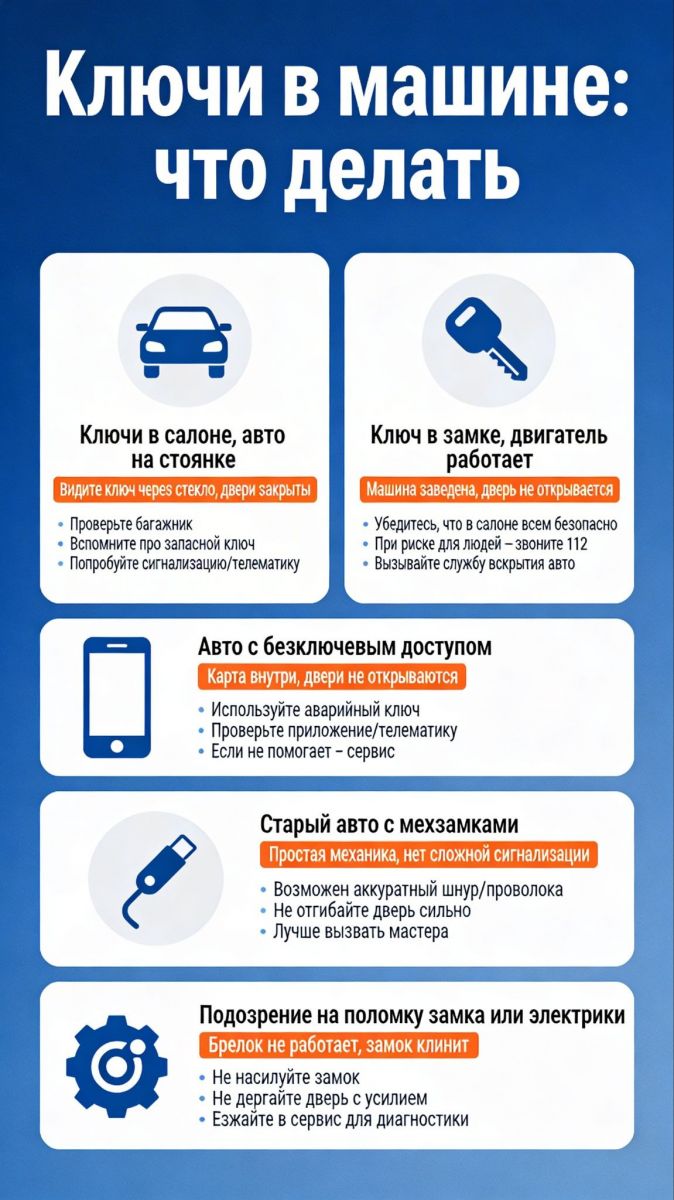
Check the emergency access
Find and use a spare key if a relative or friend has one at home.
Check to see if you have a separate "emergency" key in your key card (many cards contain a mechanical key that slides out and back out).
Check that the trunk is open: sometimes the central locking only locks the doors, but through the open trunk you can fold the rear seat and access the interior.
Use standard alarm and telematics functions
Check whether your alarm system supports PIN entry or emergency disarming (there is often a sticker with a “secret” on the windshield).
If your vehicle has telematics services installed (manufacturer-proprietary apps, GSM alarm), try unlocking the doors using the app or by calling the system manufacturer's service center.
The simplest mechanical methods (for older cars)
These methods are generally suitable for older models with simple mechanical locks and no complex electronics, but still carry a risk of damage:
A thin wire or cord through the door gap - by very carefully bending the edge of the door/seal to catch the lock button or the lock rod.
A specialized air spring + hook - if the equipment is available and the person understands exactly where to hook it to press the button or hook the rod.
Even with these methods, manufacturers and service centers emphasize that without experience, there is a high risk of damaging the body, glass, or lock, so in most cases, it is safer to call professionals.

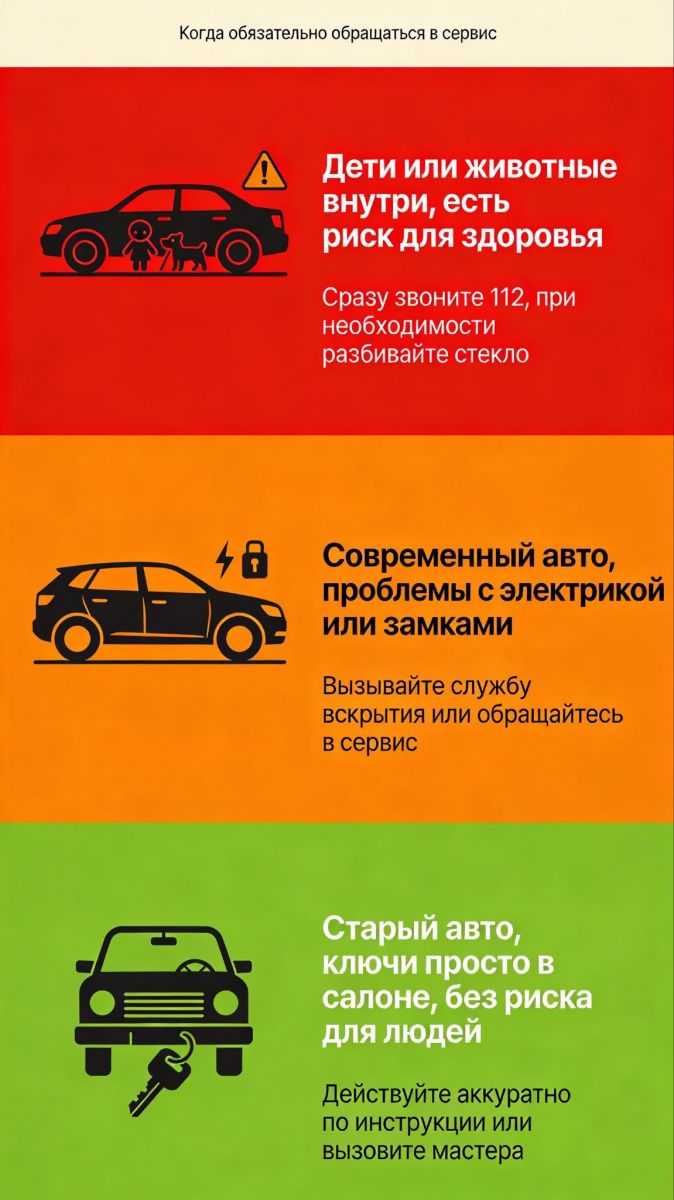
When is it necessary to contact a service or opening service?
There are children, animals, and a person in poor health in the salon.
If children, elderly people, animals, or a sick person remain inside a locked car, this is a reason to immediately call emergency services and/or perform emergency opening of the car, including breaking the window if necessary. In such a situation, the safety of the window or lock is secondary to the safety of the people.
A modern car with smart electronics
On new cars with keyless entry, complex alarm systems, and extensive door electronics, it's best to avoid experimenting with wire, homemade door locks, or door "prying." It's best to call a professional car locksmith immediately.
Suspected faulty lock, alarm or electrical equipment
If the key doesn't turn, the cylinder is jammed, the doors lock on their own, the key fob is silent even though the battery is working, and error codes are flashing in the cabin, the causes may be mechanical wear, oxidation of the contacts, a faulty lock unit, or a faulty security system.
In such cases, independent attempts to open the device often worsen the problem, so it is worth contacting a service center for diagnostics and safe opening.
You've already tried to open it yourself and something went wrong.
If you've already tried to pry the door open, inserted wire, wedges, or hard objects, and noticed scratches, door deformation, a stuck lock cylinder, or unusual electronic behavior, it's best to take the car to a professional. Further attempts could make the repair significantly more expensive.
Typical situations, signs and actions
FAQ
Is it possible to open the car yourself with a wire or cord if the keys are inside?
Technically, this is sometimes possible on older cars with simple locks, but even specialized services warn of the high risk of damage to the door, locks, and glass, so without experience, it's best to call in specialists.
What should you do if your car is locked with the engine running and the key inside?
If no one is inside, try the spare key, the emergency key from the key fob, or the telematics functions. If none of these are available, call a car locksmith. If there are people inside and there is a health risk, call emergency services and, if necessary, break the window.
Is it possible to break the glass if the keys are inside the car?
When life or health is at risk (children, animals, extreme heat, or extreme cold), breaking glass is considered a justified measure; experts recommend choosing glass away from people and using a controlled strike.
Will opening through the trunk help?
Yes, on some cars the trunk may be open even if the doors are closed, and you can fold the seats down and get into the car through it, so checking the trunk is one of the first safety steps.
Conclusion and recommendations for prevention
To avoid finding yourself locked in your car with your keys inside, it's helpful to develop a few simple habits: keep a spare key with a trusted person, don't put your main key on the seat or in the trunk, and keep an eye on the locks, alarm, and key fob battery.
At the first sign of instability in the central locking or alarm system, it's worth having it diagnosed at a service center. If the doors are already locked, first use the standard unlocking options (trunk, emergency key, telematics), and only then resort to mechanical methods or call a professional car unlocking service.