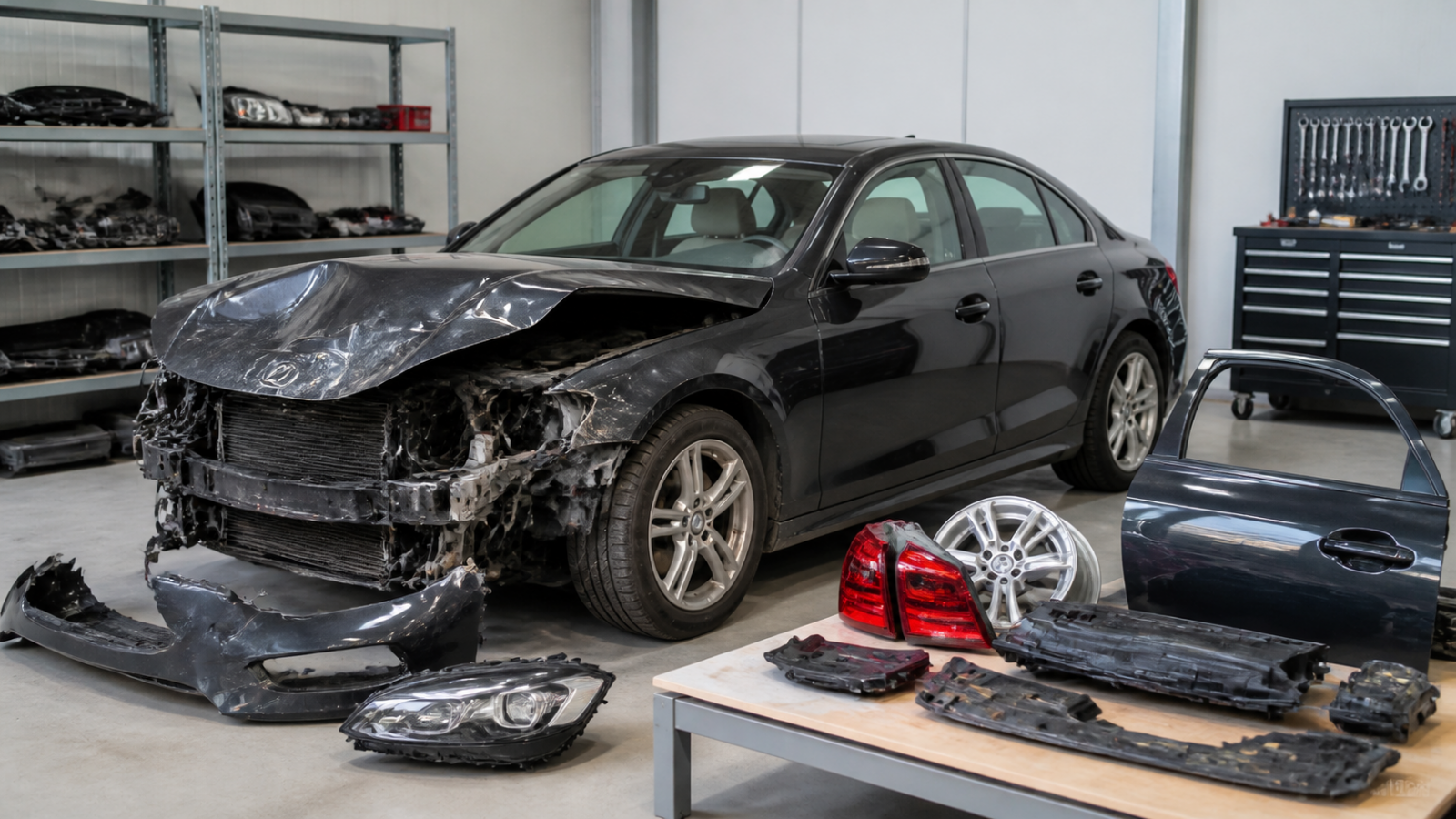
Imagine: you receive a photo of your BMW after a serious impact—the hood is folded, the headlight is shattered, the bumper is hanging—but the insurance company quotes a repair cost comparable to the price of a used car.
Ultimately, the car is deemed uneconomical to repair and is sent to a salvage yard, leaving the owner to wonder what can be salvaged after such an accident and how much it will cost.
In recent years, the cost of new original parts has increased by 5-15%, so even a relatively minor accident can result in a bill that's an unpleasant surprise for any driver. Against this backdrop, used original parts from auto dismantlers offer a real opportunity to save money without sacrificing factory quality.
In this article, we'll use one car as an example to examine which components most often survive a serious impact, what disassembly looks like from the inside, what actually remains valuable, and how the driver can safely use such parts.
Why is this important to know?
In recent years, modern cars have become significantly more complex: even inexpensive models now have radars, parking sensors, and cameras hidden in the bumper, grille, and headlights. A frontal impact damages not only the plastic but also expensive electronics, which dramatically increases the cost of repairs.
At the same time, prices for new original spare parts are rising, and some items are periodically in short supply, so drivers are increasingly considering original used parts as a viable alternative.
Auto dismantlers specializing in imported cars, including those from the United States, are building large warehouses of body parts, optics, and components that can be selected by VIN or OEM number.
What Happened to the Car: The Story of a Disassembly
An Audi A4 after a frontal impact at approximately 50–60 km/h. The car struck the expensive LED lighting, reinforced bumper with sensors, and radiator panel, leaving the front end completely damaged.
The impact damaged the front bumper, power steering, grille, both headlights, hood, one fender, radiators, and part of the TV mounts, as well as the subframe and suspension components. In the photo, it looks like a total loss, but a detailed inspection at the dismantling site reveals that a significant number of the original parts remained intact and have market value.
Which parts were damaged and which survived?
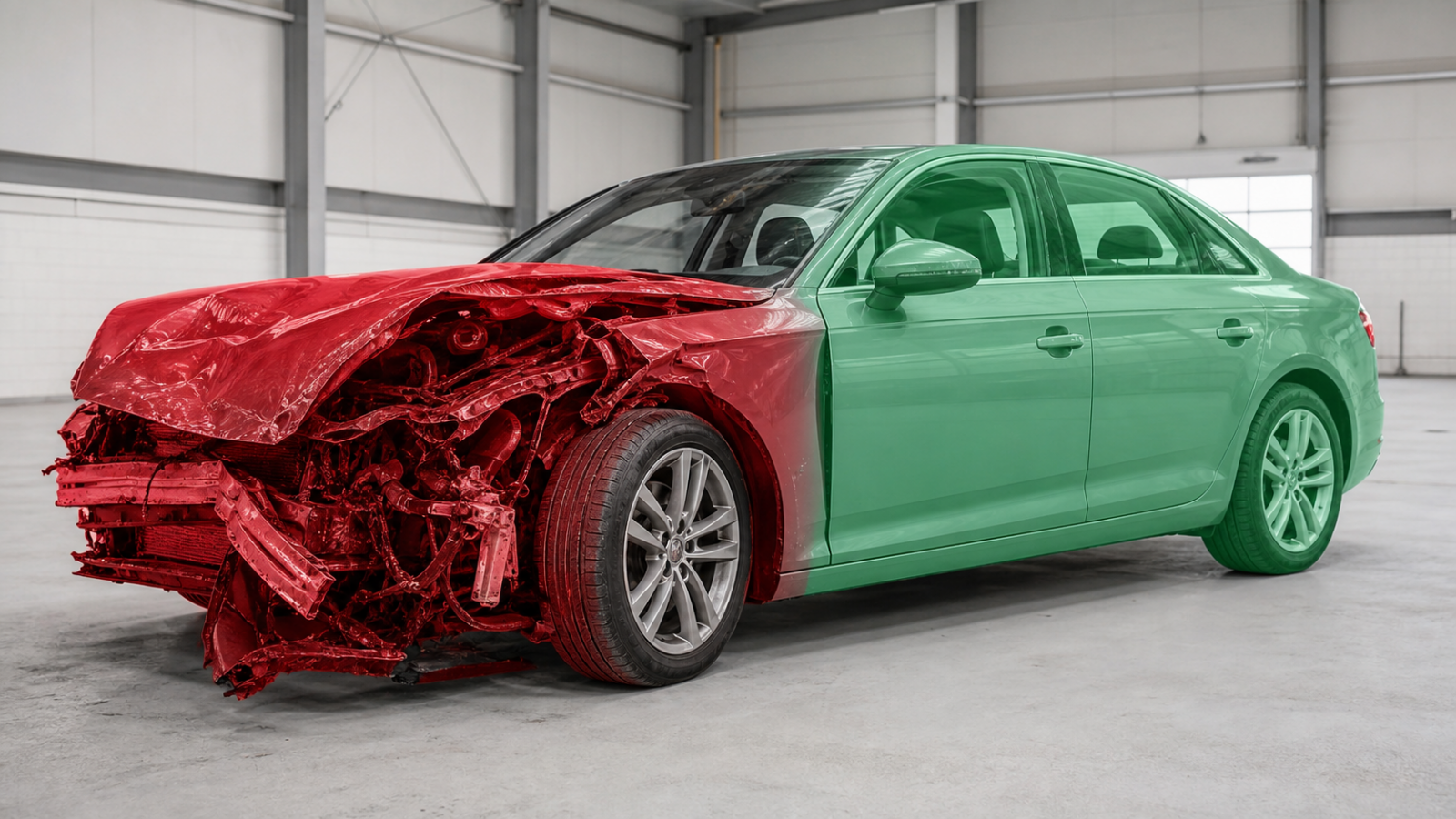
Severely damaged parts of this Audi A4:
- Front bumper with reinforcement and grille - deformation of plastic and metal, cracks, broken fasteners and damaged parking sensor seats.
- Both front LED headlights have broken glass, damaged housings and some fasteners, and the connectors are torn out in some places.
- The hood and left front fender have folds along the edge, the geometry is distorted, the metal is pulled to the pillar area.
- Radiators and plastic frame of the TV - antifreeze leaked, mounting ears and guides were broken.
- Part of the subframe and suspension components - the impact occurred in the wheel area, which damaged the levers, shock absorber mounts, and camber geometry.
These parts in this condition are no longer suitable for fair sale as used originals: they are either written off or used as donors for small components.
At the same time, the same Audi A4 survived and remained liquid:
- The right front fender and most of the plastic fender liners on the side where the impact did not occur.
- The rear bumper, trunk lid and taillights show only cosmetic signs of use, without any signs of impact.
- Both rear doors and the right front door are perfectly aligned, with even gaps and factory paint without any serious chips.
- Interior: dashboard, seats, door panels, center console—the impact did not reach the interior, and only the front airbags deployed, so the upholstery and plastic remained in good condition.
- Most of the control units, some of the underhood wiring, and engine components—despite the damaged radiators—were not critically deformed, and the electronics remained functional.
For auto dismantlers, this Audi A4 becomes a fully functional "donor": body parts from the rear, doors, interior, suspension parts, electronics, and engine components can be disassembled, inspected, and offered to owners of similar A4s who are looking for used original parts instead of expensive new originals.
So how much can you save on an Audi A4 after such a hit?
A new, original LED headlight for the current generation of the A4 easily costs 60,000–80,000 UAH per unit, and in some trim levels, even more, especially if it’s a full LED headlight with dynamic turn signals.
A used, original Audi A4 headlight in good condition from a car dismantler with intact mounts costs an average of 18,000–30,000 UAH, depending on the generation, type of light, and configuration.
A new front bumper (even without paint or attachments) costs around 20,000–30,000 UAH on the market, while a used original Audi A4 bumper from a salvage yard can be found for around 8,000–15,000 UAH, especially if you're lucky with the color and have minimal defects.
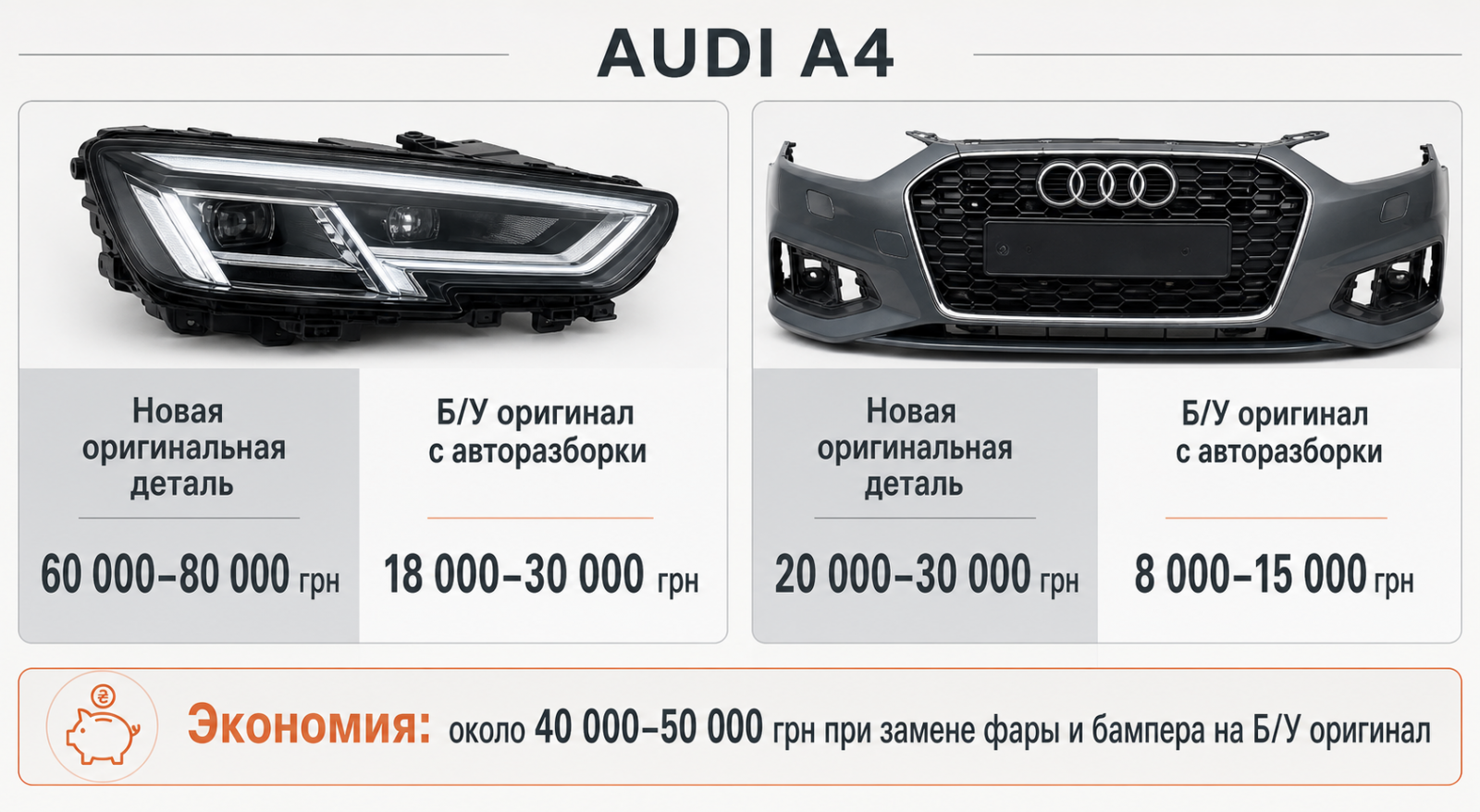
Even if the owner of this Audi A4 only buys one LED headlight and a bumper from a salvage yard, the savings easily reach 40,000–50,000 UAH compared to installing new, original parts. Using genuine, used parts from salvage yards like Aleto, you can get your Audi A4 back on the road without sacrificing quality, while staying within a more reasonable budget.
What do owners of such cars most often look for?
Body and optics
Owners of classmates of a wrecked car most often come to the dismantling for:
Wings and doors in the original color to minimize paintwork.
Used bumpers without cracks and with live fasteners, especially if new original body kits cost tens of thousands of hryvnias.
Original headlights—LED modules and ignition units—can cost as much as half the price of a standard car, so used headlights are a real way to save money.
For the owner, this is an opportunity to obtain an original part with the correct fit and factory geometry, but at a price 2-3 times lower than a new one.
Interior, wheels, electronics
No less in demand:
Seats, steering wheel, door panels and dashboard elements, especially for trim levels with electric drives and heating.
Original wheels, which are often sold as a set and are significantly cheaper than new branded wheel sets.
Multimedia units, climate control, amplifiers and other electronic modules, if they were not flooded or damaged by impact.
Some of these parts are shipped to other regions of Ukraine via delivery, so large auto dismantlers focus on online catalogs and nationwide shipping.
New, Replacement, or Used Original: Comparing Options by Price and Purpose
When deciding what to install after an accident—a new original part, an aftermarket replacement, or a used original from a salvage yard—it's important to consider not only price but also durability, compatibility, and safety. For many bodywork and optical components, used original parts offer a compromise that satisfies both budget and quality.
Approximate logic of choice:
A new, original part offers the highest level of reliability and predictability, but also the highest price; it's often chosen for relatively new and expensive vehicles, as well as for critical safety components.
The new equivalent is a cheaper option that is suitable for simple body parts, but sometimes differs in metal quality or fit accuracy.
Used original – factory quality with a history that requires verification; most often ideal for optics, body parts, mirrors, interior, and some electronics.
At the same time, many used parts suppliers offer inspection and a minimum warranty for startup/installation, which further reduces the risks for the buyer.
What to look for when buying a used part
Check the OEM number (or compare by VIN) to ensure compatibility by body type, year of manufacture, and configuration.
Inspect the fasteners: for body parts, headlights, mirrors and bumpers, the integrity of the ears and clips is critical for proper installation.
Check for signs of repair: putty, welding, soldering of plastic or a thick layer of sealant can hide old damage.
Assess the condition of the connectors and wiring - especially important for optics and control units.
Check the complete set of the part: does the headlight come with an ignition unit, does the door come with a lock, a window lifter and moldings.
Ask for photos from all sides, including the back and OEM number stamps.
Drivers' Mistakes When Purchasing Parts from a Car Dismantler
Buying a part "from a photo of the front" without pictures of the fasteners and the back: this results in the part not being aligned properly, causing gaps and vibrations. It's better to ask for close-up photos of all the fastening points and the back.
Ignoring the OEM number and Reliance simply because it "looks the same": slight differences in connectors or fasteners make the part incompatible. Always check the part number against the part number or VIN.
Purchasing electronic units without testing and without a return policy: risk receiving a faulty unit, especially after an accident or flood. It's worth checking whether the vehicle can be tested or if the starting warranty applies.
Save on safety: it's best to buy seat belts, airbags, and brake system components only if they've been tested and you understand their history.
Such mistakes often turn savings into additional expenses, so a smart approach to choosing used spare parts is critical.
FAQ
Is it possible to buy used headlights if the car was in a serious head-on accident?
Yes, but only if the headlight was removed from another vehicle not involved in a severe impact, and you've checked the OEM number, the integrity of the fasteners, the tightness of the housing, and the condition of the lens. It's important to ensure that the headlight wasn't overheated, flooded, or subject to amateur repair after an accident.
How do you know if a used part is safe to install after a serious impact?
You need to check the OEM number, take into account the year of manufacture and the restyling, and carefully inspect the part for signs of a strong impact: cracks, creases, welding marks, and thick layers of putty. If the donor car was in a serious accident, it is advisable to have the part undergo additional inspection at a rig or service station.
What parts should you avoid purchasing after a serious accident without diagnostics?
The most dangerous parts to buy blindly are turbochargers, control units, suspension components, and high-voltage modules from hybrids and electric vehicles: hidden damage from an impact or flooding can manifest itself on your car. Such components must be diagnosed by a specialist or purchased only with a test and a running warranty.
How safe is it to use body parts from cars that have been in serious accidents?
Fenders, doors, trunk lids, and bumpers can be installed as long as their geometry is intact and there are no signs of significant deformation of the supporting elements near the installation site. If there is any doubt about whether the metal has been pulled or the reinforcements have been cut, it's best to show the part to a body shop before purchasing.
Conclusion and recommendations
Even after a serious accident, a car rarely becomes completely scrap metal—many original body, interior, and electronic parts remain in good condition and are in demand on the used auto parts market.
For owners, this is an opportunity to significantly reduce repair costs by using proven original spare parts from a salvage yard, provided they are carefully selected by OEM number and inspected carefully.