The main reasons why a car pulls to the side
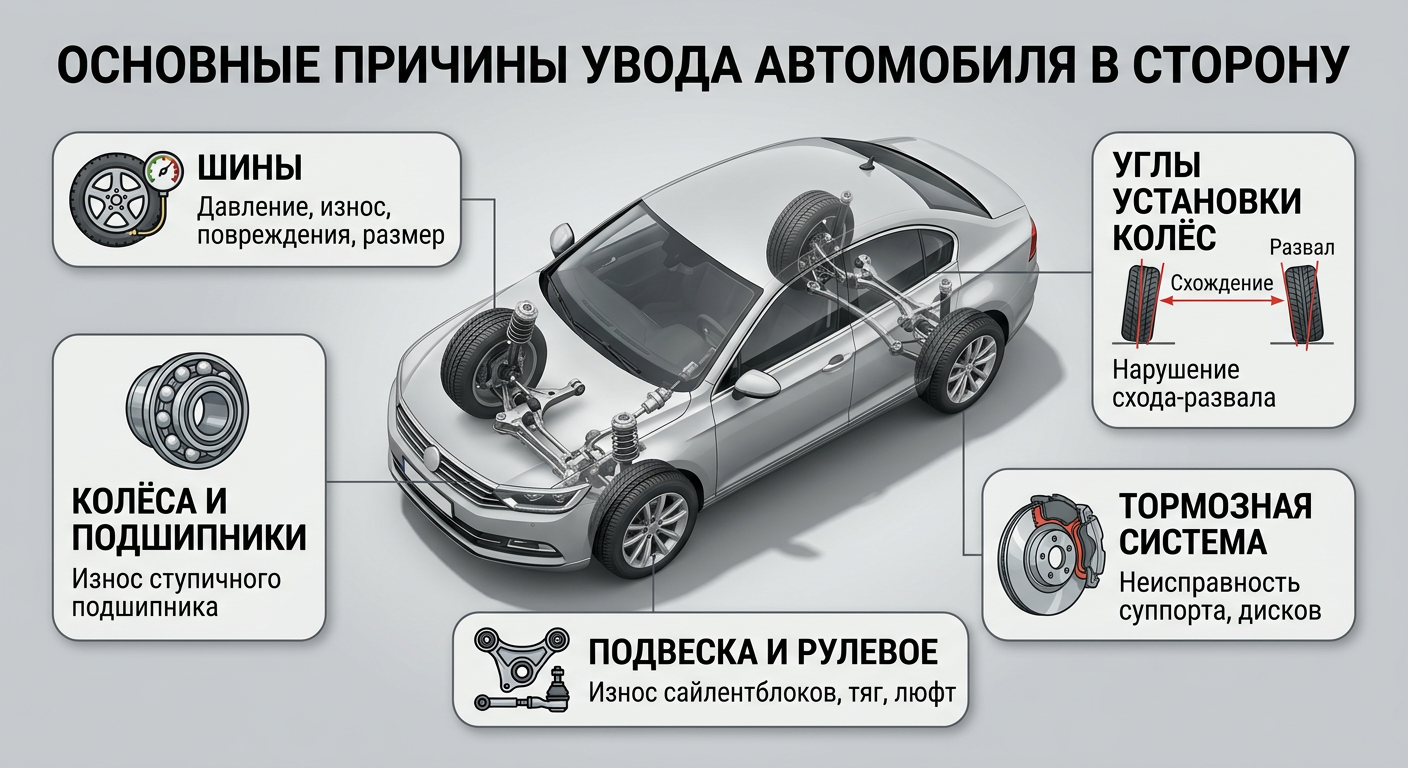
Incorrect tire pressure and condition
Different pressures in the left and right tires change the contact patch and rolling resistance, causing the car to pull toward the flatter tire.
Uneven wear, a broken cord, or a "bulge" on one tire also creates lateral force, especially at high speed.
A typical example: the front left wheel is 1–1.5 bar “flatter” than the right one, the car pulls to the left when driving straight and when braking.
Wheel alignment errors (wheel alignment)
The most common cause of vehicle pull is improper wheel alignment after hitting a pothole, a curb, or poor suspension repair. Incorrect angles (especially toe and caster) force the car to "search" for its direction, requiring constant steering adjustments.
Problems with the braking system
If the car pulls when braking, the most common cause is a sticking or partially seized caliper, uneven wear of the pads, or problems with the brake hose.
On the "weak" side, the brakes barely work, while on the opposite side, they over-brake, causing the car to pull sharply to one side. This is a critical safety defect.
Wear of suspension and steering components
Play in ball joints, steering tips, control arm bushings, worn shock absorbers and strut mounts cause wheel movement and changes in wheel angles under load.
When hitting bumps or braking, the car may “fall through” on one side, increasing the drift.
Defect or damage to wheels and bearings
Warped wheels, heavy impacts over potholes, bent rims and broken wheel bearings can cause steering wheel pull and vibration.
Bearing failure is often accompanied by a humming noise and heating of the wheel, and in the case of severe wear, a change in the trajectory of movement.
Signs and symptoms of malfunction
When you feel pulled to the side the most
If the car is constantly pulling away on a level road without wind, it is most often due to wheel alignment, tires, or suspension.
If the pull appears only when braking, first check the brake mechanisms (calipers, hoses, pads, discs).
Steering wheel behavior
The steering wheel is slightly turned when the car is driving straight, or slowly returns to the center position after a turn - a typical sign of incorrect wheel alignment or problems with the rack.
Rattling, beating or play in the steering wheel along with pulling is a reason to check the steering rods, ends and wheel bearings.
Additional warning signs
Visible uneven wear on the tread (shoulders are eaten away on one side, a “ladder” pattern on the tread) indicates problems with the wheel alignment or suspension.
Heating of one wheel after driving, increased amount of brake dust on one disc – typical symptoms of a jammed caliper.
The dangers of ignoring vehicle theft
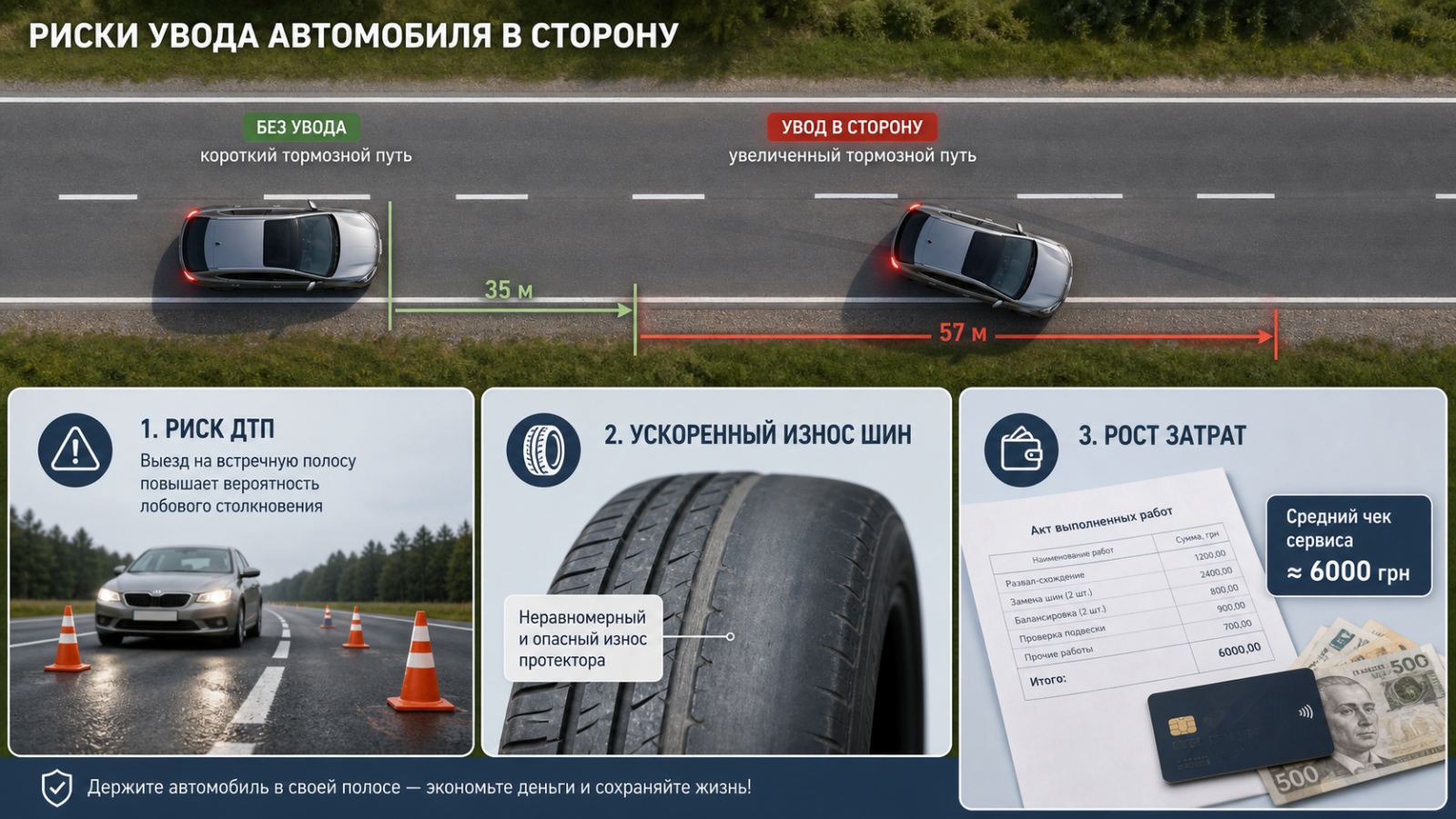
Increased braking distance and risk of accidents
When the car pulls away while braking, the braking distance can increase by tens of percent, and the car goes off course, especially on wet or slippery roads.
At high speed, uncontrolled drifting into the oncoming lane or shoulder can lead to serious accidents.
Accelerated wear of tires and suspension
Constantly driving with incorrect wheel alignment or different tire pressures leads to rapid tread wear, sometimes down to the cord.
Due to impact loads and improper suspension operation, shock absorbers, ball joints, and steering components fail faster, increasing the overall repair bill.
Rising maintenance costs
According to Ukrainian analytics, the average service bill (labor and parts) for a single visit already exceeds UAH 6,000, and ignoring minor issues directly leads to more expensive repairs.
Timely wheel alignment correction and replacement of worn parts is significantly cheaper than a comprehensive chassis overhaul.
What can you check yourself?
1. Tire pressure and condition
Check the tire pressure at least once a month or whenever your vehicle's performance changes; it should match the manufacturer's recommendations on the sticker in the door jamb or on the fuel filler flap.
Visually inspect the tread: look for “bald” spots, bulges, cracks, and differences in tread height on different sides of the wheel.
Helpful: swap the front wheels and take a short test drive. If the pull changes direction, there's a good chance the problem is with a specific tire or wheel.
2. Simple road check
On a flat, quiet road, release the steering wheel for a couple of seconds (while maintaining safety) and assess how far the car noticeably moves to the side.
Note under what conditions the pull is most pronounced: during braking, acceleration, or simply when driving at a constant speed. This will help the mechanic narrow down the search.
3. Monitor the brakes
After a short drive without aggressive braking, carefully touch the wheel rims (not with your bare palm, but through a glove or very carefully): if one wheel is significantly hotter, this indicates a problem with the brakes or bearings.
If the brake pedal "jerks" the steering wheel or the steering wheel itself moves to the side when braking, further brake diagnostics should be entrusted to a service station.
When is it necessary to contact service?
Situations when you can't delay
If your car suddenly pulls to the side whenever you brake or when driving at speed, this is a reason to immediately reduce speed and go straight to a service station without putting it off.
If, along with the pull, extraneous sounds (knocking, humming of the bearing, grinding when braking) or vibrations in the steering wheel appear, this could indicate critical wear of the part.
Why it makes sense to consider used original parts
For many models, original control arms, struts, calipers, and other components can be very expensive when new, especially for premium brands. High-quality used original parts from auto salvage yards allow you to save money while maintaining factory reliability: for example, an original control arm or shock absorber in good condition often lasts longer than cheaper alternatives.
In situations where the vehicle pulls to one side , steering tips, control arms, shock absorbers , and brake system components are often replaced—all of which can be found among genuine used parts if you need to optimize your repair budget.
If the cause of the pull is tires or wheels, it makes sense to consider options in the tires and wheel components category, comparing the size and load index with the vehicle manufacturer's requirements.
When the suspension is severely impacted, the body geometry is often damaged, so you may need parts from the body parts section – for example, subframe mounting arms, brackets, and reinforcements.
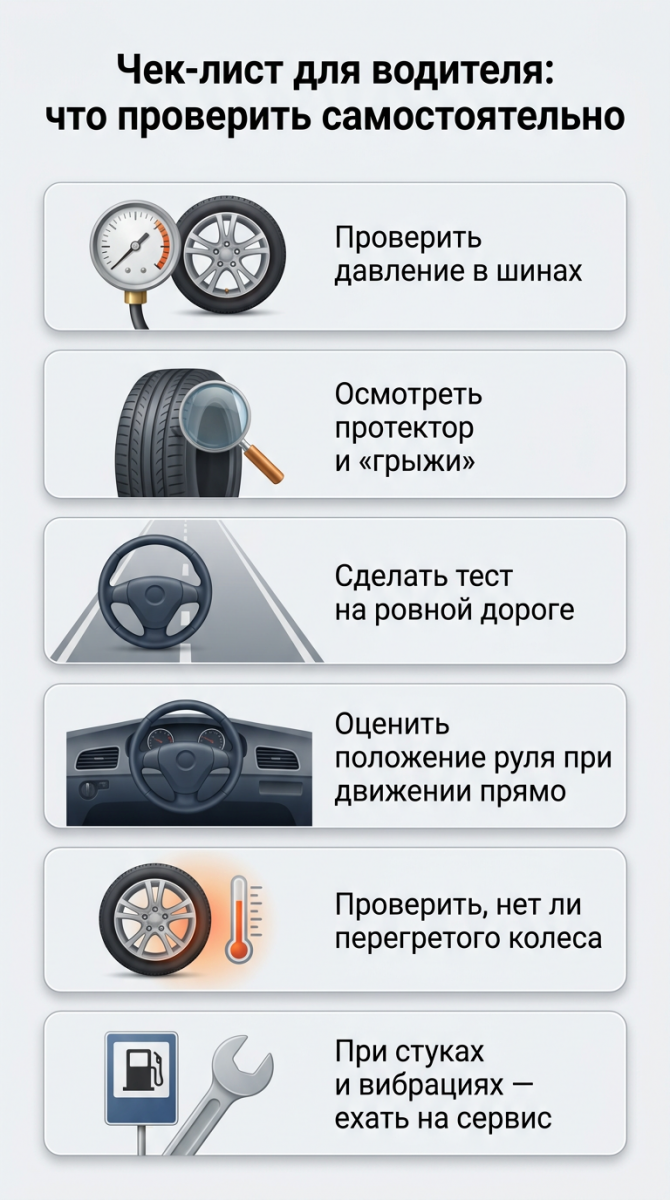
What and how to check: a checklist for drivers
Check the pressure in all tires according to the manual.
Inspect the tread for obvious uneven wear and "hernias".
Do a test on a flat road: when and how it pulls – always, when braking, when accelerating.
Assess the position of the steering wheel when driving straight ahead.
After a short drive, check to see if the wheel is overheated.
If you notice knocking/humming/vibration, don’t delay your visit to the service station.
The more accurately you describe the symptoms to the mechanic (the speed at which the pull is noticeable, the connection with braking, turns, and the type of road), the faster and cheaper the diagnosis will be.
Conclusion and recommendations
Car pulling to the side is not a “trifle,” but a symptom of a problem: from banal tire pressure to critical defects in the brakes and suspension.
A consistent approach (checking the basics yourself + having a professional diagnostic done at a service station) helps you quickly identify the source of the problem and avoid overpaying for unnecessary work.
The optimal repair cost can be achieved by combining high-quality used original parts from a car dismantler and competent service, especially when replacing expensive chassis and brake system components.
FAQ
The car only pulls when braking. Is it really the brakes?
In most cases, yes: a sticking caliper, uneven pad wear, or a problem with the brake hose are the most common culprits, but the suspension and tires should also be checked.
Is it normal for the car to pull slightly with the slope of the road?
A slight shift towards the slope (towards the side of the road) on a very “curved” road is acceptable, but on a flat surface the car should go straight without steering.
Is it possible to limit yourself to just wheel alignment if the wheel is pulling to one side?
If the suspension and steering are worn, a wheel alignment alone won't solve the problem; play and component defects must be eliminated first, and only then can fine-tune the alignment.
Is it dangerous to continue driving if the pull is small?
Even a small amount of pull accelerates wear on tires and suspension, and during an emergency maneuver or braking can play a critical role in losing control of the vehicle.
What is more profitable – new cheap analogues or used original parts?
For many chassis and brake components, used original parts from a reputable auto dismantler often last longer and perform more predictably than the cheapest new equivalents.