The main reasons why a car won't start
The situation of "turning the key but the engine is silent" is almost always related to the same components: power supply, starting, ignition, or fuel. Below are the most common causes, confirmed by the experience of service centers and auto clubs.
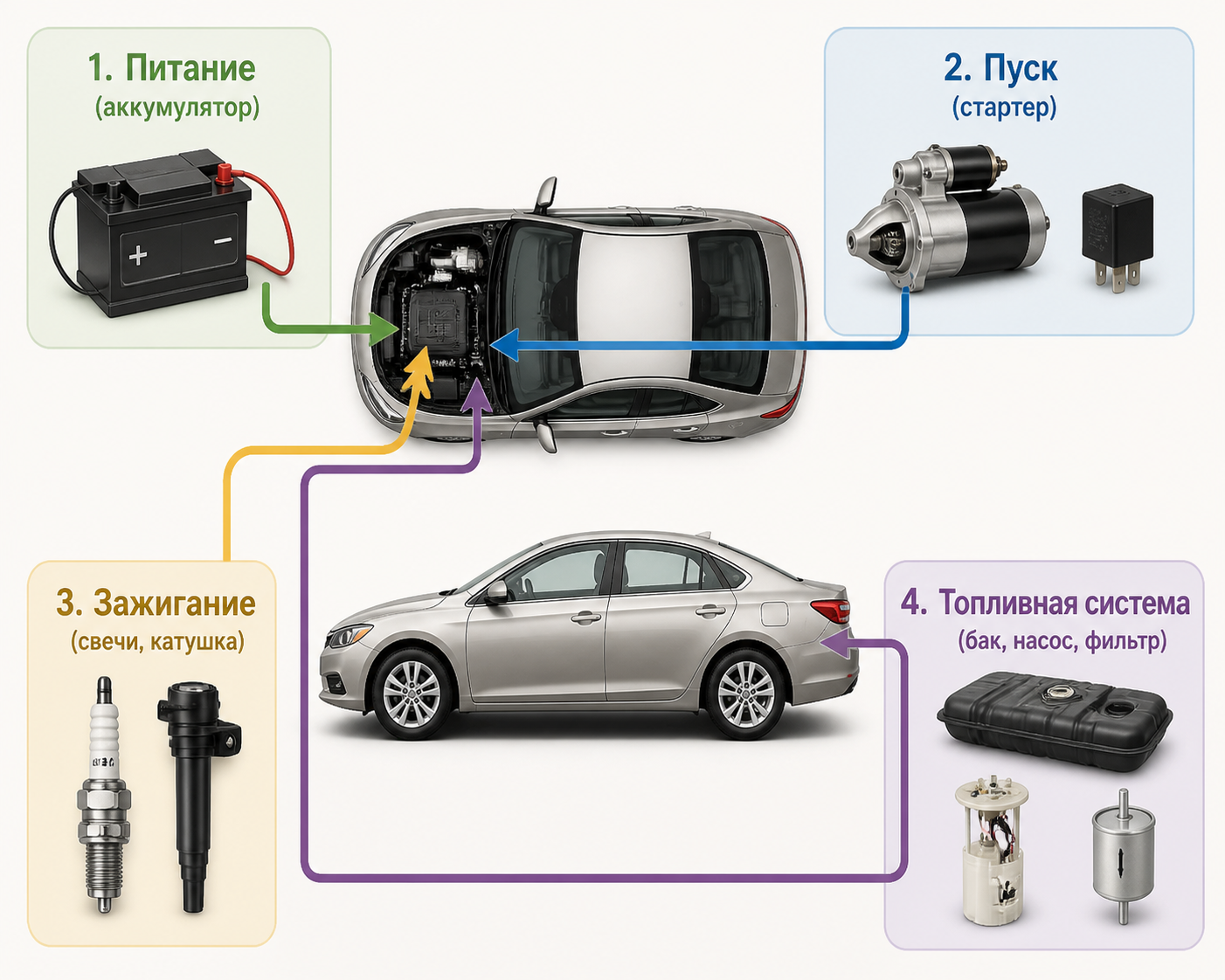
A discharged or faulty battery
According to road authorities, a dead battery is the most common reason a car won't start, especially in winter and after being parked for a long time. Symptoms include weak or no cranking of the starter, dim headlights, and a clicking sound when turning the key.
A new battery for mass-market models in Ukraine typically costs around UAH 2,500–4,500 in the mid-price segment, depending on the capacity and brand, according to Ukrainian online auto parts stores.
Faulty starter or its relay
If the battery is charged, but a single click or a series of clicks is heard when starting the engine, but the engine does not crank, the starter or starter relay is often at fault. Service centers indicate that wear of the starter relay, brushes, or mechanical damage to the starter drive are typical causes of starting failure.
The price of a used original starter for popular European and Japanese models on the Ukrainian market starts from approximately 2000–3500 UAH and up, depending on the brand, engine size, and condition of the unit.
Problems with the fuel system
Even a properly functioning starter won't start the engine if there's no fuel reaching the cylinders. The main options are:
Empty tank or incorrect fuel level sensor readings.
Fuel pump or its relay is faulty.
A clogged fuel filter causes fuel pressure to drop below normal.
Replacing a fuel pump, based on Ukrainian prices and including the cost of the part, can cost between 3,000 and 7,000 UAH or more, depending on the pump type (submersible, in-tank module) and brand.
Failures in the ignition system and electronics
Even if the starter is working properly and there is fuel, the engine will not start without a spark. Reasons:
Faulty spark plugs or high-voltage wires.
Ignition coil or ignition module failure.
Malfunctions of sensors (crankshaft position sensor, etc.) and the engine control unit.
Service recommendations emphasize that diagnosing electronic systems without a scanner is often ineffective—reading errors and checking sensor signals is necessary.
Immobilizer, alarm, and electronic glitches
Even a technically sound car may not start due to a blocked factory security system. Typically:
The car does not respond to turning the key or the Start/Stop button.
The immobilizer indicator on the panel is flashing.
The starter does not turn at all, while the other systems work.
Manufacturers and road authorities recommend first trying a spare key, replacing the battery in the key fob, and making sure the automatic transmission selector is in the "P" or "N" position.
Signs and symptoms of malfunction
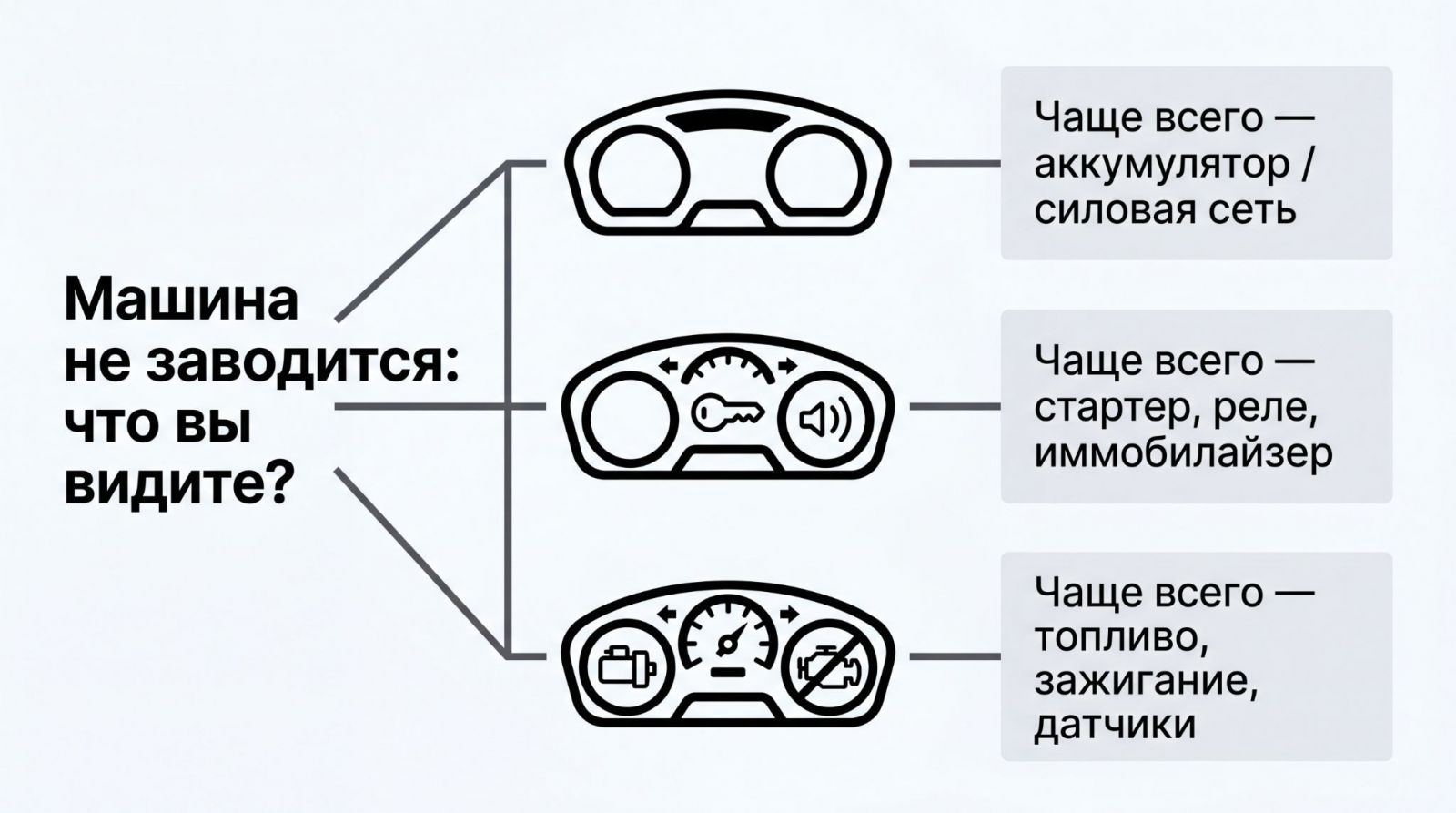
Based on the nature of the machine's behavior when trying to start it, it is possible to fairly accurately narrow down the range of causes.
The car shows no signs of life at all.
There are no clicks, the instrument panel does not light up, the central lock does not work.
This often indicates a deeply discharged battery, poor terminal contact, or a power failure.
There is power, but the starter does not turn.
The instrument panel lights up, there is light, but when I turn the key there is silence or a single click.
Possible causes: faulty starter, starter relay, ignition switch, or immobilizer blocking.
The starter turns, but the engine doesn't catch.
The engine turns over confidently or sluggishly, but does not start at all, or starts and immediately stalls.
The areas of suspicion include the fuel system, ignition, sensors, or heavily flooded spark plugs.
Unstable start-up, extraneous sounds and odors
A grinding, squealing or whistling noise when starting is a sign of problems with the starter drive or flywheel.
A burning smell or smoke coming from under the hood after multiple attempts to start may indicate overheating of the starter or wiring.
The dangers of ignoring the problem
Continuing to “crank it until it starts” is not just a bad habit, but a real risk to key components.
Overheating of the starter and wiring. Prolonged repeated starting attempts can cause the starter to fail and the wiring to melt.
Accelerated battery wear. Deep discharges significantly reduce battery life, especially in cold weather.
Risk of damage to the catalytic converter when constantly trying to start an “over-rich” engine.
A potentially dangerous road stop if the problem is left untreated and the first symptoms are ignored.
What can you check yourself?
Auto manufacturers and road authorities recommend a simple initial inspection procedure that most drivers can perform.
Inspect the battery and terminals
Visually inspect the terminals for signs of oxidation (white/green plaque) or loosening.
If you have a multimeter, measure the voltage: values significantly below 12.4 V at rest indicate a weak charge.
If you have wires and a second car, you can carefully try to jump-start the car, strictly observing polarity and safety recommendations.
Check fuel level and simple things
Make sure there is indeed fuel in the tank, especially if the level sensor has previously been unstable.
For cars with automatic transmission, check that the selector is in the "P" or "N" position - some cars simply do not give the command to start in other modes.
Inspect the fuse box for burnt out components in the starter or fuel pump circuit, referring to the diagram in the owner's manual.
Try a spare key or fob
If you suspect an immobilizer failure, manufacturers recommend trying a second key or replacing the battery in the key fob.
In some models, it helps to bring the key as close as possible to the reader zone (Start/Stop button or ignition switch).
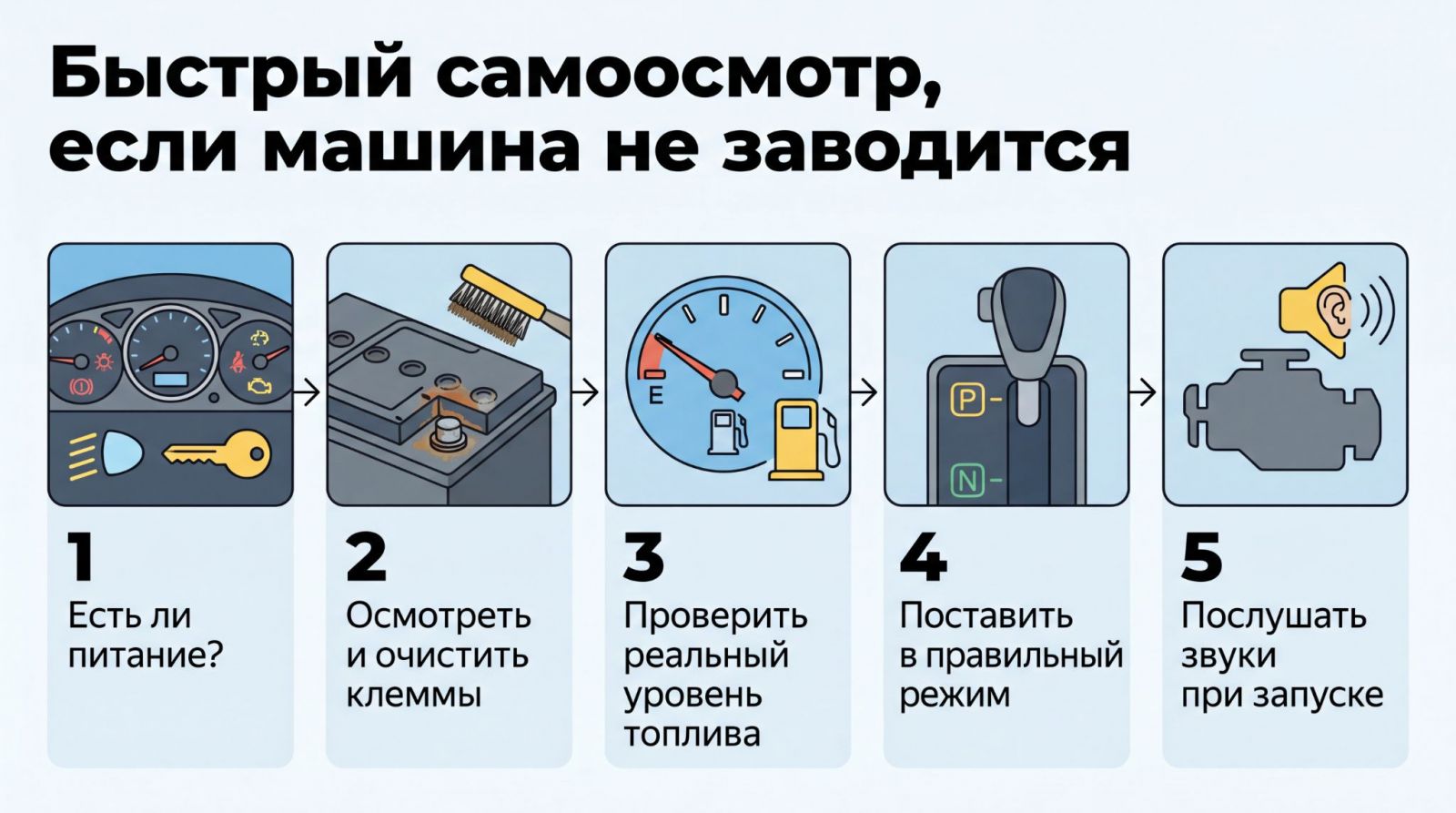
Checklist: A quick self-inspection if your car won't start
Step | Action | Comment |
1 | Check the lights and instrument panel | Is there any food at all? |
2 | Inspect the battery terminals | Clean plaque, tighten if necessary |
3 | Make sure there is fuel | Check the indicator and the actual level |
4 | Check the automatic transmission selector | Put in "P" or "N" |
5 | Rate the startup sounds | Clicking, scrolling, grinding sounds are important clues |
If after these steps the car shows no signs of life, you should not delay visiting the service center.
When is it necessary to contact service?
Professional diagnostics are especially important when the problem is not obvious or is recurring. It's best to visit a service center (or call a tow truck) if:
The starter does not turn at all, although the battery is working properly and the fuses have been checked.
The starter turns, but the engine does not catch, and extraneous sounds are heard under the hood or a burning smell is felt.
If the car periodically fails to start when hot or stalls immediately after starting, there may be problems with the electronics, sensors, or fuel system.
The dashboard displays engine, stability control, or immobilizer errors.
Modern diagnostics include reading error codes, checking sensor parameters, and testing circuits—checking this type of testing at home is virtually impossible.
Conclusion and recommendations
Don't ignore the first symptoms: slow scrolling, clicking, and unstable startup almost always mean that the unit is working "at the limit" and may fail completely at the most inopportune moment.
Start with the simple: the condition of the battery, terminals, fuel level, and fuses—you can check these yourself without any special equipment.
If problems persist and the cause is unclear, don't waste your starter and battery life—it's best to immediately contact a specialized service station or auto dismantler, where they can diagnose your vehicle and select the right parts for your model.
If your car won't start due to engine or electrical problems, it's a good idea to select verified used original parts by VIN or model specific to your car, so you don't overpay for a new original or risk it with cheap replacements.
FAQ
Why won't the car start in cold weather, even though the battery seems to be new?
Low temperatures reduce battery capacity and thicken the oil, making it harder for the starter to crank the engine; even a relatively new battery may fail if it's undercharged or sized too low.
The starter clicks but doesn't turn the engine over. What could this be?
Most often, the problem is in the starter itself (solenoid relay, brushes, mechanics) or in the starter power supply circuit, less often - in a deeply discharged battery that is not capable of delivering current under load.
Is it worth trying to push start a car?
Manufacturers and service centers warn that this method is dangerous for modern vehicles with catalytic converters and complex electronics, and can lead to additional damage. Therefore, it is better to use a proper jump starter or a tow truck.
Is it possible to continue driving if the car only starts on the second or third try?
A one-off issue is possible, but repeated starting difficulties indicate an impending failure of the battery, starter, or fuel/ignition system—it's best to get it diagnosed to avoid being left on the road.
What is more reliable: new non-original parts or used original ones?
According to auto experts, a high-quality used original component often performs just as well as an inexpensive new equivalent, while also guaranteeing compliance with the manufacturer's requirements for materials and specifications. Therefore, the choice depends on the brand of the aftermarket component and the condition of the specific used part.