The lyrical name "iron horse" fully reflects reality. The main material for creating a car is iron alloys and other metals. With prolonged contact with moisture, they rust, and the owner is faced with the task of how to remove rust from the car.
Contents
- Main spots of car rust appearance
- How to remove rust from car yourself
- Chemical method of treating rust on the body
- Advanced cases of car corrosion
- Conclusions
Main spots
The body of a vehicle is entirely made of steel. Although it is covered with several layers of paint and anti-corrosion substances, it cannot be called full protection. Constant contact with moisture (rain, melting snow, fog, etc.) can cause corrosion. Especially in places of scratches, chips, rubbing surfaces, or even poor treatment.
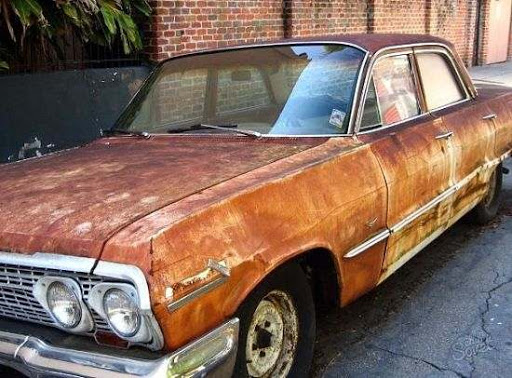
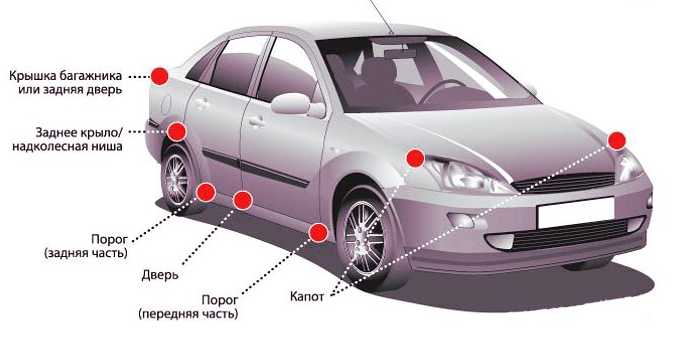
At first, rust spots appear on the body, and if not paid attention to, they can also develop inside. This is already a reason to think about how to remove rust from the car. Vulnerable parts include:
- • lower parts of the doors
- • sills
- • wings and wheel arches
- • joints of parts
- • hood
- • brake drums
- • exhaust system
- • dents after car events and accidents
- • poorly treated welds after repair
Timely removal of rust from the car is almost the most important rule for a car owner. Delay can lead to total and thorough corrosion of the body, which is not only unsightly but also dangerous. Rust spots on the car are a manifestation of oxidation, miniature spots that may not be noticed immediately, and then be surprised by the presence of scales and even holes. They harm not only the owner but also the seller. A product with such defects will be difficult to sell for the desired amount. If at all possible. Then the buyer gains an advantage in negotiations and has a chance to purchase an excellent option with a minor defect for a lower amount.
Moreover, removing corrosion from the car body can be done independently at home. Sometimes, only after customs clearance, "rust spots" become visible. And if the purchase arrived from the USA across the entire Atlantic Ocean, it is quite possible that the "infection" was picked up on the road. Then removing rust from the car is inevitable. In advanced cases, it is better to go to an auto repair shop.
How to remove rust from car yourself
With the onset of October, the humidity of the air and the amount of precipitation in our expanses increases. And with the arrival of frosts and snowfalls on the roads, aggressive salt solutions are used against ice. Therefore, during this period, it is better to allocate one day to identify and remove corrosion from the car body. Especially now, when the coronavirus is spreading around the world and most activities have become unavailable. If there are suspicions that the car is rusting, the main thing is not to panic.
The first step in repairing rust on a car is a thorough inspection of all body components, joints, welds, and compartments where water can accumulate. Pay attention to rust spots and paint swelling, while large manifestations will be visible to the naked eye. After identifying problem areas, you can proceed to the direct treatment of rust on the car.
The first rule of the procedure is complete cleaning to undamaged metal. It is carried out mechanically or chemically depending on the degree of damage and accessibility. Removing rust from the car body is done using such tools:
- • hand brushes
- • brush attachments for a grinder or drill
- • sandpaper
- • grinder with wheels
- • chisels, chisels, cutting wheels
For minor damage, sandpaper will be sufficient, while in critical cases, the entire arsenal will be needed. There are no secrets on how to remove rust from the car body - you need to clean all the detected areas of "rust plague" until clean metallic shine appears. This will be a sign that you have reached undamaged material. Sometimes it is necessary to remove the paint around a large rust spot. All these actions to remove corrosion from the car body can be done at home.
Chemical method of treating rust on the body
However, neither in a personal garage nor in a workshop, mechanical cleaning, even with a sandblasting machine, will not solve the problem completely. Rust on the car penetrates deep inside, where only autochemistry can reach. Therefore, the cleaned area is treated with converters and other substances. Without chemistry, it is impossible to remove oxidation in hard-to-reach areas - in hollow parts (longitudinals, for example), drainage holes.
There are several options for treating a car from rust:
- • classic acid converter
- • neutral liquid solution
- • with an additional protective film in the form of a gel
- • with primer qualities
- • paste that needs to be removed later
All of them are applied to a degreased, dry, clean, dust-free surface. Before treating rust on the car body, it is important to study the instructions for use and the principle of action. Some products need to be mixed, some need to be diluted, and so on. Some give the effect of slowing down the spread, while others neutralize oxidation at a microscopic level. Treating rust on a car with "chemistry" affects the surface differently. For example, there are products that act as a primer for subsequent painting, while others must be washed off the treated areas.
If the removal of rust from the car body was successful, you can proceed to the finishing (priming, puttying) and painting.
Advanced cases
When a car owner did not have time for preventive body treatment, and it simply rotted, the only way to save it is to visit a service station for rust repair on cars by "surgical" means. Signs that cannot be handled on your own are:
- • delamination of affected iron
- • through holes of large diameter (as if after a shotgun at close range)
- • lack of part of the detail, "eaten" by rust
Advanced rust on a car not only looks disgusting but also becomes dangerous. Water enters through holes in the body, which can cause a short circuit in the wiring and disable the vehicle at the most unexpected moment on the road. Not to mention that due to damaged elements, door locks stop working, doors do not open, headlights get stuck, and other unpleasant things happen.
Removing corrosion from the car body and its internal parts is impossible without welding, cutting, and spare sheets for patches. Sometimes it is faster and cheaper to replace a body component than to restore it. This primarily concerns fenders, trunk lids, and hoods. Before removing rust from the car, it is better to study the feasibility of this measure.
If the frame, cabin pillars, sills have suffered critical damage, the only way out is to cut. The master removes weak sections by simply cutting them out. Traditional rust treatment on the body with cleaning and chemical dissolution is applied to the "healthy" contact areas. A patch of similar size and thickness is welded to the vacant space. The seams require additional attention. Small irregularities are covered with special putty.
Conclusions
Careful and attentive operation along with proper storage will help avoid questions on how to remove rust from the car body. If this could not be avoided, panicking in this matter would be a mistake. Removing rust from the car is within the reach of every owner, and you do not need a specialized education for this. Any doubts on this matter are dispelled after consulting with professionals who will advise on how to treat rust on the car body in a personal garage. The main thing to remember is that saving property will always be possible.
See also:
- camry 55 usa
- ford edge parts
- ford escape dismantling
- ford focus 3 dismantling
- ford fusion 2017 dismantling
- volkswagen jetta dismantling
- parts for passat b7 American
- headlights passat b8 American
- toyota camry 70 dismantling
- toyota highlander 2014
- nissan rogue door