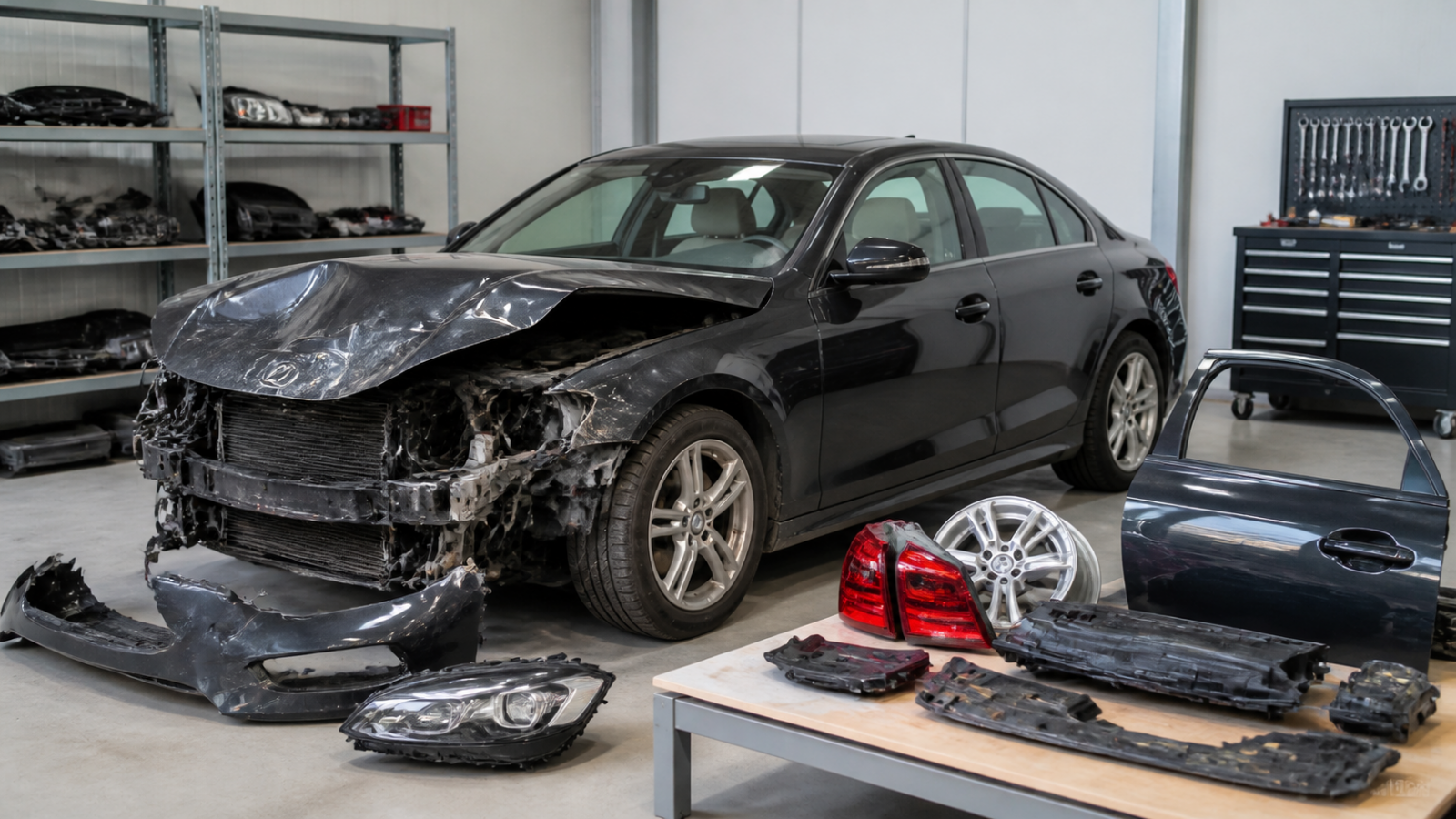
Imagine this: a minor accident, a headlight cracks and a bent fender. The service station quotes the price of new original headlights—18,000–25,000 hryvnias each—but when you add the bumper, mountings, and paint, the repair cost suddenly approaches the cost of a minor engine repair.
As a result, the owner begins to look for ways to save money, and the choice is usually between a cheap new equivalent and an original used part from a car dismantling yard.
In this article, we'll explore why an original used part is sometimes more cost-effective than a cheap new equivalent, what to look for when purchasing, and when it's best not to skimp at all.
Relevance of the problem
In recent years, the cost of new original spare parts has increased in line with new car prices and exchange rates—this is particularly noticeable in optics, electronic components, and add-on parts.
For many owners of mid-range cars, the repair bill after even a minor accident has become comparable to several monthly salaries. A pair of modern LED headlights easily runs 40,000–60,000 hryvnias, and adding a bumper with parking sensors and a radar sensor increases the cost even further.
At the same time, the cars themselves have become more complex: body elements are now often “tied” to driver assistance systems (ADAS), parking assistants, and all-round cameras.
Choosing a cheap replacement can lead to problems with radar calibration, incorrect operation of security systems, and a constant string of errors on the dashboard.
Against this backdrop, interest in genuine used parts from auto dismantlers is naturally growing: you can get factory quality and correct geometry for a more reasonable price.
Which parts are most often damaged and where the choice is especially important
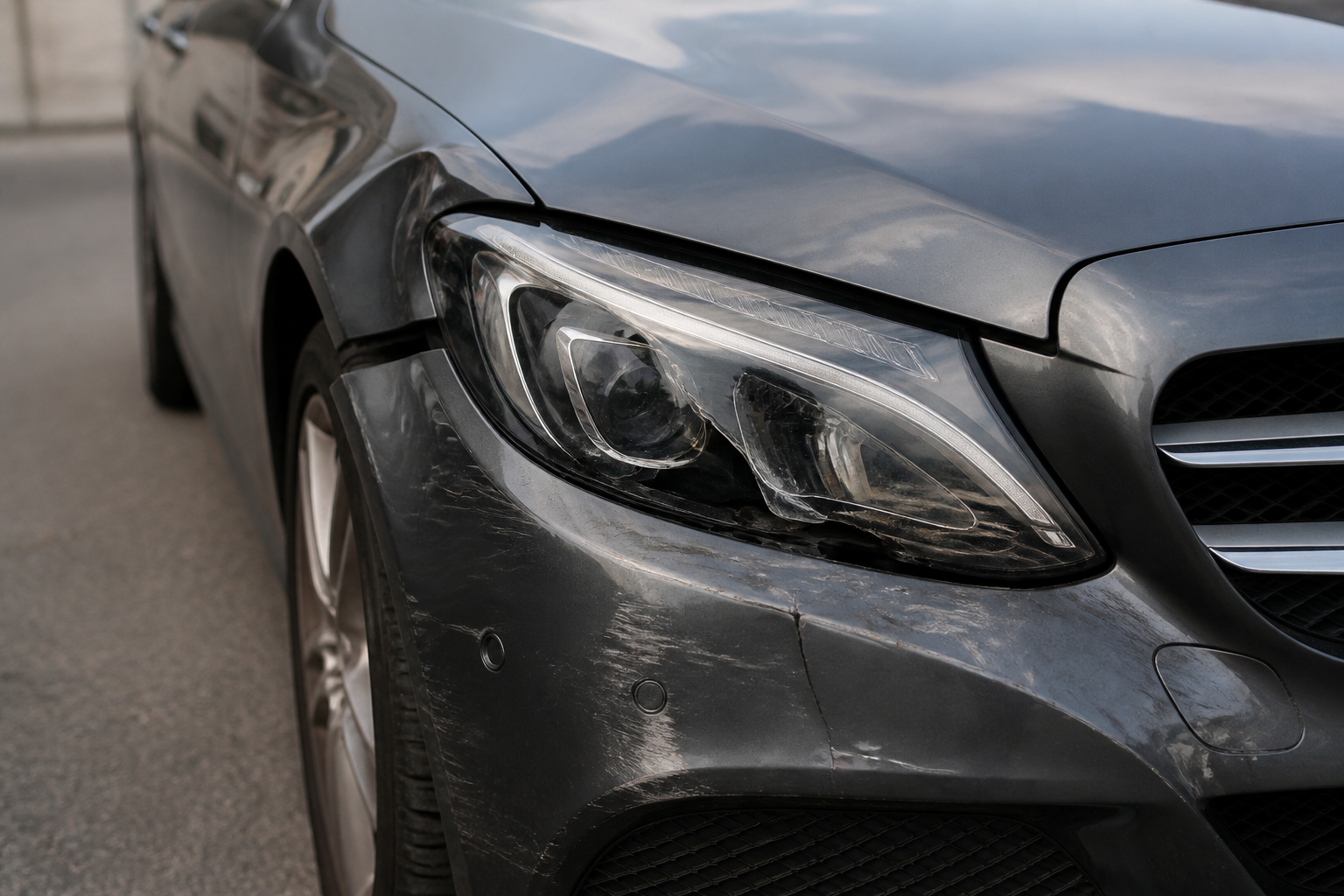
Headlights and light control units
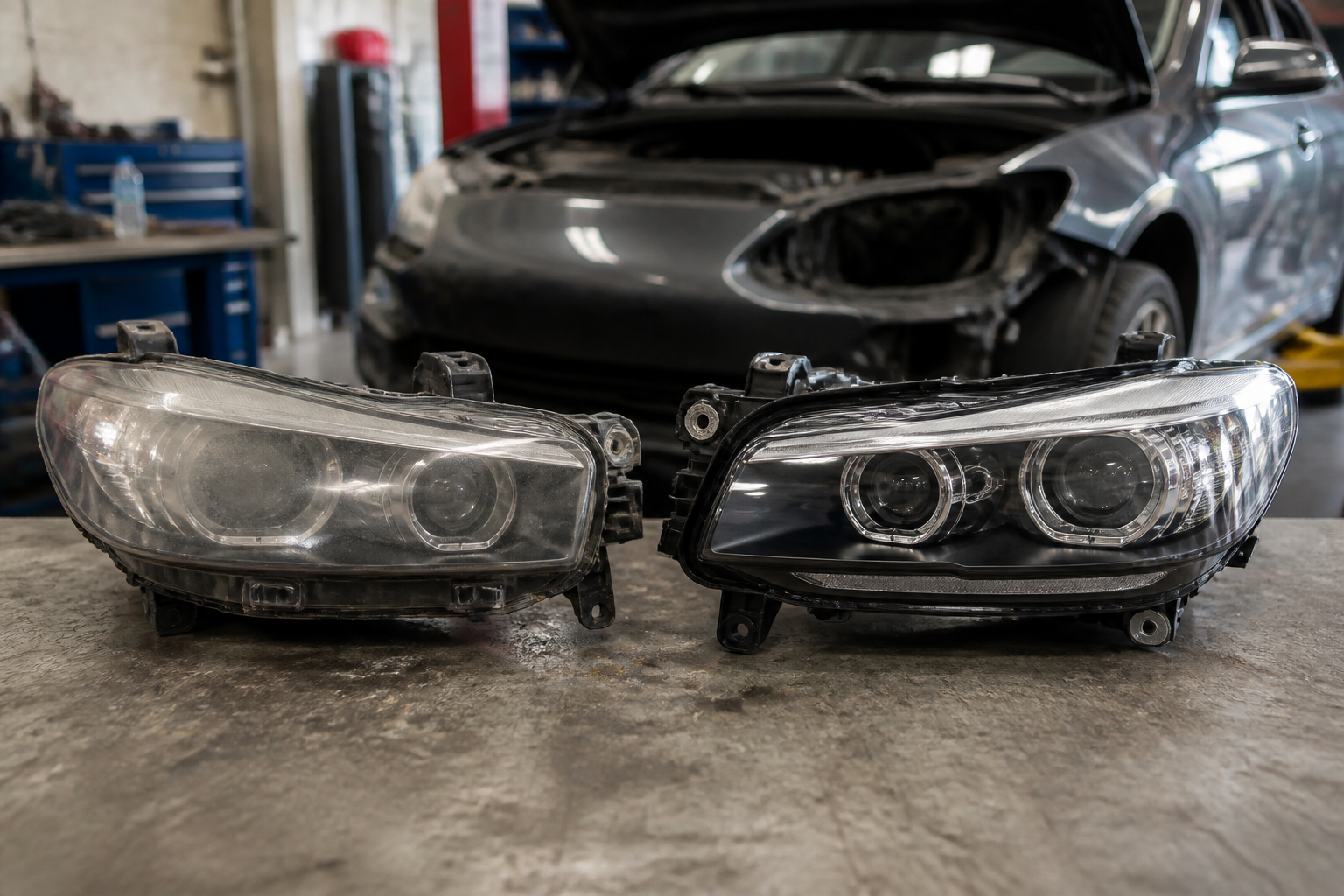
A modern headlight is more than just a reflector and lens, but a complete module with ballast units, LED drivers, lenses, and complex optics. Cheaper alternatives often suffer from poor plastic quality, sealing, and light accuracy, causing the headlight to fog up more quickly, fog up, and produce less light than the original.
An original used headlight with a good housing and fasteners often lasts longer and better than a new no-name part, especially on cars with LED or xenon optics.
Bumpers with sensors and radars
The front and rear bumpers of new cars are no longer just plastic, but a platform for parking sensors, cameras, and radars for adaptive cruise control or lane-keeping systems. Cheap, aftermarket bumpers often have varying plastic thickness and stiffness, which can cause gaps to become distorted and sensors to malfunction.
An original used bumper, even with minor cosmetic defects, usually fits better in place and does not require “adjustment” by grinding and cutting.
Mirrors with cameras and heating
Modern car mirrors are equipped with turn signal repeaters, 360-degree cameras, temperature sensors, power folding, and position memory. When replacing them with aftermarket parts, you may encounter incompatible connectors, missing features, or a more fragile housing that is more likely to wobble and vibrate.
An original used mirror with the same options and OEM code is most often installed “bolt-on” and fully retains factory functionality.
Hoods, fenders and doors
For body parts, the key parameters are geometry, metal thickness, and the quality of the anti-corrosion coating. Cheaper alternatives sometimes have different curves, which affects gaps, body lines, and the overall appearance of the car.
An original used hood, fender, or door with minimal damage and original geometry often saves the painter and body shop time and ultimately reduces the overall repair bill.
Control units and wiring
Electronic control units (ECUs) for the engine, automatic transmission, climate control, multimedia, and wiring harnesses are all expensive components in the original equipment. Newer replacements are often either unavailable or have limited software compatibility and require custom modifications.
A used original unit with the correct part number and history from a working vehicle is often a more predictable solution, provided proper diagnostics are performed before installation.
What to look for when buying a used part
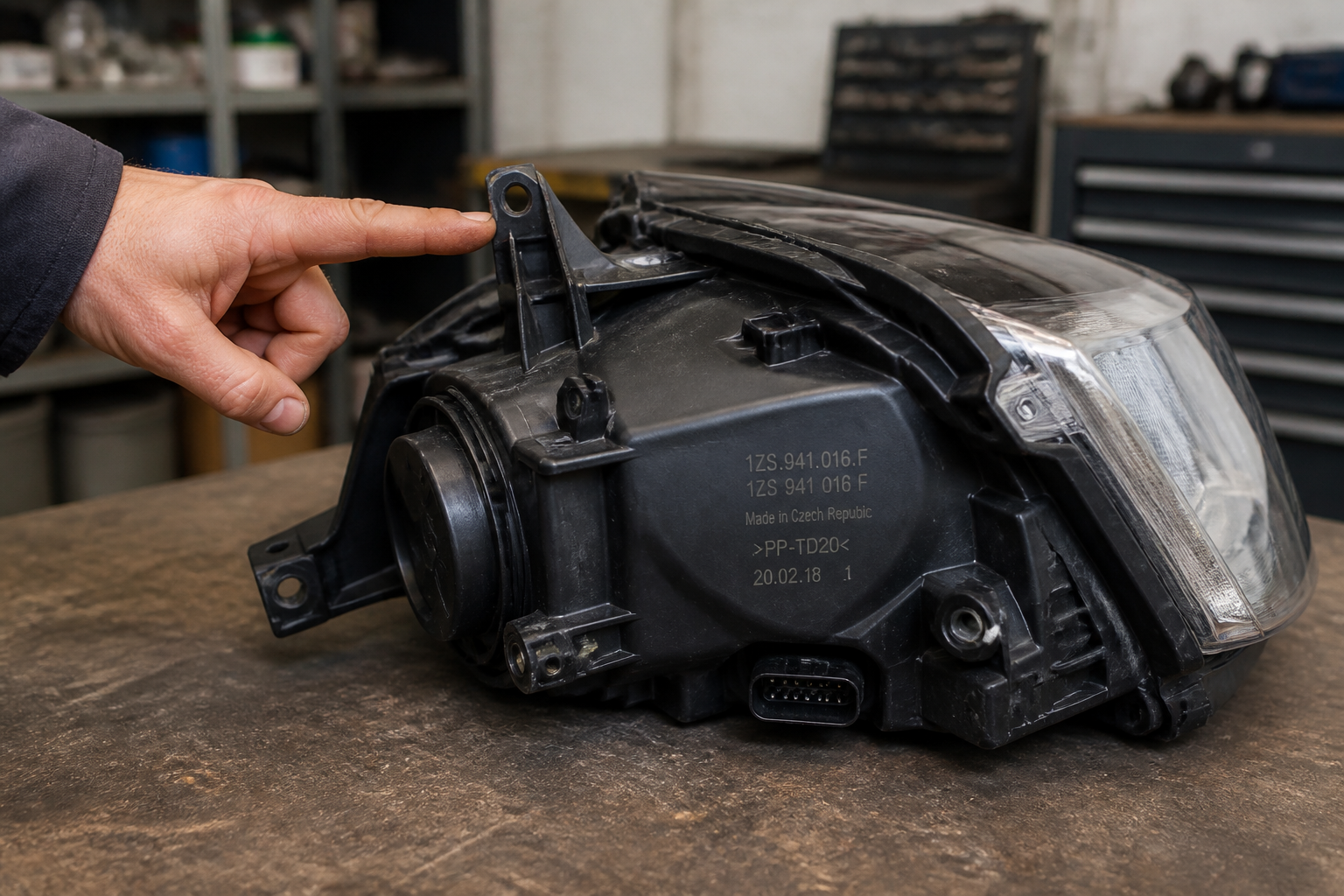
This block is the main tool to avoid making a mistake when choosing a spare part from a car dismantling site.
OEM part number. Check the original part number against the catalog or your old part—this increases the chances of a proper fit without any hassles.
Compatibility by model and year. Even within the same model generation, there may be restylings, different trim levels, and different markets (Europe/USA), which may result in differences in mounts, connectors, and firmware.
Condition of the fasteners. Check all lugs, mounting points, and bolt threads. Cracks, glued-on joints, "farm-grown" metal, or screws are a sign to think twice.
Signs of repair. Look for traces of plastic soldering, thick layers of putty, uneven sealant, or non-factory seams. This is especially true for headlights, bumpers, and body panels.
Cracks, chips, corrosion. Minor cosmetic defects are acceptable, but cracks in stressed areas or severe rust on load-bearing components are a reason to refuse the purchase.
Condition of connectors and wiring. Connectors should be intact, without scorched contacts or oxidation. Damaged insulation or twisted connections pose a risk of future problems.
Part kit. Check whether the kit includes the control unit, sensors, wiring, covers, plugs, and plastic parts. For example, a headlight may be sold with or without the ignitor.
Photos from all sides. Ask for real, high-quality photos: general view, close-ups of fasteners, connectors, markings, and part numbers.
Inspection warranty. Having at least a minimal warranty on installation and inspection of the part (e.g., 7-14 days) reduces the risk for the buyer and demonstrates the auto dismantler's serious approach.
New part, analog or used original
Below is a basic table that will help you understand when each option is appropriate in your particular situation.
Part replacement option | Pros | Cons | When it suits |
New original part | Maximum compatibility and resource | High price, waiting for delivery | New and expensive cars, safety details |
New analogue | Lower price than the original | There may be differences in quality, geometry and plastic | Simple body parts without electronics |
Used original | Factory quality and fit, reasonable price | It is necessary to carefully check the condition and history | Optics, body, mirrors, interior, some electronic units |
In many real-life cases, cars are given a new lease of life after an accident thanks to a combination of new consumables and genuine used parts, which allows for a reasonable budget. This is especially true for mass-produced models, which are actively dismantled and have a good selection of parts available at auto dismantlers.
A real example from a car dismantling yard
Car: Toyota Corolla 2019, gasoline, automatic.
Damage: Impact to the front left corner after a minor city accident. The headlight, bumper, left fender, some mountings, and bumper reinforcement were damaged, but the radiators were intact.
Option 1 — everything is new and original: a headlight costs around 22,000 UAH, a bumper for painting costs 10,000–12,000 UAH, a fender costs 8,000–9,000 UAH, plus labor, painting, and minor consumables—the total bill easily exceeds 55,000–60,000 UAH. Option 2 — original used parts from a car dismantler: a headlight costs 9,000–12,000 UAH, a primed bumper with intact mounts costs 6,000–7,000 UAH, and a fender costs 4,000–5,000 UAH.
As a result, the owner saves 20-25 thousand hryvnias on hardware alone, while maintaining the correct geometry and factory quality of the parts.
The main thing is not to chase the lowest price, but to look at the condition of the fasteners, the absence of hidden damage, and the matching OEM numbers.
Drivers' Mistakes When Buying Used Parts
Mistakes are what turn savings into unnecessary expenses. Below are typical scenarios that auto dismantlers and service stations often encounter.
Error | What is dangerous? | What is the correct way? |
Buying a headlight without checking the mountings | The headlight will not fit straight, gaps and vibrations will appear. | Ask for detailed, close-up photos of the fasteners |
Ignoring the OEM number | The part may not fit the connectors and fasteners. | Always check the OEM code against the catalog or the old part |
Buying a control unit "from a photo" | The risk of receiving a unit with different firmware and errors | Check the number, compatibility and the possibility of verification |
Selecting the cheapest replacement body part | Incorrect geometry, gap problems | Compare with the original, see reviews by brand |
Ignoring traces of repair on a part | Hidden cracks and weak spots in load-bearing areas | Inspect the seams, soldering, putty layer, ask questions |
Purchase without verification guarantees | If there is a hidden defect, money will be lost. | Choose sellers with clear return policies |
When choosing a used, genuine part, it's important not only to find a "similar" part but also to ensure the OEM number, configuration, and condition match. At auto dismantlers, it's important to verify in advance which parts fit your car by VIN, request detailed photos of the fasteners, connectors, and markings, and discuss inspection and return policies. This allows you to combine savings with safety and avoid spending money twice.
FAQ
Is it possible to buy used headlights?
Yes, if it is an original headlight with intact mounts, good optics and a matching OEM code, and it is also possible to check for leaks and functionality.
How do I know if a used part will fit my car?
Check the OEM number, specify the model, year, and trim level of the vehicle, and compare the connectors and fasteners using photos or during an in-person inspection.
What is better: a new analogue or a used original?
For simple body parts without electronics, high-quality analogs can be considered, but in the case of complex headlights, mirrors, and electronic units, the original used version often wins.
Is it possible to return a used spare part if it doesn’t fit?
This depends on the conditions of a particular auto dismantling facility, so check in advance whether the part can be returned or exchanged, and when it will be inspected.
Conclusion and recommendations
An original used part often turns out to be a reasonable compromise between the high price of a new original and high-quality, but still resource-saving analogues.
This is especially true for expensive body parts, headlights, mirrors, interior components, and electronic components, where factory quality and precise fit play a key role.
The main thing is not to buy blindly: always check the OEM number, carefully inspect the condition, and don't hesitate to ask the seller specific questions, backing them up with photos and inspection agreements.