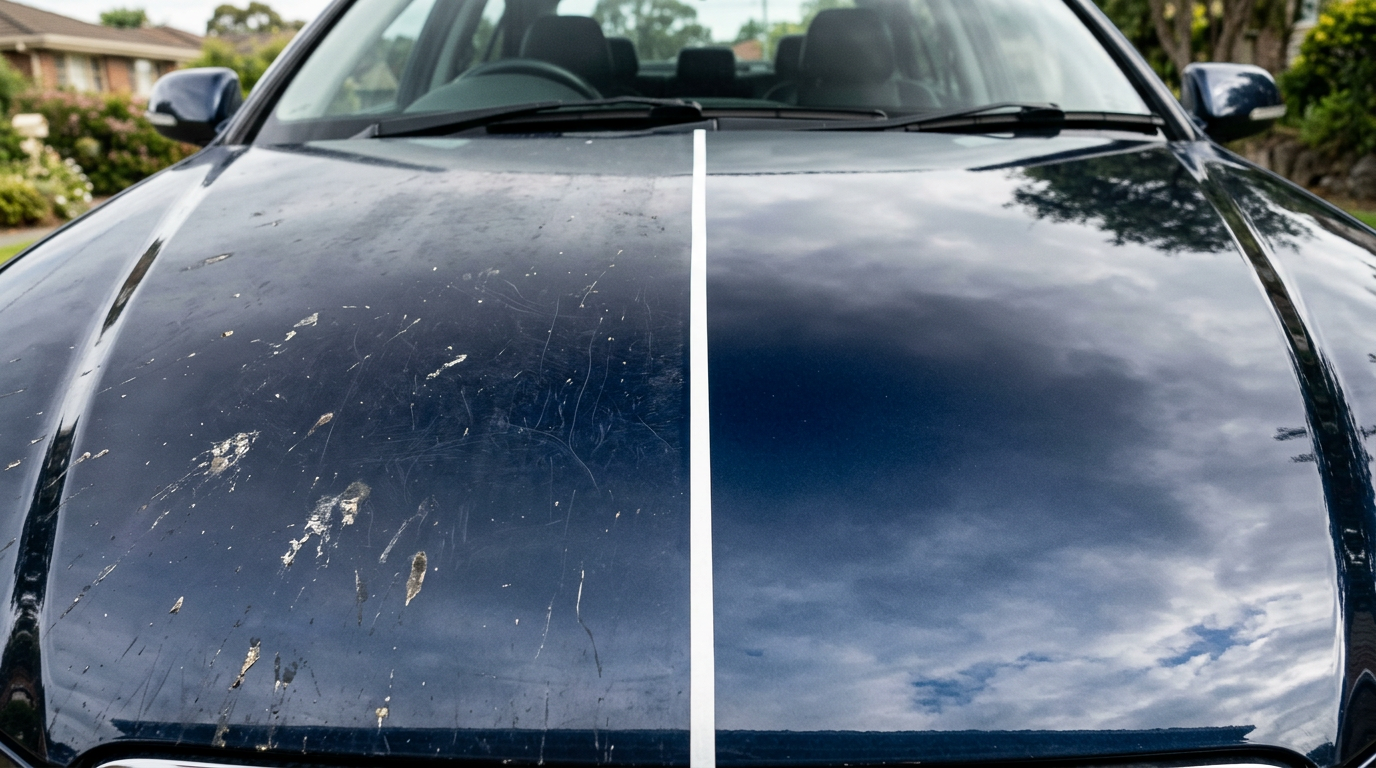
You drive out of the car wash, your car gleaming, its paintwork sparkling in the sun. A couple of hours later, you discover the first traces of bird droppings and resin drips from a nearby tree on the hood. By the next day, these "spots" have turned into matte streaks and eaten into the paintwork.
It's a similar story with dried insects left on the road: it seems like a small thing, but if you try to wipe them off with a hard sponge several times, shallow but noticeable scratches appear.
For many drivers, this looks like a cosmetic defect that can be "polished off later." In reality, however, acidic bird droppings and tree resin can literally burn away the top layer of paint, and rough cleaning can destroy it mechanically. The longer you wait, the higher the risk of ending up repainting the part or searching for a used bumper, hood, or door at a salvage yard.
In this article, we'll discuss how to safely clean resin, insects, and bird droppings from a car body, which products actually work, what should absolutely not be used to remove paint, and when it's time to consider moving away from it. Along the way, we'll highlight when paint restoration is justified, and when it's more cost-effective to replace a used part with genuine body parts from a salvage yard.
Why is this topic particularly relevant now?
Modern cars increasingly feature soft, high-gloss paints, enhanced corrosion protection, and complex multi-layer coatings. While this is good for appearance, it makes the paint more susceptible to aggressive contaminants and improper hand washing.
The situation is getting worse:
the growing share of city parking under trees—it's comfortable in the shade, but there's a constant risk of resin and bird droppings;
the popularity of regular "self-washing" in the yard: quickly wiping a stain with an old rag or a hard sponge is a normal habit that often ends in scratches;
The active import of used cars from the US and Europe—many cars already arrive with damaged paint, and any new attack of resin or manure finishes it off.
In a situation where even a small repaint can cost several thousand hryvnias, and a new original bumper or hood can cost tens of thousands of hryvnias, the need for proper paint care and a clear alternative in the form of used original body parts from a car dismantler becomes a very practical matter of saving money.
A real-life example: a "regular" parking spot under a tree
Let's imagine a typical situation: a 2018 Toyota RAV4 crossover is parked for several days under spreading trees near a house in the summer. After a rain, there are dozens of tar and bird droppings on the hood and roof, some of which the owner only noticed a week later.
The first thing that catches your eye when inspecting at the service center:
The varnish on the hood has become cloudy in several places, microcracks and light “burnt” spots have appeared.
On the roof there is a chain of small chips and scratches from attempts to wipe off dirt with a dry cloth.
The front bumper is covered with a layer of dried insects, and there are marks from a hard sponge along the edges.
After the diagnosis, the technician honestly says:
Local polishing will save some of the stains and restore the shine, but it will not be possible to completely remove the “burnt” areas of the varnish;
The hood can be restored, but it's on the verge of being damaged - if the damage gets worse, it will be cheaper to install a used original hood in the same color from a car dismantling yard;
A bumper with multiple scratches from improper insect cleaning is already a candidate for replacement with a used original, especially if there are cracks and abrasions along the edge.
As a result, the owner:
saves on repainting by taking a used bumper and, if necessary, an original hood from a dismantling site, rather than ordering a new one;
some parts (wings, doors) are left original, limited to polishing and protective coating;
understands that next spring it is worth either avoiding parking under trees, or at least regularly washing off resin and droppings with warm water and car shampoo.
Safe car body cleaning: which products work and which are harmful
What contaminants are the most dangerous for varnish?
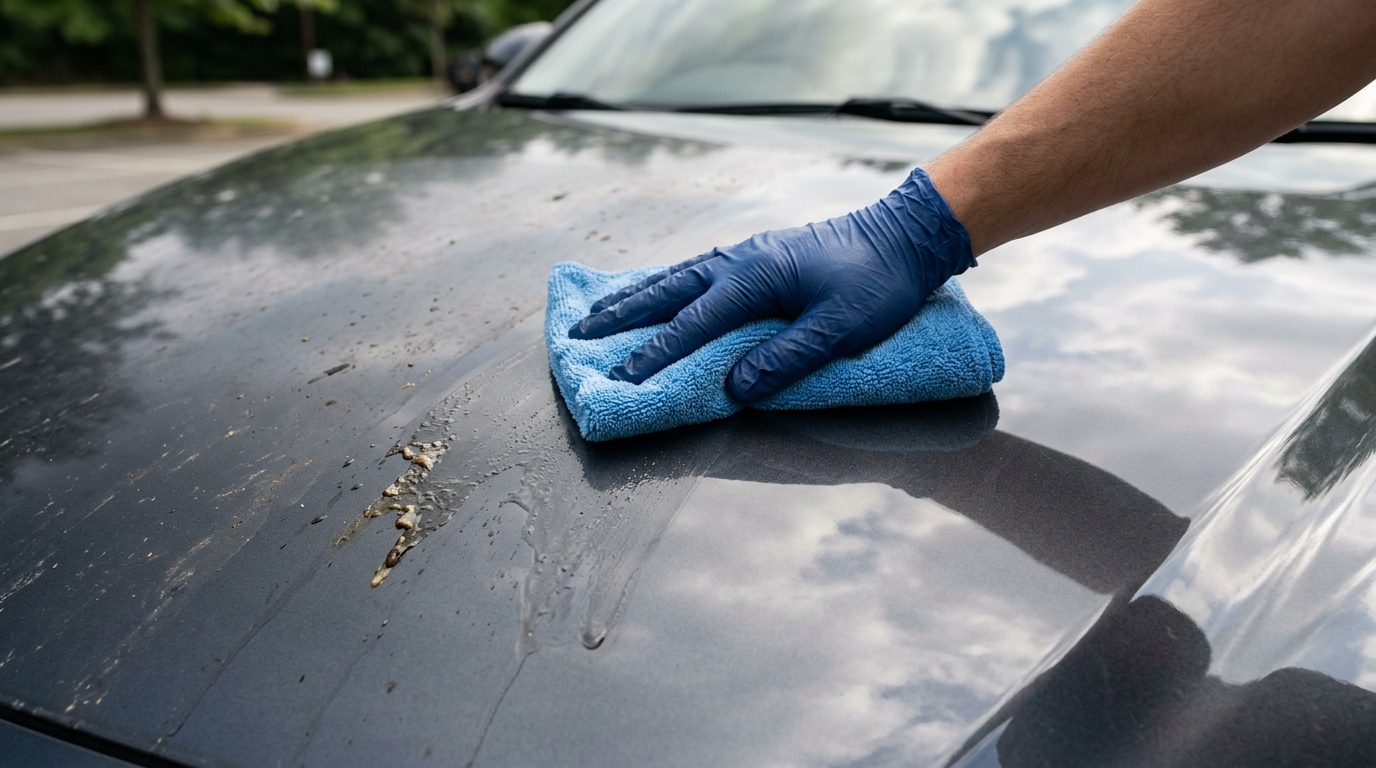
Bird droppings contain acids that quickly corrode paint, leaving dull stains and pits. The longer the stain remains on the car body, the deeper the damage.
Tree resin is thick and sticky, often hardening and bonding with the varnish like glue. Trying to peel it off with a dry cloth can easily remove part of the protective layer.
Insects are organic residues that bake onto the varnish in the heat and turn into a hard, abrasive coating.
The key principle: any such stain must first be softened and then carefully removed. Any attempts at dry scrubbing or using harsh solvents are often more costly than a careful wash or an inexpensive specialized cleaner.
Special cleaner: pinpoint strike on resin and litter
Professional resin, bitumen, and organic stain removers are designed specifically for automotive paintwork: they dissolve the stain but, when used correctly, do not damage the finish.
How to use:
apply the product to a stain of resin, droppings or a thick layer of insects;
leave for several minutes (according to the instructions, usually 2–10 minutes);
gently remove dirt with a soft microfiber cloth without applying much pressure;
Be sure to rinse off any residue with water and add a protective layer (wax or spray sealant).
Pros: works quickly on complex stains, minimal risk of mechanical damage, suitable for spot treatment, does not require a full wash.
Cons: Good products cost between 200 and 400 UAH per bottle, but they last for several seasons. If used incorrectly (on a hot body, without rinsing), you can get streaks or stains that will then need to be polished out.
Automotive clay bar: when you need a "thin" tool
Auto body clay is a popular detailing tool that gently removes surface contaminants from the paint, including tar film, insect residue, and road chemicals. It works as a very gentle abrasive: when properly lubricated, it glides over the paint, picking up contaminants without leaving scratches.
How to work with clay:
wash the body thoroughly, remove sand and dust;
use a special lubricant or highly diluted car shampoo to make the surface slippery;
move the clay over small areas of the body until the surface becomes smooth;
Periodically change the working side of the clay to avoid rubbing the collected debris back into the varnish.
Pros: Safely removes thin resin films and insect deposits, significantly improves the smoothness of the varnish before applying wax or ceramics; helps avoid aggressive polishing if damage is superficial.
Cons: Requires time and care, should not be used on heavily damaged paintwork - diagnostics and possible replacement of the part are required.
Warm water with car shampoo: "first aid" in the yard
If you don't have professional cleaning products on hand but the stain is fresh, warm water and neutral car shampoo are the best start. The main idea is to soften the stain and reduce friction.
Algorithm:
wash off the top layer of dirt with warm water;
apply the car shampoo solution to the area and cover with a soft damp cloth or microfiber for 5-10 minutes;
carefully remove the dirt with light movements, avoiding pressure;
wash the area and, if possible, apply inexpensive wax (from 200–300 UAH) to restore protection.
This method often saves fresh manure stains and light resin stains if noticed within the first few hours or days. For dried stains that have been in place for several weeks, it's less effective and should be combined with specialized cleaners or clay.
Bitumen cleaner: specialized but useful
Bitumen and road tar removers are most often used on sills, lower door panels, and bumpers, where road grime and fine tar accumulate. However, many are also effective against organic tree sap.
Peculiarities:
It is better to work on a cold body in the shade;
strictly observe the curing time of the varnish;
Do not use on matte or delicate surfaces without testing on a small area.
This isn't a daily product, but it's useful if the car is frequently driven on highways, country roads, or parked near pine trees. Its price is comparable to a regular resin cleaner and rarely exceeds 300–500 UAH.
Home Remedies: When Saving Money Backfires
Drivers often experiment with improvised solutions, from carbonated drinks and vinegar to gasoline and "universal" solvent. Some tips actually work, but many result in damaged paintwork.
Relatively safer (but with caveats):
Mineral water or a weak vinegar solution for fresh droppings - with short contact, they help soften the plaque, after which the area should be thoroughly washed and protected;
Soft vegetable oil for resin - helps soften it, but requires careful removal and subsequent washing with shampoo and wax.
Risky and often dangerous:
solvent, acetone, aggressive degreaser - very quickly remove or dull the varnish, leaving stains that can no longer be removed by simple polishing;
abrasive cleaning powders for the home - contain solid particles that instantly scratch the coating;
"universal" household chemical spray of unknown composition.
If your budget is limited, it's better to spend 200-300 UAH on a specialized cleaner than to have to look for a used bumper or door later because of a visible solvent stain.
Means | Resin/Litter Efficiency | Risk to varnish | Estimated price, UAH |
Special resin/litter cleaner | High | Short | 200–500 |
Automotive clay bar | Medium-high (thin layer) | Short | 300–800 |
Warm water + car shampoo | Medium for fresh stains | Very low | 100-300 for shampoo |
Bitumen cleaner | High on road tar | Low-medium | 300–500 |
Home remedies (oil, etc.) | Low-medium | Average | up to 100 |
Solvent/acetone | Tall but dangerous | Very tall | 50–150 |
Car body cleaning mistakes: how to avoid repainting and buying parts
Mistake 1: Rubbing the stain dry
Why it's a problem: A dry cloth or napkin, along with sand and hard dirt particles, acts as an abrasive, leaving a network of fine scratches.
The right way: always first soak the stain with warm water and shampoo or a special product, then carefully remove it with a soft microfiber.
Mistake 2. Using solvent or gasoline "by eye"
Why it's a problem: Harsh solvents quickly corrode the varnish and leave a matte halo that almost always requires polishing or repainting.
The right way: use only specialized auto chemicals designed for paintwork, or contact a detailing/service center for advice.
Mistake 3: Ignoring the stain for weeks
Why this is a problem: resin and bird droppings penetrate deeper into the coating over time, and even professional chemicals no longer prevent visual defects.
The right way: check the body at least once every few days and remove such contaminants as soon as possible.
When "scratched" paint turns into body repair
In practice, the boundary is simple:
If the damage is superficial, without chips or cracks, it can most often be resolved by polishing and a protective coating;
If there are deep scratches, faded spots or cracks in the varnish and primer, the discussion about repainting the part begins;
When the damage area is large, the cost of quality work is sometimes comparable to buying a used original bumper, hood, or door from a car dismantling yard.
At this point, many owners opt for a used original: a part with the original geometry, with factory metal and often in the same color, which, with proper selection and installation, is cheaper than a major paint job and preparation.
When choosing a used body part, it's important to look beyond the price. It's also important to ensure it's genuine, verify the OEM number, check the fasteners, geometry, and paintwork.
At the auto dismantler, it's a good idea to request additional photos, clarify the history of the vehicle from which the part was removed, and the inspection or return policy in case of incompatibility. This approach can help you save money on repairs without turning the purchase of a used part into a gamble.
FAQ
Is it possible to buy a used bumper or hood after paint damage?
Yes, if a new part is too expensive and the used original is in good condition, with intact fasteners and a clear history, this is a reasonable alternative to repainting.
How do you know if a used body part will fit your car?
You need to verify the OEM part number, year and model of the vehicle, as well as the geometry and mounting hardware using photos. If in doubt, consult a car dismantler or mechanic.
What's better after serious paint damage: a new part or a used original?
If the original part has a lot of chips, cracks, and corrosion, it is often cheaper to buy a used original in good condition than to invest in a complete repaint and restoration.
Do I need to check the OEM number when purchasing a used body part?
Yes, the OEM number is the key compatibility indicator. A similar appearance without a matching number may indicate differences in mounting hardware or geometry.
Conclusion and practical recommendations
Resin, dried insects, and bird droppings aren't just cosmetic contaminants; they're real enemies of paintwork, especially on modern cars with delicate paint. The sooner you spot them and carefully remove them, the less likely you are to end up with polishing, repainting, or replacing the part.
Practical algorithm:
regularly inspect the body and do not leave aggressive contaminants for a long time;
use warm water with car shampoo and specialized cleaners, not solvents and abrasives;
for complex cases, contact professionals or work carefully with clay;
If the paintwork is already seriously damaged, consider used original body parts from a car dismantling yard as a reasonable alternative to expensive repainting.
This way, you'll preserve your car's appearance, avoid unnecessary expenses, and be able to consciously decide where proper maintenance is sufficient, and where it's more economical and safe to replace a part with an original from a salvage yard.